Person
Paul
Also called Saul, Mercurius
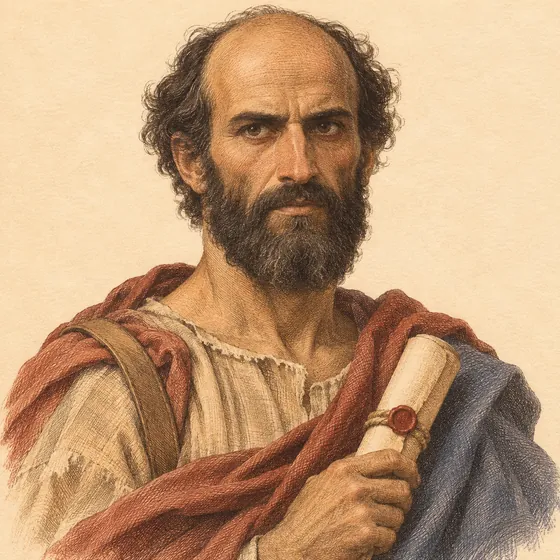
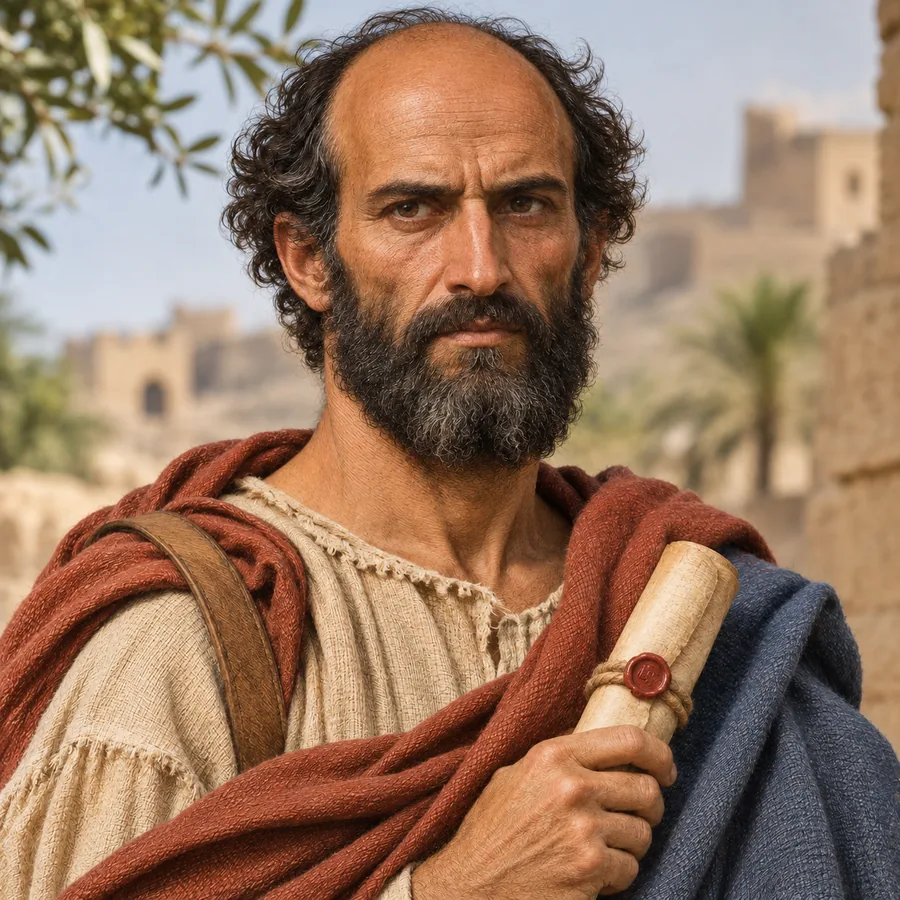
A Pharisee who persecutes the early church until a vision of Jesus on the road to Damascus; he becomes a missionary across the Roman world, and thirteen New Testament letters bear his name.
See Acts 8:3, Acts 9:3, Philippians 3:5, Romans 1:1.
 A sealed letter marks Paul in the reading view: “The salutation of Paul with mine own hand, which is the token in every epistle” (2 Thessalonians 3:17).
Mentioned in 179 verses across 15 books, first in Acts 7:58. The verses below are the ones linked to this person (the Theographic dataset, with our sourced corrections).
How artists have pictured him
3 works from different centuries and traditions. Each shows how its time and place imagined Paul, not how he looked.


In these stories
Questions about this
In the Bible
All 179 verses, in Bible order. Text from the Berean Standard Bible; verse numbers follow the KJV.
Acts
- Acts 7:58
They dragged him out of the city and began to stone him. Meanwhile the witnesses laid their garments at the feet of a young man named Saul.
- Acts 8:1
And Saul was there, giving approval to Stephen’s death. On that day a great persecution broke out against the church in Jerusalem, and all except the apostles were scattered throughout Judea and Samaria.
- Acts 8:3
But Saul began to destroy the church. Going from house to house, he dragged off men and women and put them in prison.
- Acts 9:1
Meanwhile, Saul was still breathing out murderous threats against the disciples of the Lord. He approached the high priest
- Acts 9:4
He fell to the ground and heard a voice say to him, “Saul, Saul, why do you persecute Me?”
- Acts 9:8
Saul got up from the ground, but when he opened his eyes he could not see a thing. So they led him by the hand into Damascus.
- Acts 9:11
“Get up!” the Lord told him. “Go to the house of Judas on Straight Street and ask for a man from Tarsus named Saul, for he is praying.
- Acts 9:17
So Ananias went to the house, and when he arrived, he placed his hands on Saul. “Brother Saul,” he said, “the Lord Jesus, who appeared to you on the road as you were coming here, has sent me so that you may see again and be filled with the Holy Spirit.”
- Acts 9:19
and after taking some food, he regained his strength. And he spent several days with the disciples in Damascus.
- Acts 9:22
But Saul was empowered all the more, and he confounded the Jews living in Damascus by proving that Jesus is the Christ.
- Acts 9:24
but Saul learned of their plot. Day and night they watched the city gates in order to kill him.
- Acts 9:26
When Saul arrived in Jerusalem, he tried to join the disciples, but they were all afraid of him, not believing that he was a disciple.
- Acts 11:25
Then Barnabas went to Tarsus to look for Saul,
- Acts 11:30
This they did, sending their gifts to the elders with Barnabas and Saul.
- Acts 12:25
When Barnabas and Saul had fulfilled their mission to Jerusalem, they returned, bringing with them John, also called Mark.
- Acts 13:1
Now in the church at Antioch there were prophets and teachers: Barnabas, Simeon called Niger, Lucius of Cyrene, Manaen (who had been brought up with Herod the tetrarch), and Saul.
- Acts 13:2
While they were worshiping the Lord and fasting, the Holy Spirit said, “Set apart for Me Barnabas and Saul for the work to which I have called them.”
- Acts 13:7
an attendant of the proconsul, Sergius Paulus. The proconsul, a man of intelligence, summoned Barnabas and Saul because he wanted to hear the word of God.
- Acts 13:9
Then Saul, who was also called Paul, filled with the Holy Spirit, looked directly at Elymas
- Acts 13:13
After setting sail from Paphos, Paul and his companions came to Perga in Pamphylia, where John left them to return to Jerusalem.
- Acts 13:16
Paul stood up, motioned with his hand, and began to speak: “Men of Israel and you Gentiles who fear God, listen to me!
- Acts 13:43
After the synagogue was dismissed, many of the Jews and devout converts to Judaism followed Paul and Barnabas, who spoke to them and urged them to continue in the grace of God.
- Acts 13:45
But when the Jews saw the crowds, they were filled with jealousy, and they blasphemously contradicted what Paul was saying.
- Acts 13:46
Then Paul and Barnabas answered them boldly: “It was necessary to speak the word of God to you first. But since you reject it and do not consider yourselves worthy of eternal life, we now turn to the Gentiles.
- Acts 13:50
The Jews, however, incited the religious women of prominence and the leading men of the city. They stirred up persecution against Paul and Barnabas and drove them out of their district.
- Acts 14:9
This man was listening to the words of Paul, who looked intently at him and saw that he had faith to be healed.
- Acts 14:11
When the crowds saw what Paul had done, they lifted up their voices in the Lycaonian language: “The gods have come down to us in human form!”
- Acts 14:12
Barnabas they called Zeus, and Paul they called Hermes, because he was the chief speaker.
- Acts 14:14
But when the apostles Barnabas and Paul found out about this, they tore their clothes and rushed into the crowd, shouting,
- Acts 14:19
Then some Jews arrived from Antioch and Iconium and won over the crowds. They stoned Paul and dragged him outside the city, presuming he was dead.
- Acts 15:2
And after engaging these men in sharp debate, Paul and Barnabas were appointed, along with some other believers, to go up to Jerusalem to see the apostles and elders about this question.
- Acts 15:12
The whole assembly fell silent as they listened to Barnabas and Paul describing the signs and wonders God had done among the Gentiles through them.
- Acts 15:22
Then the apostles and elders, with the whole church, decided to select men from among them to send to Antioch with Paul and Barnabas. They chose Judas called Barsabbas and Silas, two leaders among the brothers,
- Acts 15:25
So we all agreed to choose men to send to you along with our beloved Barnabas and Paul,
- Acts 15:35
But Paul and Barnabas remained at Antioch, along with many others, teaching and preaching the word of the Lord.
- Acts 15:36
Some time later Paul said to Barnabas, “Let us go back and visit the brothers in every town where we proclaimed the word of the Lord, to see how they are doing.”
- Acts 15:38
But Paul thought it best not to take him, because he had deserted them in Pamphylia and had not accompanied them in the work.
- Acts 15:40
but Paul chose Silas and left, commended by the brothers to the grace of the Lord.
- Acts 16:3
Paul wanted Timothy to accompany him, so he took him and circumcised him on account of the Jews in that area, for they all knew that his father was a Greek.
- Acts 16:9
During the night, Paul had a vision of a man of Macedonia standing and pleading with him, “Come over to Macedonia and help us.”
- Acts 16:14
Among those listening was a woman named Lydia, a dealer in purple cloth from the city of Thyatira, who was a worshiper of God. The Lord opened her heart to respond to Paul’s message.
- Acts 16:17
This girl followed Paul and the rest of us, shouting, “These men are servants of the Most High God, who are proclaiming to you the way of salvation!”
- Acts 16:18
She continued this for many days. Eventually Paul grew so aggravated that he turned and said to the spirit, “In the name of Jesus Christ I command you to come out of her!” And the spirit left her at that very moment.
- Acts 16:19
When the girl’s owners saw that their hope of making money was gone, they seized Paul and Silas and dragged them before the authorities in the marketplace.
- Acts 16:25
About midnight Paul and Silas were praying and singing hymns to God, and the other prisoners were listening to them.
- Acts 16:28
But Paul called out in a loud voice, “Do not harm yourself! We are all here!”
- Acts 16:29
Calling for lights, the jailer rushed in and fell trembling before Paul and Silas.
- Acts 16:36
The jailer informed Paul: “The magistrates have sent orders to release you. Now you may go on your way in peace.”
- Acts 16:37
But Paul said to the officers, “They beat us publicly without a trial and threw us into prison, even though we are Roman citizens. And now do they want to send us away secretly? Absolutely not! Let them come themselves and escort us out!”
- Acts 17:2
As was his custom, Paul went into the synagogue, and on three Sabbaths he reasoned with them from the Scriptures,
- Acts 17:4
Some of the Jews were persuaded and joined Paul and Silas, along with a large number of God-fearing Greeks and quite a few leading women.
- Acts 17:10
As soon as night had fallen, the brothers sent Paul and Silas away to Berea. On arriving there, they went into the Jewish synagogue.
- Acts 17:13
But when the Jews from Thessalonica learned that Paul was also proclaiming the word of God in Berea, they went there themselves to incite and agitate the crowds.
- Acts 17:14
The brothers immediately sent Paul to the coast, but Silas and Timothy remained in Berea.
- Acts 17:15
Those who escorted Paul brought him to Athens and then returned with instructions for Silas and Timothy to join him as soon as possible.
- Acts 17:16
While Paul was waiting for them in Athens, he was deeply disturbed in his spirit to see that the city was full of idols.
- Acts 17:22
Then Paul stood up in the meeting of the Areopagus and said, “Men of Athens, I see that in every way you are very religious.
- Acts 17:33
At that, Paul left the Areopagus.
- Acts 18:1
After this, Paul left Athens and went to Corinth.
- Acts 18:5
And when Silas and Timothy came down from Macedonia, Paul devoted himself fully to the word, testifying to the Jews that Jesus is the Christ.
- Acts 18:9
One night the Lord spoke to Paul in a vision: “Do not be afraid; keep on speaking; do not be silent.
- Acts 18:12
While Gallio was proconsul of Achaia, the Jews coordinated an attack on Paul and brought him before the judgment seat.
- Acts 18:14
But just as Paul was about to speak, Gallio told the Jews, “If this matter involved a wrongdoing or vicious crime, O Jews, it would be reasonable for me to hear your complaint.
- Acts 18:18
Paul remained in Corinth for quite some time before saying goodbye to the brothers. He had his head shaved in Cenchrea to keep a vow he had made, and then he sailed for Syria, accompanied by Priscilla and Aquila.
- Acts 19:1
While Apollos was at Corinth, Paul passed through the interior and came to Ephesus. There he found some disciples
- Acts 19:4
Paul explained: “John’s baptism was a baptism of repentance. He told the people to believe in the One coming after him, that is, in Jesus.”
- Acts 19:6
And when Paul laid his hands on them, the Holy Spirit came upon them, and they spoke in tongues and prophesied.
- Acts 19:11
God did extraordinary miracles through the hands of Paul,
- Acts 19:13
Now there were some itinerant Jewish exorcists who tried to invoke the name of the Lord Jesus over those with evil spirits. They would say, “I bind you by Jesus, whom Paul proclaims.”
- Acts 19:15
Eventually, one of the evil spirits answered them, “Jesus I know, and I know about Paul, but who are you?”
- Acts 19:21
After these things had happened, Paul resolved in the Spirit to go to Jerusalem after he had passed through Macedonia and Achaia. “After I have been there,” he said, “I must see Rome as well.”
- Acts 19:26
And you can see and hear that not only in Ephesus, but in nearly the whole province of Asia, Paul has persuaded a great number of people to turn away. He says that man-made gods are no gods at all.
- Acts 19:29
Soon the whole city was in disarray. They rushed together into the theatre, dragging with them Gaius and Aristarchus, Paul’s traveling companions from Macedonia.
- Acts 19:30
Paul wanted to go before the assembly, but the disciples would not allow him.
- Acts 20:1
When the uproar had ended, Paul sent for the disciples. And after encouraging them, he said goodbye to them and left for Macedonia.
- Acts 20:7
On the first day of the week we came together to break bread. Since Paul was ready to leave the next day, he talked to them and kept on speaking until midnight.
- Acts 20:9
And a certain young man named Eutychus, seated in the window, was sinking into a deep sleep as Paul talked on and on. When he was sound asleep, he fell from the third story and was picked up dead.
- Acts 20:10
But Paul went down, threw himself on the young man, and embraced him. “Do not be alarmed!” he said. “He is still alive!”
- Acts 20:13
We went on ahead to the ship and sailed to Assos, where we were to take Paul aboard. He had arranged this because he was going there on foot.
- Acts 20:16
Paul had decided to sail past Ephesus to avoid spending time in the province of Asia, because he was in a hurry to reach Jerusalem, if possible, by the day of Pentecost.
- Acts 20:37
They all wept openly as they embraced Paul and kissed him.
- Acts 21:4
We sought out the disciples in Tyre and stayed with them seven days. Through the Spirit they kept telling Paul not to go up to Jerusalem.
- Acts 21:8
Leaving the next day, we went on to Caesarea and stayed at the home of Philip the evangelist, who was one of the Seven.
- Acts 21:11
Coming over to us, he took Paul’s belt, bound his own feet and hands, and said, “The Holy Spirit says: ‘In this way the Jews of Jerusalem will bind the owner of this belt and hand him over to the Gentiles.’”
- Acts 21:13
Then Paul answered, “Why are you weeping and breaking my heart? I am ready not only to be bound, but also to die in Jerusalem for the name of the Lord Jesus.”
- Acts 21:18
The next day Paul went in with us to see James, and all the elders were present.
- Acts 21:26
So the next day Paul took the men and purified himself along with them. Then he entered the temple to give notice of the date when their purification would be complete and the offering would be made for each of them.
- Acts 21:29
For they had previously seen Trophimus the Ephesian with him in the city, and they assumed that Paul had brought him into the temple.
- Acts 21:30
The whole city was stirred up, and the people rushed together. They seized Paul and dragged him out of the temple, and at once the gates were shut.
- Acts 21:32
Immediately he took some soldiers and centurions and ran down to the crowd. When the people saw the commander and the soldiers, they stopped beating Paul.
- Acts 21:37
As they were about to take Paul into the barracks, he asked the commander, “May I say something to you?” “Do you speak Greek?” he replied.
- Acts 21:39
But Paul answered, “I am a Jew from Tarsus in Cilicia, a citizen of no ordinary city. Now I beg you to allow me to speak to the people.”
- Acts 21:40
Having received permission, Paul stood on the steps and motioned to the crowd. A great hush came over the crowd, and he addressed them in Hebrew:
- Acts 22:7
I fell to the ground and heard a voice say to me, ‘Saul, Saul, why do you persecute Me?’
- Acts 22:13
came and stood beside me. ‘Brother Saul,’ he said, ‘receive your sight.’ And at that moment I could see him.
- Acts 22:25
But as they stretched him out to strap him down, Paul said to the centurion standing there, “Is it lawful for you to flog a Roman citizen without a trial?”
- Acts 22:28
“I paid a high price for my citizenship,” said the commander. “But I was born a citizen,” Paul replied.
- Acts 22:30
The next day the commander, wanting to learn the real reason Paul was accused by the Jews, released him and ordered the chief priests and the whole Sanhedrin to assemble. Then he brought Paul down and had him stand before them.
- Acts 23:1
Paul looked directly at the Sanhedrin and said, “Brothers, I have conducted myself before God in all good conscience to this day.”
- Acts 23:3
Then Paul said to him, “God will strike you, you whitewashed wall! You sit here to judge me according to the law, yet you yourself violate the law by commanding that I be struck.”
- Acts 23:5
“Brothers,” Paul replied, “I was not aware that he was the high priest, for it is written: ‘Do not speak evil about the ruler of your people.’”
- Acts 23:6
Then Paul, knowing that some of them were Sadducees and others Pharisees, called out in the Sanhedrin, “Brothers, I am a Pharisee, the son of a Pharisee. It is because of my hope in the resurrection of the dead that I am on trial.”
- Acts 23:10
The dispute grew so violent that the commander was afraid they would tear Paul to pieces. He ordered the soldiers to go down and remove him by force and bring him into the barracks.
- Acts 23:11
The following night the Lord stood near Paul and said, “Take courage! As you have testified about Me in Jerusalem, so also you must testify in Rome.”
- Acts 23:12
When daylight came, the Jews formed a conspiracy and bound themselves with an oath not to eat or drink until they had killed Paul.
- Acts 23:14
They went to the chief priests and elders and said, “We have bound ourselves with a solemn oath not to eat anything until we have killed Paul.
- Acts 23:16
But when the son of Paul’s sister heard about the plot, he went into the barracks and told Paul.
- Acts 23:17
Then Paul called one of the centurions and said, “Take this young man to the commander; he has something to tell him.”
- Acts 23:18
So the centurion took him to the commander and said, “Paul the prisoner sent and asked me to bring this young man to you. He has something to tell you.”
- Acts 23:20
He answered, “The Jews have agreed to ask you to bring Paul to the Sanhedrin tomorrow on the pretext of acquiring more information about him.
- Acts 23:24
Provide mounts for Paul to take him safely to Governor Felix.”
- Acts 23:31
So the soldiers followed their orders and brought Paul by night to Antipatris.
- Acts 23:33
When the horsemen arrived in Caesarea, they delivered the letter to the governor and presented Paul to him.
- Acts 24:1
Five days later the high priest Ananias came down with some elders and a lawyer named Tertullus, who presented to the governor their case against Paul.
- Acts 24:10
When the governor motioned for Paul to speak, he began his response: “Knowing that you have been a judge over this nation for many years, I gladly make my defense.
- Acts 24:23
He ordered the centurion to keep Paul under guard, but to allow him some freedom and permit his friends to minister to his needs.
- Acts 24:24
After several days, Felix returned with his wife Drusilla, who was a Jewess. He sent for Paul and listened to him speak about faith in Christ Jesus.
- Acts 24:26
At the same time, he was hoping that Paul would offer him a bribe. So he sent for Paul frequently and talked with him.
- Acts 24:27
After two years had passed, Felix was succeeded by Porcius Festus. And wishing to do the Jews a favor, Felix left Paul in prison.
- Acts 25:2
where the chief priests and Jewish leaders presented their case against Paul. They urged Festus
- Acts 25:4
But Festus replied, “Paul is being held in Caesarea, and I myself am going there soon.
- Acts 25:6
After spending no more than eight or ten days with them, Festus went down to Caesarea. The next day he sat on the judgment seat and ordered that Paul be brought in.
- Acts 25:7
When Paul arrived, the Jews who had come down from Jerusalem stood around him, bringing many serious charges that they could not prove.
- Acts 25:9
But Festus, wishing to do the Jews a favor, said to Paul, “Are you willing to go up to Jerusalem to stand trial before me on these charges?”
- Acts 25:10
Paul replied, “I am standing before the judgment seat of Caesar, where I ought to be tried. I have done nothing wrong to the Jews, as you yourself know very well.
- Acts 25:14
Since they were staying several days, Festus laid out Paul’s case before the king: “There is a certain man whom Felix left in prison.
- Acts 25:19
They only had some contentions with him regarding their own religion and a certain Jesus who had died, but whom Paul affirmed to be alive.
- Acts 25:21
But when Paul appealed to be held over for the decision of the Emperor, I ordered that he be held until I could send him to Caesar.”
- Acts 25:23
The next day Agrippa and Bernice came with great pomp and entered the auditorium, along with the commanders and leading men of the city. And Festus ordered that Paul be brought in.
- Acts 26:1
Agrippa said to Paul, “You have permission to speak for yourself.” Then Paul stretched out his hand and began his defense:
- Acts 26:14
We all fell to the ground, and I heard a voice say to me in Hebrew, ‘Saul, Saul, why do you persecute Me? It is hard for you to kick against the goads.’
- Acts 26:24
At this stage of Paul’s defense, Festus exclaimed in a loud voice, “You are insane, Paul! Your great learning is driving you to madness!”
- Acts 26:28
Then Agrippa said to Paul, “Can you persuade me in such a short time to become a Christian?”
- Acts 26:29
“Short time or long,” Paul replied, “I wish to God that not only you but all who hear me this day may become what I am, except for these chains.”
- Acts 27:1
When it was decided that we would sail for Italy, Paul and some other prisoners were handed over to a centurion named Julius, who belonged to the Imperial Regiment.
- Acts 27:3
The next day we landed at Sidon, and Julius treated Paul with consideration, allowing him to visit his friends and receive their care.
- Acts 27:9
By now much time had passed, and the voyage had already become dangerous because it was after the Fast. So Paul advised them,
- Acts 27:11
But contrary to Paul’s advice, the centurion was persuaded by the pilot and by the owner of the ship.
- Acts 27:21
After the men had gone a long time without food, Paul stood up among them and said, “Men, you should have followed my advice not to sail from Crete. Then you would have averted this disaster and loss.
- Acts 27:24
and said, ‘Do not be afraid, Paul; you must stand before Caesar. And look, God has granted you the lives of all who sail with you.’
- Acts 27:31
But Paul said to the centurion and the soldiers, “Unless these men remain with the ship, you cannot be saved.”
- Acts 27:33
Right up to daybreak, Paul kept urging them all to eat: “Today is your fourteenth day in constant suspense, without taking any food.
- Acts 27:43
But the centurion, wanting to spare Paul’s life, thwarted their plan. He commanded those who could swim to jump overboard first and get to land.
- Acts 28:3
Paul gathered a bundle of sticks, and as he laid them on the fire, a viper, driven out by the heat, fastened itself to his hand.
- Acts 28:8
The father of Publius was sick in bed, suffering from fever and dysentery. Paul went in to see him, and after praying and placing his hands on him, he healed the man.
- Acts 28:15
The brothers there had heard about us and traveled as far as the Forum of Appius and the Three Taverns to meet us. When Paul saw them, he was encouraged and gave thanks to God.
- Acts 28:16
When we arrived in Rome, Paul was permitted to stay by himself, with a soldier to guard him.
- Acts 28:17
After three days, he called together the leaders of the Jews. When they had gathered, he said to them, “Brothers, although I have done nothing against our people or the customs of our fathers, I was taken prisoner in Jerusalem and handed over to the Romans.
- Acts 28:25
They disagreed among themselves and began to leave after Paul had made this final statement: “The Holy Spirit was right when He spoke to your fathers through Isaiah the prophet:
- Acts 28:30
Paul stayed there two full years in his own rented house, welcoming all who came to visit him.
Romans
- Romans 1:1
Paul, a servant of Christ Jesus, called to be an apostle, and set apart for the gospel of God—
1 Corinthians
- 1 Corinthians 1:1
Paul, called to be an apostle of Christ Jesus by the will of God, and our brother Sosthenes,
- 1 Corinthians 1:12
What I mean is this: Individuals among you are saying, “I follow Paul,” “I follow Apollos,” “I follow Cephas,” or “I follow Christ.”
- 1 Corinthians 1:13
Is Christ divided? Was Paul crucified for you? Were you baptized into the name of Paul?
- 1 Corinthians 3:4
For when one of you says, “I follow Paul,” and another, “I follow Apollos,” are you not mere men?
- 1 Corinthians 3:5
What then is Apollos? And what is Paul? They are servants through whom you believed, as the Lord has assigned to each his role.
- 1 Corinthians 3:22
whether Paul or Apollos or Cephas or the world or life or death or the present or the future. All of them belong to you,
- 1 Corinthians 16:21
This greeting is in my own hand—Paul.
2 Corinthians
- 2 Corinthians 1:1
Paul, an apostle of Christ Jesus by the will of God, and Timothy our brother, To the church of God in Corinth, together with all the saints throughout Achaia:
- 2 Corinthians 10:1
Now by the mildness and gentleness of Christ, I appeal to you—I, Paul, who am humble when face to face with you, but bold when away.
Galatians
- Galatians 1:1
Paul, an apostle—sent not from men nor by man, but by Jesus Christ and God the Father, who raised Him from the dead—
- Galatians 5:2
Take notice: I, Paul, tell you that if you let yourselves be circumcised, Christ will be of no value to you at all.
Ephesians
- Ephesians 1:1
Paul, an apostle of Christ Jesus by the will of God, To the saints in Ephesus, the faithful in Christ Jesus:
- Ephesians 3:1
For this reason I, Paul, the prisoner of Christ Jesus for the sake of you Gentiles...
Philippians
- Philippians 1:1
Paul and Timothy, servants of Christ Jesus, To all the saints in Christ Jesus at Philippi, together with the overseers and deacons:
Colossians
- Colossians 1:1
Paul, an apostle of Christ Jesus by the will of God, and Timothy our brother,
- Colossians 1:23
if indeed you continue in your faith, established and firm, not moved from the hope of the gospel you heard, which has been proclaimed to every creature under heaven, and of which I, Paul, have become a servant.
- Colossians 4:18
This greeting is in my own hand—Paul. Remember my chains. Grace be with you.
1 Thessalonians
- 1 Thessalonians 1:1
Paul, Silvanus, and Timothy, To the church of the Thessalonians in God the Father and the Lord Jesus Christ: Grace and peace to you.
- 1 Thessalonians 2:18
For we wanted to come to you—indeed I, Paul, tried again and again—but Satan obstructed us.
2 Thessalonians
- 2 Thessalonians 1:1
Paul, Silvanus, and Timothy, To the church of the Thessalonians in God our Father and the Lord Jesus Christ:
- 2 Thessalonians 3:17
This greeting is in my own hand—Paul. This is my mark in every letter; it is the way I write.
1 Timothy
- 1 Timothy 1:1
Paul, an apostle of Christ Jesus by the command of God our Savior and of Christ Jesus our hope,
2 Timothy
- 2 Timothy 1:1
Paul, an apostle of Christ Jesus by the will of God, according to the promise of life in Christ Jesus,
Titus
- Titus 1:1
Paul, a servant of God and an apostle of Jesus Christ for the faith of God’s elect and their knowledge of the truth that leads to godliness,
Philemon
- Philemon 1:1
Paul, a prisoner of Christ Jesus, and Timothy our brother, To Philemon our beloved fellow worker,
- Philemon 1:9
I prefer to appeal on the basis of love. For I, Paul, am now aged, and a prisoner of Christ Jesus as well.
- Philemon 1:19
I, Paul, write this with my own hand. I will repay it—not to mention that you owe me your very self.
2 Peter
- 2 Peter 3:15
Consider also that our Lord’s patience brings salvation, just as our beloved brother Paul also wrote you with the wisdom God gave him.
Events
Events the dataset lists Paul as taking part in. Dates follow its Ussher–Jones reckoning (one of several traditional counts), not established history.
- c. AD 31Stephen is stoned
- c. AD 31Saul persecutes the church
- c. AD 32Saul is converted
- c. AD 38Saul proclaims Jesus
- c. AD 40Disciples first called Christians
- no dateFirst missionary journey begins
- c. AD 45First Missionary Journey
- no dateBarnabas and Saul go to Cyprus
- no dateMission to Antioch in Pisidia
- no dateMission to Iconium
- no dateMission to Lystra and Derbe
- no dateReturn to Antioch in Syria
Dictionary
From Easton’s Bible Dictionary (1897), as attached to this record by Theographic. The entry is for the name and can describe more than one person who bore it. Easton wrote in 1897, and some of his views are now debated.
Read Easton’s entry
'=Saul (q.v.) was born about the same time as our Lord. His circumcision-name was Saul, and probably the name Paul was also given to him in infancy “for use in the Gentile world,” as “Saul” would be his Hebrew home-name. He was a native of Tarsus, the capital of Cilicia, a Roman province in the south-east of Asia Minor. That city stood on the banks of the river Cydnus, which was navigable thus far; hence it became a centre of extensive commercial traffic with many countries along the shores of the Mediterranean, as well as with the countries of central Asia Minor. It thus became a city distinguished for the wealth of its inhabitants.
Tarsus was also the seat of a famous university, higher in reputation even than the universities of Athens and Alexandria, the only others that then existed. Here Saul was born, and here he spent his youth, doubtless enjoying the best education his native city could afford. His father was of the straitest sect of the Jews, a Pharisee, of the tribe of Benjamin, of pure and unmixed Jewish blood (Acts 23:6; Phil. 3:5). We learn nothing regarding his mother; but there is reason to conclude that she was a pious woman, and that, like-minded with her husband, she exercised all a mother influence in moulding the character of her son, so that he could afterwards speak of himself as being, from his youth up, “touching the righteousness which is in the law, blameless” (Phil. 3:6).
We read of his sister and his sister’s son (Acts 23:16), and of other relatives (Rom. 16:7, 11, 12). Though a Jew, his father was a Roman citizen. How he obtained this privilege we are not informed. “It might be bought, or won by distinguished service to the state, or acquired in several other ways; at all events, his son was freeborn. It was a valuable privilege, and one that was to prove of great use to Paul, although not in the way in which his father might have been expected to desire him to make use of it.” Perhaps the most natural career for the youth to follow was that of a merchant. “But it was decided that...he should go to college and become a rabbi, that is, a minister, a teacher, and a lawyer all in one.”
According to Jewish custom, however, he learned a trade before entering on the more direct preparation for the sacred profession. The trade he acquired was the making of tents from goats’ hair cloth, a trade which was one of the commonest in Tarsus.
His preliminary education having been completed, Saul was sent, when about thirteen years of age probably, to the great Jewish school of sacred learning at Jerusalem as a student of the law. Here he became a pupil of the celebrated rabbi Gamaliel, and here he spent many years in an elaborate study of the Scriptures and of the many questions concerning them with which the rabbis exercised themselves. During these years of diligent study he lived “in all good conscience,” unstained by the vices of that great city.
After the period of his student-life expired, he probably left Jerusalem for Tarsus, where he may have been engaged in connection with some synagogue for some years. But we find him back again at Jerusalem very soon after the death of our Lord. Here he now learned the particulars regarding the crucifixion, and the rise of the new sect of the “Nazarenes.”
For some two years after Pentecost, Christianity was quietly spreading its influence in Jerusalem. At length Stephen, one of the seven deacons, gave forth more public and aggressive testimony that Jesus was the Messiah, and this led to much excitement among the Jews and much disputation in their synagogues. Persecution arose against Stephen and the followers of Christ generally, in which Saul of Tarsus took a prominent part. He was at this time probably a member of the great Sanhedrin, and became the active leader in the furious persecution by which the rulers then sought to exterminate Christianity.
But the object of this persecution also failed. “They that were scattered abroad went everywhere preaching the word.” The anger of the persecutor was thereby kindled into a fiercer flame. Hearing that fugitives had taken refuge in Damascus, he obtained from the chief priest letters authorizing him to proceed thither on his persecuting career. This was a long journey of about 130 miles, which would occupy perhaps six days, during which, with his few attendants, he steadily went onward, “breathing out threatenings and slaughter.” But the crisis of his life was at hand. He had reached the last stage of his journey, and was within sight of Damascus. As he and his companions rode on, suddenly at mid-day a brilliant light shone round them, and Saul was laid prostrate in terror on the ground, a voice sounding in his ears, “Saul, Saul, why persecutest thou me?” The risen Saviour was there, clothed in the vesture of his glorified humanity. In answer to the anxious inquiry of the stricken persecutor, “Who art thou, Lord?” he said, “I am Jesus whom thou persecutest” (Acts 9:5; 22:8; 26:15).
This was the moment of his conversion, the most solemn in all his life. Blinded by the dazzling light (Acts 9:8), his companions led him into the city, where, absorbed in deep thought for three days, he neither ate nor drank (9:11). Ananias, a disciple living in Damascus, was informed by a vision of the change that had happened to Saul, and was sent to him to open his eyes and admit him by baptism into the Christian church (9:11-16). The whole purpose of his life was now permanently changed.
Immediately after his conversion he retired into the solitudes of Arabia (Gal. 1:17), perhaps of “Sinai in Arabia,” for the purpose, probably, of devout study and meditation on the marvellous revelation that had been made to him. “A veil of thick darkness hangs over this visit to Arabia. Of the scenes among which he moved, of the thoughts and occupations which engaged him while there, of all the circumstances of a crisis which must have shaped the whole tenor of his after-life, absolutely nothing is known. ‘Immediately,’ says St. Paul, ‘I went away into Arabia.’ The historian passes over the incident comp. [Acts 9:23 and 1 Kings 11:38, 39]. It is a mysterious pause, a moment of suspense, in the apostle’s history, a breathless calm, which ushers in the tumultuous storm of his active missionary life.” Coming back, after three years, to Damascus, he began to preach the gospel “boldly in the name of Jesus” (Acts 9:27), but was soon obliged to flee (9:25; 2 Cor. 11:33) from the Jews and betake himself to Jerusalem. Here he tarried for three weeks, but was again forced to flee (Acts 9:28, 29) from persecution. He now returned to his native Tarsus (Gal. 1:21), where, for probably about three years, we lose sight of him. The time had not yet come for his entering on his great life-work of preaching the gospel to the Gentiles.
At length the city of Antioch, the capital of Syria, became the scene of great Christian activity. There the gospel gained a firm footing, and the cause of Christ prospered. Barnabas (q.v.), who had been sent from Jerusalem to superintend the work at Antioch, found it too much for him, and remembering Saul, he set out to Tarsus to seek for him. He readily responded to the call thus addressed to him, and came down to Antioch, which for “a whole year” became the scene of his labours, which were crowned with great success. The disciples now, for the first time, were called “Christians” (Acts 11:26).
The church at Antioch now proposed to send out missionaries to the Gentiles, and Saul and Barnabas, with John Mark as their attendant, were chosen for this work. This was a great epoch in the history of the church. Now the disciples began to give effect to the Master’s command: “Go ye into all the world, and preach the gospel to every creature.”
The three missionaries went forth on the first missionary tour. They sailed from Seleucia, the seaport of Antioch, across to Cyprus, some 80 miles to the south-west. Here at Paphos, Sergius Paulus, the Roman proconsul, was converted, and now Saul took the lead, and was ever afterwards called Paul. The missionaries now crossed to the mainland, and then proceeded 6 or 7 miles up the river Cestrus to Perga (Acts 13:13), where John Mark deserted the work and returned to Jerusalem. The two then proceeded about 100 miles inland, passing through Pamphylia, Pisidia, and Lycaonia. The towns mentioned in this tour are the Pisidian Antioch, where Paul delivered his first address of which we have any record (13:16-51; comp. 10:30-43), Iconium, Lystra, and Derbe. They returned by the same route to see and encourage the converts they had made, and ordain elders in every city to watch over the churches which had been gathered. From Perga they sailed direct for Antioch, from which they had set out.
After remaining “a long time”, probably till A.D. 50 or 51, in Antioch, a great controversy broke out in the church there regarding the relation of the Gentiles to the Mosaic law. For the purpose of obtaining a settlement of this question, Paul and Barnabas were sent as deputies to consult the church at Jerusalem. The council or synod which was there held ([Acts 15](/acts#Acts.15)) decided against the Judaizing party; and the deputies, accompanied by Judas and Silas, returned to Antioch, bringing with them the decree of the council.
After a short rest at Antioch, Paul said to Barnabas: “Let us go again and visit our brethren in every city where we have preached the word of the Lord, and see how they do.” Mark proposed again to accompany them; but Paul refused to allow him to go. Barnabas was resolved to take Mark, and thus he and Paul had a sharp contention. They separated, and never again met. Paul, however, afterwards speaks with honour of Barnabas, and sends for Mark to come to him at Rome (Col. 4:10; 2 Tim. 4:11).
Paul took with him Silas, instead of Barnabas, and began his second missionary journey about A.D. 51. This time he went by land, revisiting the churches he had already founded in Asia. But he longed to enter into “regions beyond,” and still went forward through Phrygia and Galatia (16:6). Contrary to his intention, he was constrained to linger in Galatia (q.v.), on account of some bodily affliction (Gal. 4:13, 14). Bithynia, a populous province on the shore of the Black Sea, lay now before him, and he wished to enter it; but the way was shut, the Spirit in some manner guiding him in another direction, till he came down to the shores of the AEgean and arrived at Troas, on the north-western coast of Asia Minor (Acts 16:8). Of this long journey from Antioch to Troas we have no account except some references to it in his Epistle to the Galatians (4:13).
As he waited at Troas for indications of the will of God as to his future movements, he saw, in the vision of the night, a man from the opposite shores of Macedonia standing before him, and heard him cry, “Come over, and help us” (Acts 16:9). Paul recognized in this vision a message from the Lord, and the very next day set sail across the Hellespont, which separated him from Europe, and carried the tidings of the gospel into the Western world. In Macedonia, churches were planted in Philippi, Thessalonica, and Berea. Leaving this province, Paul passed into Achaia, “the paradise of genius and renown.” He reached Athens, but quitted it after, probably, a brief sojourn (17:17-31). The Athenians had received him with cold disdain, and he never visited that city again. He passed over to Corinth, the seat of the Roman government of Achaia, and remained there a year and a half, labouring with much success. While at Corinth, he wrote his two epistles to the church of Thessalonica, his earliest apostolic letters, and then sailed for Syria, that he might be in time to keep the feast of Pentecost at Jerusalem. He was accompanied by Aquila and Priscilla, whom he left at Ephesus, at which he touched, after a voyage of thirteen or fifteen days. He landed at Caesarea, and went up to Jerusalem, and having “saluted the church” there, and kept the feast, he left for Antioch, where he abode “some time” (Acts 18:20-23).
He then began his third missionary tour. He journeyed by land in the “upper coasts” (the more eastern parts) of Asia Minor, and at length made his way to Ephesus, where he tarried for no less than three years, engaged in ceaseless Christian labour. “This city was at the time the Liverpool of the Mediterranean. It possessed a splendid harbour, in which was concentrated the traffic of the sea which was then the highway of the nations; and as Liverpool has behind her the great towns of Lancashire, so had Ephesus behind and around her such cities as those mentioned along with her in the epistles to the churches in the book of Revelation, Smyrna, Pergamos, Thyatira, Sardis, Philadelphia, and Laodicea. It was a city of vast wealth, and it was given over to every kind of pleasure, the fame of its theatres and race-course being world-wide” (Stalker’s Life of St. Paul). Here a “great door and effectual” was opened to the apostle. His fellow-labourers aided him in his work, carrying the gospel to Colosse and Laodicea and other places which they could reach.
Very shortly before his departure from Ephesus, the apostle wrote his First Epistle to the Corinthians (q.v.). The silversmiths, whose traffic in the little images which they made was in danger (see DEMETRIUS), organized a riot against Paul, and he left the city, and proceeded to Troas (2 Cor. 2:12), whence after some time he went to meet Titus in Macedonia. Here, in consequence of the report Titus brought from Corinth, he wrote his second epistle to that church. Having spent probably most of the summer and autumn in Macedonia, visiting the churches there, specially the churches of Philippi, Thessalonica, and Berea, probably penetrating into the interior, to the shores of the Adriatic (Rom. 15:19), he then came into Greece, where he abode three month, spending probably the greater part of this time in Corinth (Acts 20:2). During his stay in this city he wrote his Epistle to the Galatians, and also the great Epistle to the Romans. At the end of the three months he left Achaia for Macedonia, thence crossed into Asia Minor, and touching at Miletus, there addressed the Ephesian presbyters, whom he had sent for to meet him (Acts 20:17), and then sailed for Tyre, finally reaching Jerusalem, probably in the spring of A.D. 58.
While at Jerusalem, at the feast of Pentecost, he was almost murdered by a Jewish mob in the temple. (See TEMPLE, HEROD’S.) Rescued from their violence by the Roman commandant, he was conveyed as a prisoner to Caesarea, where, from various causes, he was detained a prisoner for two years in Herod’s praetorium (Acts 23:35). “Paul was not kept in close confinement; he had at least the range of the barracks in which he was detained. There we can imagine him pacing the ramparts on the edge of the Mediterranean, and gazing wistfully across the blue waters in the direction of Macedonia, Achaia, and Ephesus, where his spiritual children were pining for him, or perhaps encountering dangers in which they sorely needed his presence. It was a mysterious providence which thus arrested his energies and condemned the ardent worker to inactivity; yet we can now see the reason for it. Paul was needing rest. After twenty years of incessant evangelization, he required leisure to garner the harvest of experience...During these two years he wrote nothing; it was a time of internal mental activity and silent progress” (Stalker’s Life of St. Paul).
At the end of these two years Felix (q.v.) was succeeded in the governorship of Palestine by Porcius Festus, before whom the apostle was again heard. But judging it right at this crisis to claim the privilege of a Roman citizen, he appealed to the emperor (Acts 25:11). Such an appeal could not be disregarded, and Paul was at once sent on to Rome under the charge of one Julius, a centurion of the “Augustan cohort.” After a long and perilous voyage, he at length reached the imperial city in the early spring, probably, of A.D. 61. Here he was permitted to occupy his own hired house, under constant military custody. This privilege was accorded to him, no doubt, because he was a Roman citizen, and as such could not be put into prison without a trial. The soldiers who kept guard over Paul were of course changed at frequent intervals, and thus he had the opportunity of preaching the gospel to many of them during these “two whole years,” and with the blessed result of spreading among the imperial guards, and even in Caesar’s household, an interest in the truth (Phil. 1:13). His rooms were resorted to by many anxious inquirers, both Jews and Gentiles (Acts 28:23, 30, 31), and thus his imprisonment “turned rather to the furtherance of the gospel,” and his “hired house” became the centre of a gracious influence which spread over the whole city. According to a Jewish tradition, it was situated on the borders of the modern Ghetto, which has been the Jewish quarters in Rome from the time of Pompey to the present day. During this period the apostle wrote his epistles to the Colossians, Ephesians, Philippians, and to Philemon, and probably also to the Hebrews.
This first imprisonment came at length to a close, Paul having been acquitted, probably because no witnesses appeared against him. Once more he set out on his missionary labours, probably visiting western and eastern Europe and Asia Minor. During this period of freedom he wrote his First Epistle to Timothy and his Epistle to Titus. The year of his release was signalized by the burning of Rome, which Nero saw fit to attribute to the Christians. A fierce persecution now broke out against the Christians. Paul was siezed, and once more conveyed to Rome a prisoner. During this imprisonment he probably wrote the Second Epistle to Timothy, the last he ever wrote. “There can be little doubt that he appered again at Nero’s bar, and this time the charge did not break down. In all history there is not a more startling illustration of the irony of human life than this scene of Paul at the bar of Nero. On the judgment-seat, clad in the imperial purple, sat a man who, in a bad world, had attained the eminence of being the very worst and meanest being in it, a man stained with every crime, a man whose whole being was so steeped in every nameable and unnameable vice, that body and soul of him were, as some one said at the time, nothing but a compound of mud and blood; and in the prisoner’s dock stood the best man the world possessed, his hair whitened with labours for the good of men and the glory of God. The trial ended: Paul was condemned, and delivered over to the executioner. He was led out of the city, with a crowd of the lowest rabble at his heels. The fatal spot was reached; he knelt beside the block; the headsman’s axe gleamed in the sun and fell; and the head of the apostle of the world rolled down in the dust” (probably A.D. 66), four years before the fall of Jerusalem.