Person
Jacob (Israel)
Also called Israel
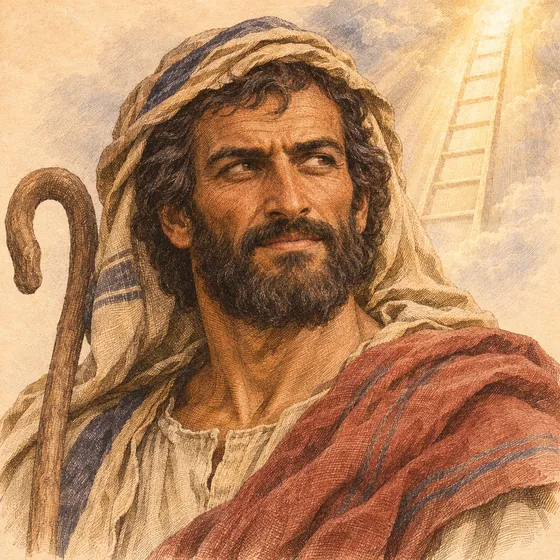
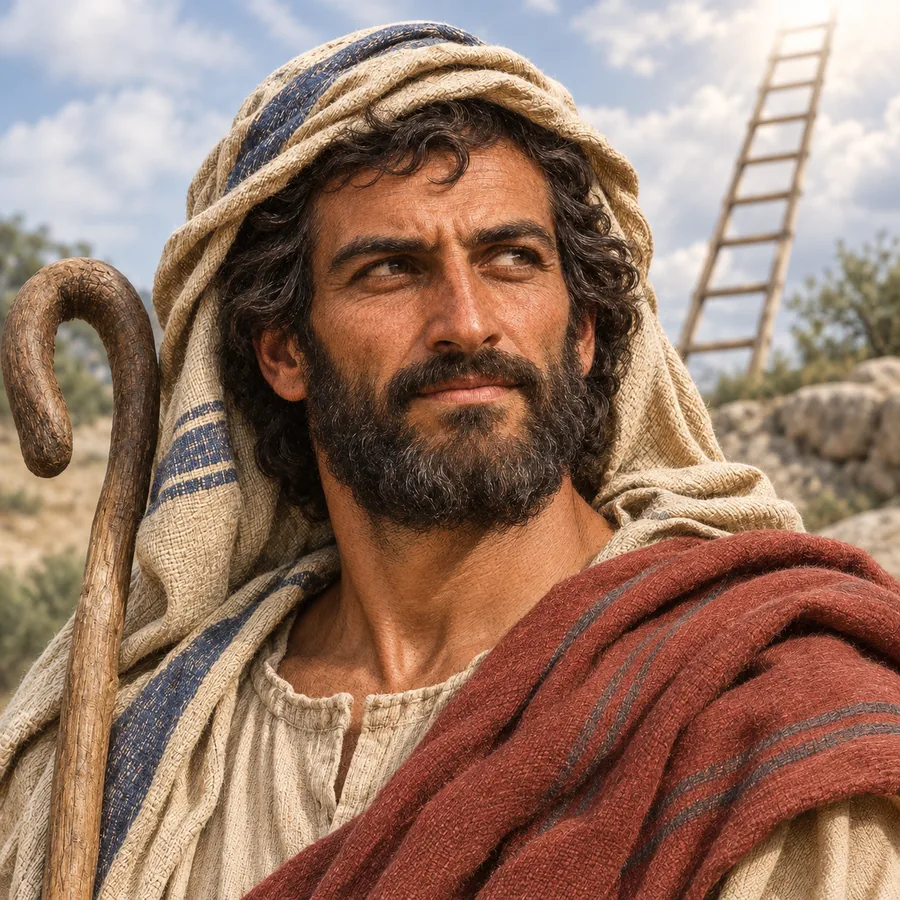
In Genesis 25–50, Isaac's son, who takes his brother's blessing, wrestles through the night with a mysterious man and is renamed Israel; his twelve sons are the ancestors of Israel's tribes.
See Genesis 27:36, Genesis 32:24, Genesis 32:28, Genesis 49:28.
 A ladder to a star marks Jacob in the reading view: his dream of a stairway reaching to heaven (Genesis 28:12).
Mentioned in 1,009 verses across 37 books, first in Exodus 1:1. The verses below are the ones linked to this person (the Theographic dataset, with our sourced corrections).
How artists have pictured him
3 works from different centuries and traditions. Each shows how its time and place imagined Jacob, not how he looked.


In these stories
In the Bible
All 165 verses in Exodus, in Bible order. Text from the Berean Standard Bible; verse numbers follow the KJV.
Exodus
- Exodus 1:1
These are the names of the sons of Israel who went to Egypt with Jacob, each with his family:
- Exodus 1:5
The descendants of Jacob numbered seventy in all, including Joseph, who was already in Egypt.
- Exodus 1:7
but the Israelites were fruitful and increased rapidly; they multiplied and became exceedingly numerous, so that the land was filled with them.
- Exodus 1:9
“Look,” he said to his people, “the Israelites have become too numerous and too powerful for us.
- Exodus 1:12
But the more they were oppressed, the more they multiplied and flourished; so the Egyptians came to dread the Israelites.
- Exodus 1:13
They worked the Israelites ruthlessly
- Exodus 2:23
After a long time, the king of Egypt died. The Israelites groaned and cried out under their burden of slavery, and their cry for deliverance from bondage ascended to God.
- Exodus 2:24
So God heard their groaning, and He remembered His covenant with Abraham, Isaac, and Jacob.
- Exodus 2:25
God saw the Israelites and took notice.
- Exodus 3:6
Then He said, “I am the God of your father, the God of Abraham, the God of Isaac, and the God of Jacob.” At this, Moses hid his face, for he was afraid to look at God.
- Exodus 3:9
And now the cry of the Israelites has reached Me, and I have seen how severely the Egyptians are oppressing them.
- Exodus 3:10
Therefore, go! I am sending you to Pharaoh to bring My people the Israelites out of Egypt.”
- Exodus 3:11
But Moses asked God, “Who am I, that I should go to Pharaoh and bring the Israelites out of Egypt?”
- Exodus 3:13
Then Moses asked God, “Suppose I go to the Israelites and say to them, ‘The God of your fathers has sent me to you,’ and they ask me, ‘What is His name?’ What should I tell them?”
- Exodus 3:14
God said to Moses, “I AM WHO I AM. This is what you are to say to the Israelites: ‘I AM has sent me to you.’”
- Exodus 3:15
God also told Moses, “Say to the Israelites, ‘The LORD, the God of your fathers—the God of Abraham, the God of Isaac, and the God of Jacob—has sent me to you.’ This is My name forever, and this is how I am to be remembered in every generation.
- Exodus 3:16
Go, assemble the elders of Israel and say to them, ‘The LORD, the God of your fathers—the God of Abraham, Isaac, and Jacob—has appeared to me and said: I have surely attended to you and have seen what has been done to you in Egypt.
- Exodus 3:18
The elders of Israel will listen to what you say, and you must go with them to the king of Egypt and tell him, ‘The LORD, the God of the Hebrews, has met with us. Now please let us take a three-day journey into the wilderness, so that we may sacrifice to the LORD our God.’
- Exodus 4:5
“This is so that they may believe that the LORD, the God of their fathers—the God of Abraham, the God of Isaac, and the God of Jacob—has appeared to you.”
- Exodus 4:22
Then tell Pharaoh that this is what the LORD says: ‘Israel is My firstborn son,
- Exodus 4:29
Then Moses and Aaron went and assembled all the elders of the Israelites,
- Exodus 4:31
and they believed. And when they heard that the LORD had attended to the Israelites and had seen their affliction, they bowed down and worshiped.
- Exodus 5:1
After that, Moses and Aaron went to Pharaoh and said, “This is what the LORD, the God of Israel, says: ‘Let My people go, so that they may hold a feast to Me in the wilderness.’”
- Exodus 5:2
But Pharaoh replied, “Who is the LORD that I should obey His voice and let Israel go? I do not know the LORD, and I will not let Israel go.”
- Exodus 5:14
Then the Israelite foremen, whom Pharaoh’s taskmasters had set over the people, were beaten and asked, “Why have you not fulfilled your quota of bricks yesterday or today, as you did before?”
- Exodus 5:15
So the Israelite foremen went and appealed to Pharaoh: “Why are you treating your servants this way?
- Exodus 5:19
The Israelite foremen realized they were in trouble when they were told, “You must not reduce your daily quota of bricks.”
- Exodus 6:3
I appeared to Abraham, to Isaac, and to Jacob as God Almighty, but by My name the LORD I did not make Myself known to them.
- Exodus 6:5
Furthermore, I have heard the groaning of the Israelites, whom the Egyptians are enslaving, and I have remembered My covenant.
- Exodus 6:6
Therefore tell the Israelites: ‘I am the LORD, and I will bring you out from under the yoke of the Egyptians and deliver you from their bondage. I will redeem you with an outstretched arm and with mighty acts of judgment.
- Exodus 6:8
And I will bring you into the land that I swore to give to Abraham, Isaac, and Jacob. I will give it to you as a possession. I am the LORD!’”
- Exodus 6:9
Moses relayed this message to the Israelites, but on account of their broken spirit and cruel bondage, they did not listen to him.
- Exodus 6:11
“Go and tell Pharaoh king of Egypt to let the Israelites go out of his land.”
- Exodus 6:12
But in the LORD’s presence Moses replied, “If the Israelites will not listen to me, then why would Pharaoh listen to me, since I am unskilled in speech?”
- Exodus 6:13
Then the LORD spoke to Moses and Aaron and gave them a charge concerning both the Israelites and Pharaoh king of Egypt, to bring the Israelites out of the land of Egypt.
- Exodus 6:14
These were the heads of their fathers’ houses: The sons of Reuben, the firstborn of Israel, were Hanoch and Pallu, Hezron and Carmi. These were the clans of Reuben.
- Exodus 6:26
It was this Aaron and Moses to whom the LORD said, “Bring the Israelites out of the land of Egypt by their divisions.”
- Exodus 6:27
Moses and Aaron were the ones who spoke to Pharaoh king of Egypt in order to bring the Israelites out of Egypt.
- Exodus 7:2
You are to speak all that I command you, and your brother Aaron is to tell Pharaoh to let the Israelites go out of his land.
- Exodus 7:4
Pharaoh will not listen to you. Then I will lay My hand on Egypt, and by mighty acts of judgment I will bring the divisions of My people the Israelites out of the land of Egypt.
- Exodus 7:5
And the Egyptians will know that I am the LORD, when I stretch out My hand against Egypt and bring the Israelites out from among them.”
- Exodus 9:4
But the LORD will make a distinction between the livestock of Israel and the livestock of Egypt, so that no animal belonging to the Israelites will die.’”
- Exodus 9:6
And the next day the LORD did just that. All the livestock of the Egyptians died, but not one animal belonging to the Israelites died.
- Exodus 9:26
The only place where it did not hail was in the land of Goshen, where the Israelites lived.
- Exodus 9:35
So Pharaoh’s heart was hardened, and he would not let the Israelites go, just as the LORD had said through Moses.
- Exodus 10:20
But the LORD hardened Pharaoh’s heart, and he would not let the Israelites go.
- Exodus 10:23
No one could see anyone else, and for three days no one left his place. Yet all the Israelites had light in their dwellings.
- Exodus 11:7
But among all the Israelites, not even a dog will snarl at man or beast.’ Then you will know that the LORD makes a distinction between Egypt and Israel.
- Exodus 11:10
Moses and Aaron did all these wonders before Pharaoh, but the LORD hardened Pharaoh’s heart so that he would not let the Israelites go out of his land.
- Exodus 12:3
Tell the whole congregation of Israel that on the tenth day of this month each man must select a lamb for his family, one per household.
- Exodus 12:6
You must keep it until the fourteenth day of the month, when the whole assembly of the congregation of Israel will slaughter the animals at twilight.
- Exodus 12:15
For seven days you must eat unleavened bread. On the first day you are to remove the leaven from your houses. Whoever eats anything leavened from the first day through the seventh must be cut off from Israel.
- Exodus 12:19
For seven days there must be no leaven found in your houses. If anyone eats something leavened, that person, whether a foreigner or native of the land, must be cut off from the congregation of Israel.
- Exodus 12:21
Then Moses summoned all the elders of Israel and told them, “Go at once and select for yourselves a lamb for each family, and slaughter the Passover lamb.
- Exodus 12:27
you are to reply, ‘It is the Passover sacrifice to the LORD, who passed over the houses of the Israelites in Egypt when He struck down the Egyptians and spared our homes.’” Then the people bowed down and worshiped.
- Exodus 12:28
And the Israelites went and did just what the LORD had commanded Moses and Aaron.
- Exodus 12:31
Then Pharaoh summoned Moses and Aaron by night and said, “Get up, leave my people, both you and the Israelites! Go, worship the LORD as you have requested.
- Exodus 12:35
Furthermore, the Israelites acted on Moses’ word and asked the Egyptians for articles of silver and gold, and for clothing.
- Exodus 12:37
The Israelites journeyed from Rameses to Succoth with about 600,000 men on foot, besides women and children.
- Exodus 12:40
Now the duration of the Israelites’ stay in Egypt was 430 years.
- Exodus 12:42
Because the LORD kept a vigil that night to bring them out of the land of Egypt, this same night is to be a vigil to the LORD, to be observed by all the Israelites for the generations to come.
- Exodus 12:47
The whole congregation of Israel must celebrate it.
- Exodus 12:50
Then all the Israelites did this—they did just as the LORD had commanded Moses and Aaron.
- Exodus 12:51
And on that very day the LORD brought the Israelites out of the land of Egypt by their divisions.
- Exodus 13:2
“Consecrate to Me every firstborn male. The firstborn from every womb among the Israelites belongs to Me, both of man and beast.”
- Exodus 13:18
So God led the people around by the way of the wilderness toward the Red Sea. And the Israelites left the land of Egypt arrayed for battle.
- Exodus 13:19
Moses took the bones of Joseph with him because Joseph had made the sons of Israel swear a solemn oath when he said, “God will surely attend to you, and then you must carry my bones with you from this place.”
- Exodus 14:2
“Tell the Israelites to turn back and encamp before Pi-hahiroth, between Migdol and the sea. You are to encamp by the sea, directly opposite Baal-zephon.
- Exodus 14:3
For Pharaoh will say of the Israelites, ‘They are wandering the land in confusion; the wilderness has boxed them in.’
- Exodus 14:5
When the king of Egypt was told that the people had fled, Pharaoh and his officials changed their minds about them and said, “What have we done? We have released Israel from serving us.”
- Exodus 14:8
And the LORD hardened the heart of Pharaoh king of Egypt so that he pursued the Israelites, who were marching out defiantly.
- Exodus 14:10
As Pharaoh approached, the Israelites looked up and saw the Egyptians marching after them, and they were terrified and cried out to the LORD.
- Exodus 14:15
Then the LORD said to Moses, “Why are you crying out to Me? Tell the Israelites to go forward.
- Exodus 14:16
And as for you, lift up your staff and stretch out your hand over the sea and divide it, so that the Israelites can go through the sea on dry ground.
- Exodus 14:19
And the angel of God, who had gone before the camp of Israel, withdrew and went behind them. The pillar of cloud also moved from before them and stood behind them,
- Exodus 14:20
so that it came between the camps of Egypt and Israel. The cloud was there in the darkness, but it lit up the night. So all night long neither camp went near the other.
- Exodus 14:22
and the Israelites went through the sea on dry ground, with walls of water on their right and on their left.
- Exodus 14:25
He caused their chariot wheels to wobble, so that they had difficulty driving. “Let us flee from the Israelites,” said the Egyptians, “for the LORD is fighting for them against Egypt!”
- Exodus 14:29
But the Israelites had walked through the sea on dry ground, with walls of water on their right and on their left.
- Exodus 14:30
That day the LORD saved Israel from the hand of the Egyptians, and Israel saw the Egyptians dead on the shore.
- Exodus 14:31
When Israel saw the great power that the LORD had exercised over the Egyptians, the people feared the LORD and believed in Him and in His servant Moses.
- Exodus 15:1
Then Moses and the Israelites sang this song to the LORD: “I will sing to the LORD, for He is highly exalted. The horse and rider He has thrown into the sea.
- Exodus 15:19
For when Pharaoh’s horses, chariots, and horsemen went into the sea, the LORD brought the waters of the sea back over them. But the Israelites walked through the sea on dry ground.
- Exodus 15:22
Then Moses led Israel from the Red Sea, and they went out into the Desert of Shur. For three days they walked in the desert without finding water.
- Exodus 16:1
On the fifteenth day of the second month after they had left the land of Egypt, the whole congregation of Israel set out from Elim and came to the Desert of Sin, which is between Elim and Sinai.
- Exodus 16:2
And there in the desert they all grumbled against Moses and Aaron.
- Exodus 16:3
“If only we had died by the LORD’s hand in the land of Egypt!” they said. “There we sat by pots of meat and ate our fill of bread, but you have brought us into this desert to starve this whole assembly to death!”
- Exodus 16:6
So Moses and Aaron said to all the Israelites, “This evening you will know that it was the LORD who brought you out of the land of Egypt,
- Exodus 16:9
Then Moses said to Aaron, “Tell the whole congregation of Israel, ‘Come before the LORD, for He has heard your grumbling.’”
- Exodus 16:10
And as Aaron was speaking to the whole congregation of Israel, they looked toward the desert, and there in a cloud the glory of the LORD appeared.
- Exodus 16:12
“I have heard the grumbling of the Israelites. Tell them, ‘At twilight you will eat meat, and in the morning you will be filled with bread. Then you will know that I am the LORD your God.’”
- Exodus 16:15
When the Israelites saw it, they asked one another, “What is it?” For they did not know what it was. So Moses told them, “It is the bread that the LORD has given you to eat.
- Exodus 16:17
So the Israelites did this. Some gathered more, and some less.
- Exodus 16:31
Now the house of Israel called the bread manna. It was white like coriander seed and tasted like wafers made with honey.
- Exodus 16:35
The Israelites ate manna forty years, until they came to a land where they could settle; they ate manna until they reached the border of Canaan.
- Exodus 17:1
Then the whole congregation of Israel left the Desert of Sin, moving from place to place as the LORD commanded. They camped at Rephidim, but there was no water for the people to drink.
- Exodus 17:5
And the LORD said to Moses, “Walk on ahead of the people and take some of the elders of Israel with you. Take along in your hand the staff with which you struck the Nile, and go.
- Exodus 17:6
Behold, I will stand there before you by the rock at Horeb. And when you strike the rock, water will come out of it for the people to drink.” So Moses did this in the sight of the elders of Israel.
- Exodus 17:7
He named the place Massah and Meribah because the Israelites quarreled, and because they tested the LORD, saying, “Is the LORD among us or not?”
- Exodus 17:8
After this, the Amalekites came and attacked the Israelites at Rephidim.
- Exodus 17:11
As long as Moses held up his hands, Israel prevailed; but when he lowered them, Amalek prevailed.
- Exodus 18:1
Now Moses’ father-in-law Jethro, the priest of Midian, heard about all that God had done for Moses and His people Israel, and how the LORD had brought Israel out of Egypt.
- Exodus 18:9
And Jethro rejoiced over all the good things the LORD had done for Israel, whom He had rescued from the hand of the Egyptians.
- Exodus 18:12
Then Moses’ father-in-law Jethro brought a burnt offering and sacrifices to God, and Aaron came with all the elders of Israel to eat bread with Moses’ father-in-law in the presence of God.
- Exodus 18:25
So Moses chose capable men from all Israel and made them heads over the people as leaders of thousands, of hundreds, of fifties, and of tens.
- Exodus 19:1
In the third month, on the same day of the month that the Israelites had left the land of Egypt, they came to the Wilderness of Sinai.
- Exodus 19:2
After they had set out from Rephidim, they entered the Wilderness of Sinai, and Israel camped there in front of the mountain.
- Exodus 19:3
Then Moses went up to God, and the LORD called to him from the mountain, “This is what you are to tell the house of Jacob and explain to the sons of Israel:
- Exodus 19:6
And unto Me you shall be a kingdom of priests and a holy nation.’ These are the words that you are to speak to the Israelites.”
- Exodus 20:22
Then the LORD said to Moses, “This is what you are to tell the Israelites: ‘You have seen for yourselves that I have spoken to you from heaven.
- Exodus 24:1
Then the LORD said to Moses, “Come up to the LORD—you and Aaron, Nadab and Abihu, and seventy of Israel’s elders—and you are to worship at a distance.
- Exodus 24:4
And Moses wrote down all the words of the LORD. Early the next morning he got up and built an altar at the base of the mountain, along with twelve pillars for the twelve tribes of Israel.
- Exodus 24:5
Then he sent out some young men of Israel, and they offered burnt offerings and sacrificed young bulls as peace offerings to the LORD.
- Exodus 24:9
Then Moses went up with Aaron, Nadab and Abihu, and seventy of the elders of Israel,
- Exodus 24:10
and they saw the God of Israel. Under His feet was a work like a pavement made of sapphire, as clear as the sky itself.
- Exodus 24:11
But God did not lay His hand on the nobles of Israel; they saw Him, and they ate and drank.
- Exodus 24:17
And the sight of the glory of the LORD was like a consuming fire on the mountaintop in the eyes of the Israelites.
- Exodus 25:2
“Tell the Israelites to bring Me an offering. You are to receive My offering from every man whose heart compels him.
- Exodus 25:22
And I will meet with you there above the mercy seat, between the two cherubim that are over the ark of the Testimony; I will speak with you about all that I command you regarding the Israelites.
- Exodus 27:20
And you are to command the Israelites to bring you pure oil of pressed olives for the light, to keep the lamps burning continually.
- Exodus 27:21
In the Tent of Meeting, outside the veil that is in front of the Testimony, Aaron and his sons are to tend the lamps before the LORD from evening until morning. This is to be a permanent statute for the Israelites for the generations to come.
- Exodus 28:1
“Next, have your brother Aaron brought to you from among the Israelites, along with his sons Nadab, Abihu, Eleazar, and Ithamar, to serve Me as priests.
- Exodus 28:9
Take two onyx stones and engrave on them the names of the sons of Israel:
- Exodus 28:11
Engrave the names of the sons of Israel on the two stones the way a gem cutter engraves a seal. Then mount the stones in gold filigree settings.
- Exodus 28:12
Fasten both stones on the shoulder pieces of the ephod as memorial stones for the sons of Israel. Aaron is to bear their names on his two shoulders as a memorial before the LORD.
- Exodus 28:21
The twelve stones are to correspond to the names of the sons of Israel, each engraved like a seal with the name of one of the twelve tribes.
- Exodus 28:29
Whenever Aaron enters the Holy Place, he shall bear the names of the sons of Israel over his heart on the breastpiece of judgment, as a continual reminder before the LORD.
- Exodus 28:30
And place the Urim and Thummim in the breastpiece of judgment, so that they will also be over Aaron’s heart whenever he comes before the LORD. Aaron will continually carry the judgment of the sons of Israel over his heart before the LORD.
- Exodus 28:38
And it will be worn on Aaron’s forehead, so that he may bear the iniquity of the holy things that the sons of Israel consecrate with regard to all their holy gifts. It shall always be on his forehead, so that they may be acceptable before the LORD.
- Exodus 29:28
This will belong to Aaron and his sons as a regular portion from the Israelites, for it is the heave offering the Israelites will make to the LORD from their peace offerings.
- Exodus 29:43
I will also meet with the Israelites there, and that place will be consecrated by My glory.
- Exodus 29:45
Then I will dwell among the Israelites and be their God.
- Exodus 30:12
“When you take a census of the Israelites to number them, each man must pay the LORD a ransom for his life when he is counted. Then no plague will come upon them when they are numbered.
- Exodus 30:16
Take the atonement money from the Israelites and use it for the service of the Tent of Meeting. It will serve as a memorial for the Israelites before the LORD to make atonement for your lives.”
- Exodus 30:31
And you are to tell the Israelites, ‘This will be My sacred anointing oil for the generations to come.
- Exodus 31:13
“Tell the Israelites, ‘Surely you must keep My Sabbaths, for this will be a sign between Me and you for the generations to come, so that you may know that I am the LORD who sanctifies you.
- Exodus 31:16
The Israelites must keep the Sabbath, celebrating it as a permanent covenant for the generations to come.
- Exodus 31:17
It is a sign between Me and the Israelites forever; for in six days the LORD made the heavens and the earth, but on the seventh day He rested and was refreshed.’”
- Exodus 32:4
He took the gold from their hands, and with an engraving tool he fashioned it into a molten calf. And they said, “These, O Israel, are your gods, who brought you up out of the land of Egypt!”
- Exodus 32:8
How quickly they have turned aside from the way that I commanded them! They have made for themselves a molten calf and have bowed down to it. They have sacrificed to it and said, ‘These, O Israel, are your gods, who brought you up out of the land of Egypt.’”
- Exodus 32:13
Remember Your servants Abraham, Isaac, and Israel, to whom You swore by Your very self when You declared, ‘I will make your descendants as numerous as the stars in the sky, and I will give your descendants all this land that I have promised, and it shall be their inheritance forever.’”
- Exodus 32:20
Then he took the calf they had made, burned it in the fire, ground it to powder, and scattered the powder over the face of the water. Then he forced the Israelites to drink it.
- Exodus 32:27
He told them, “This is what the LORD, the God of Israel, says: ‘Each of you men is to fasten his sword to his side, go back and forth through the camp from gate to gate, and slay his brother, his friend, and his neighbor.’”
- Exodus 33:1
Then the LORD said to Moses, “Leave this place, you and the people you brought up out of the land of Egypt, and go to the land that I promised to Abraham, Isaac, and Jacob when I said, ‘I will give it to your descendants.’
- Exodus 33:5
For the LORD had said to Moses, “Tell the Israelites, ‘You are a stiff-necked people. If I should go with you for a single moment, I would destroy you. Now take off your jewelry, and I will decide what to do with you.’”
- Exodus 33:6
So the Israelites stripped themselves of their jewelry from Mount Horeb onward.
- Exodus 34:23
Three times a year all your males are to appear before the Lord GOD, the God of Israel.
- Exodus 34:27
The LORD also said to Moses, “Write down these words, for in accordance with these words I have made a covenant with you and with Israel.”
- Exodus 34:30
Aaron and all the Israelites looked at Moses, and behold, his face was radiant. And they were afraid to approach him.
- Exodus 34:32
And after this all the Israelites came near, and Moses commanded them to do everything that the LORD had told him on Mount Sinai.
- Exodus 34:34
But whenever Moses went in before the LORD to speak with Him, he would remove the veil until he came out. And when he came out, he would tell the Israelites what he had been commanded,
- Exodus 34:35
and the Israelites would see that the face of Moses was radiant. So Moses would put the veil back over his face until he went in to speak with the LORD.
- Exodus 35:1
Then Moses assembled the whole congregation of Israel and said to them, “These are the things that the LORD has commanded you to do:
- Exodus 35:4
Moses also told the whole congregation of Israel, “This is what the LORD has commanded:
- Exodus 35:20
Then the whole congregation of Israel withdrew from the presence of Moses.
- Exodus 35:29
So all the men and women of the Israelites whose hearts prompted them brought a freewill offering to the LORD for all the work that the LORD through Moses had commanded them to do.
- Exodus 35:30
Then Moses said to the Israelites, “See, the LORD has called by name Bezalel son of Uri, the son of Hur, of the tribe of Judah.
- Exodus 36:3
They received from Moses all the contributions that the Israelites had brought to carry out the service of constructing the sanctuary. Meanwhile, the people continued to bring freewill offerings morning after morning,
- Exodus 39:6
They mounted the onyx stones in gold filigree settings, engraved like a seal with the names of the sons of Israel.
- Exodus 39:7
Then they fastened them on the shoulder pieces of the ephod as memorial stones for the sons of Israel, as the LORD had commanded Moses.
- Exodus 39:14
The twelve stones corresponded to the names of the sons of Israel. Each stone was engraved like a seal with the name of one of the twelve tribes.
- Exodus 39:32
So all the work for the tabernacle, the Tent of Meeting, was completed. The Israelites did everything just as the LORD had commanded Moses.
- Exodus 39:42
The Israelites had done all the work just as the LORD had commanded Moses.
- Exodus 40:36
Whenever the cloud was lifted from above the tabernacle, the Israelites would set out through all the stages of their journey.
- Exodus 40:38
For the cloud of the LORD was over the tabernacle by day, and fire was in the cloud by night, in the sight of all the house of Israel through all their journeys.
Events
Events the dataset lists Jacob (Israel) as taking part in. Dates follow its Ussher–Jones reckoning (one of several traditional counts), not established history.
- c. 1836 BCBirth of Jacob and Esau
- c. 1836 BCLifetime of Jacob
- c. 1758 BCBirth of Reuben
- c. 1757 BCBirth of Simeon
- c. 1756 BCBirth of Levi
- c. 1755 BCBirth of Judah
- c. 1755 BCBirth of Dan
- c. 1754 BCBirth of Naphtali
- c. 1753 BCBirth of Gad
- c. 1752 BCBirth of Asher
- c. 1752 BCBirth of Issachar
- c. 1751 BCBirth of Zebulon
Dictionary
From Easton’s Bible Dictionary (1897), as attached to this record by Theographic. The entry is for the name and can describe more than one person who bore it. Easton wrote in 1897, and some of his views are now debated.
Read Easton’s entry
One who follows on another’s heels; supplanter, (Gen. 25:26; 27:36; Hos. 12:2-4), the second born of the twin sons of Isaac by Rebekah. He was born probably at Lahai-roi, when his father was fifty-nine and Abraham one hundred and fifty-nine years old. Like his father, he was of a quiet and gentle disposition, and when he grew up followed the life of a shepherd, while his brother Esau became an enterprising hunter. His dealing with Esau, however, showed much mean selfishness and cunning (Gen. 25:29-34).
When Isaac was about 160 years of age, Jacob and his mother conspired to deceive the aged patriarch ([Gen. 27](/gen#Gen.27)), with the view of procuring the transfer of the birthright to himself. The birthright secured to him who possessed it (1) superior rank in his family (Gen. 49:3); (2) a double portion of the paternal inheritance (Deut. 21:17); (3) the priestly office in the family (Num. 8:17-19); and (4) the promise of the Seed in which all nations of the earth were to be blessed (Gen. 22:18).
Soon after his acquisition of his father’s blessing ([Gen. 27](/gen#Gen.27)), Jacob became conscious of his guilt; and afraid of the anger of Esau, at the suggestion of Rebekah Isaac sent him away to Haran, 400 miles or more, to find a wife among his cousins, the family of Laban, the Syrian (28). There he met with Rachel (29). Laban would not consent to give him his daughter in marriage till he had served seven years; but to Jacob these years “seemed but a few days, for the love he had to her.” But when the seven years were expired, Laban craftily deceived Jacob, and gave him his daughter Leah. Other seven years of service had to be completed probably before he obtained the beloved Rachel. But “life-long sorrow, disgrace, and trials, in the retributive providence of God, followed as a consequence of this double union.”
At the close of the fourteen years of service, Jacob desired to return to his parents, but at the entreaty of Laban he tarried yet six years with him, tending his flocks (31:41). He then set out with his family and property “to go to Isaac his father in the land of Canaan” ([Gen. 31](/gen#Gen.31)). Laban was angry when he heard that Jacob had set out on his journey, and pursued after him, overtaking him in seven days. The meeting was of a painful kind. After much recrimination and reproach directed against Jacob, Laban is at length pacified, and taking an affectionate farewell of his daughters, returns to his home in Padanaram. And now all connection of the Israelites with Mesopotamia is at an end.
Soon after parting with Laban he is met by a company of angels, as if to greet him on his return and welcome him back to the Land of Promise (32:1, 2). He called the name of the place Mahanaim, i.e., “the double camp,” probably his own camp and that of the angels. The vision of angels was the counterpart of that he had formerly seen at Bethel, when, twenty years before, the weary, solitary traveller, on his way to Padan-aram, saw the angels of God ascending and descending on the ladder whose top reached to heaven (28:12).
He now hears with dismay of the approach of his brother Esau with a band of 400 men to meet him. In great agony of mind he prepares for the worst. He feels that he must now depend only on God, and he betakes himself to him in earnest prayer, and sends on before him a munificent present to Esau, “a present to my lord Esau from thy servant Jacob.” Jacob’s family were then transported across the Jabbok; but he himself remained behind, spending the night in communion with God. While thus engaged, there appeared one in the form of a man who wrestled with him. In this mysterious contest Jacob prevailed, and as a memorial of it his name was changed to Israel (wrestler with God); and the place where this occured he called Peniel, “for”, said he, “I have seen God face to face, and my life is preserved” (32:25-31).
After this anxious night, Jacob went on his way, halting, mysteriously weakened by the conflict, but strong in the assurance of the divine favour. Esau came forth and met him; but his spirit of revenge was appeased, and the brothers met as friends, and during the remainder of their lives they maintained friendly relations. After a brief sojourn at Succoth, Jacob moved forward and pitched his tent near Shechem (q.v.), 33:18; but at length, under divine directions, he moved to Bethel, where he made an altar unto God (35:6, 7), and where God appeared to him and renewed the Abrahamic covenant. While journeying from Bethel to Ephrath (the Canaanitish name of Bethlehem), Rachel died in giving birth to her second son Benjamin (35:16-20), fifteen or sixteen years after the birth of Joseph. He then reached the old family residence at Mamre, to wait on the dying bed of his father Isaac. The complete reconciliation between Esau and Jacob was shown by their uniting in the burial of the patriarch (35:27-29).
Jacob was soon after this deeply grieved by the loss of his beloved son Joseph through the jealousy of his brothers (37:33). Then follows the story of the famine, and the successive goings down into Egypt to buy corn (42), which led to the discovery of the long-lost Joseph, and the patriarch’s going down with all his household, numbering about seventy souls (Ex. 1:5; Deut. 10:22; Acts 7:14), to sojourn in the land of Goshen. Here Jacob, “after being strangely tossed about on a very rough ocean, found at last a tranquil harbour, where all the best affections of his nature were gently exercised and largely unfolded” ([Gen. 48](/gen#Gen.48)). At length the end of his checkered course draws nigh, and he summons his sons to his bedside that he may bless them. Among his last words he repeats the story of Rachel’s death, although forty years had passed away since that event took place, as tenderly as if it had happened only yesterday; and when “he had made an end of charging his sons, he gathered up his feet into the bed, and yielded up the ghost” (49:33). His body was embalmed and carried with great pomp into the land of Canaan, and buried beside his wife Leah in the cave of Machpelah, according to his dying charge. There, probably, his embalmed body remains to this day (50:1-13).
The history of Jacob is referred to by the prophets Hosea (12:3, 4, 12) and Malachi (1:2). In Micah 1:5 the name is a poetic synonym for Israel, the kingdom of the ten tribes. There are, besides the mention of his name along with those of the other patriarchs, distinct references to events of his life in Paul’s epistles (Rom. 9:11-13; Heb. 12:16; 11:21). See references to his vision at Bethel and his possession of land at Shechem in John 1:51; 4:5, 12; also to the famine which was the occasion of his going down into Egypt in Acts 7:12 (See LUZ; BETHEL.)