Person
Jacob (Israel)
Also called Israel
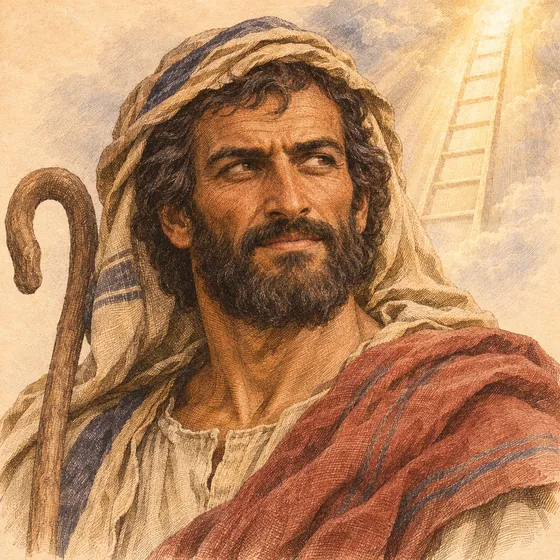
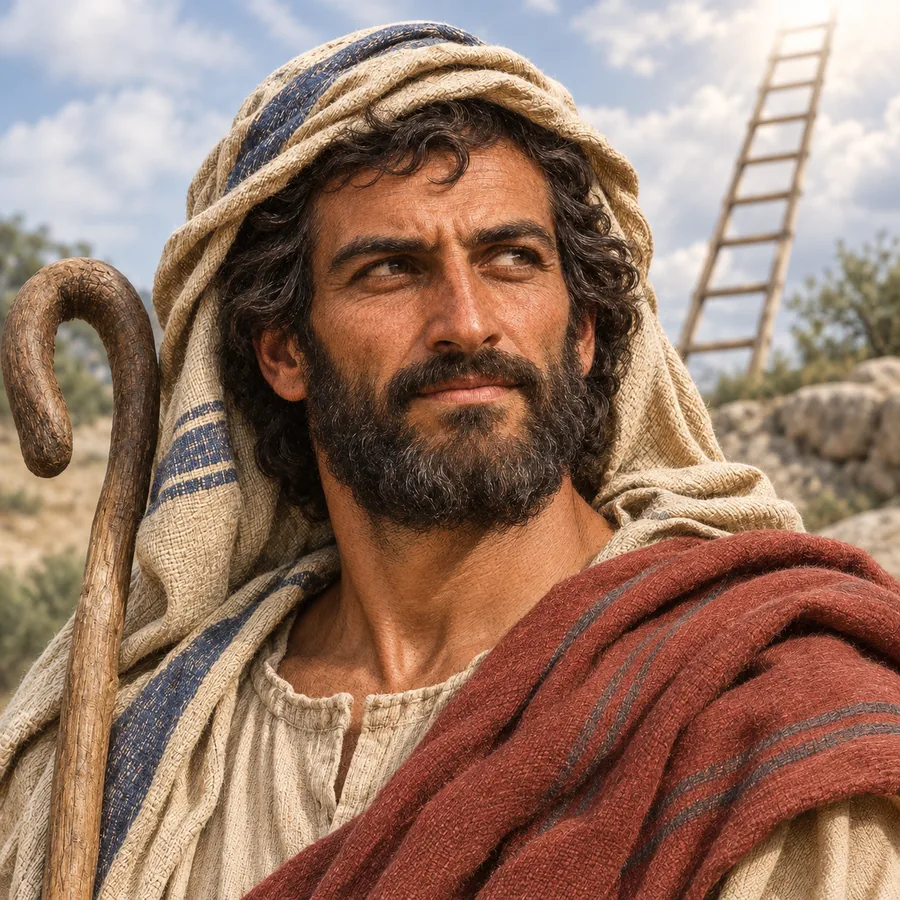

In Genesis 25–50, Isaac's son, who takes his brother's blessing, wrestles through the night with a mysterious man and is renamed Israel; his twelve sons are the ancestors of Israel's tribes.
See Genesis 27:36, Genesis 32:24, Genesis 32:28, Genesis 49:28.
 A ladder to a star marks Jacob in the reading view: his dream of a stairway reaching to heaven (Genesis 28:12).
Mentioned in 1,009 verses across 37 books, first in Joshua 1:2. The verses below are the ones linked to this person (the Theographic dataset, with our sourced corrections).
How artists have pictured him
3 works from different centuries and traditions. Each shows how its time and place imagined Jacob, not how he looked.


In these stories
In the Bible
All 63 verses in Joshua, in Bible order. Text from the Berean Standard Bible; verse numbers follow the KJV.
Joshua
- Joshua 1:2
“Moses My servant is dead. Now therefore arise, you and all these people, and cross over the Jordan into the land that I am giving to the children of Israel.
- Joshua 2:2
And it was reported to the king of Jericho: “Behold, some men of Israel have come here tonight to spy out the land.”
- Joshua 3:1
Early the next morning Joshua got up and left Shittim with all the Israelites. They went as far as the Jordan, where they camped before crossing over.
- Joshua 3:9
So Joshua told the Israelites, “Come here and listen to the words of the LORD your God.”
- Joshua 4:4
So Joshua summoned the twelve men he had appointed from the Israelites, one from each tribe,
- Joshua 4:5
and said to them, “Cross over before the ark of the LORD your God into the middle of the Jordan. Each of you is to take a stone upon his shoulder, according to the number of the tribes of Israel,
- Joshua 4:7
you are to tell them, ‘The waters of the Jordan were cut off before the ark of the covenant of the LORD. When it crossed the Jordan, the waters were cut off.’ Therefore these stones will be a memorial to the Israelites forever.”
- Joshua 4:8
Thus the Israelites did as Joshua had commanded them. They took up twelve stones from the middle of the Jordan, one for each tribe of Israel, just as the LORD had told Joshua; and they carried them to the camp, where they set them down.
- Joshua 4:12
The Reubenites, the Gadites, and the half-tribe of Manasseh crossed over before the Israelites, armed for battle as Moses had instructed them.
- Joshua 4:21
Then Joshua said to the Israelites, “In the future, when your children ask their fathers, ‘What is the meaning of these stones?’
- Joshua 5:1
Now when all the Amorite kings west of the Jordan and all the Canaanite kings along the coast heard how the LORD had dried up the waters of the Jordan before the Israelites until they had crossed over, their hearts melted and their spirits failed for fear of the Israelites.
- Joshua 5:2
At that time the LORD said to Joshua, “Make flint knives and circumcise the sons of Israel once again.”
- Joshua 5:3
So Joshua made flint knives and circumcised the sons of Israel at Gibeath-haaraloth.
- Joshua 5:6
For the Israelites had wandered in the wilderness forty years, until all the nation’s men of war who had come out of Egypt had died, since they did not obey the LORD. So the LORD vowed never to let them see the land He had sworn to their fathers to give us, a land flowing with milk and honey.
- Joshua 5:10
On the evening of the fourteenth day of the month, while the Israelites were camped at Gilgal on the plains of Jericho, they kept the Passover.
- Joshua 5:12
And the day after they had eaten from the produce of the land, the manna ceased. There was no more manna for the Israelites, so that year they began to eat the crops of the land of Canaan.
- Joshua 6:1
Now Jericho was tightly shut up because of the Israelites. No one went out and no one came in.
- Joshua 7:1
The Israelites, however, acted unfaithfully regarding the things devoted to destruction. Achan son of Carmi, the son of Zabdi, the son of Zerah, of the tribe of Judah, took some of what was set apart. So the anger of the LORD burned against the Israelites.
- Joshua 7:12
This is why the Israelites cannot stand against their enemies. They will turn their backs and run from their enemies, because they themselves have been set apart for destruction. I will no longer be with you unless you remove from among you whatever is devoted to destruction.
- Joshua 7:23
They took the things from inside the tent, brought them to Joshua and all the Israelites, and spread them out before the LORD.
- Joshua 8:31
just as Moses the servant of the LORD had commanded the Israelites. He built it according to what is written in the Book of the Law of Moses: “an altar of uncut stones on which no iron tool has been used.” And on it they offered burnt offerings to the LORD, and they sacrificed peace offerings.
- Joshua 8:32
And there in the presence of the Israelites, Joshua inscribed on the stones a copy of the law of Moses, which he had written.
- Joshua 9:17
So the Israelites set out and on the third day arrived at their cities—Gibeon, Chephirah, Beeroth, and Kiriath-jearim.
- Joshua 9:18
But the Israelites did not attack them, because the leaders of the congregation had sworn an oath to them by the LORD, the God of Israel. And the whole congregation grumbled against the leaders.
- Joshua 9:26
So Joshua did this and delivered them from the hands of the Israelites, and they did not kill the Gibeonites.
- Joshua 10:4
“Come up and help me. We will attack Gibeon, because they have made peace with Joshua and the Israelites.”
- Joshua 10:11
As they fled before Israel along the descent from Beth-horon to Azekah, the LORD cast down on them large hailstones from the sky, and more of them were killed by the hailstones than by the swords of the Israelites.
- Joshua 10:12
On the day that the LORD gave the Amorites over to the Israelites, Joshua spoke to the LORD in the presence of Israel: “O sun, stand still over Gibeon, O moon, over the Valley of Aijalon.”
- Joshua 10:20
So Joshua and the Israelites continued to inflict a terrible slaughter until they had finished them off, and the remaining survivors retreated to the fortified cities.
- Joshua 10:21
The whole army returned safely to Joshua in the camp at Makkedah, and no one dared to utter a word against the Israelites.
- Joshua 11:14
The Israelites took for themselves all the plunder and livestock of these cities, but they put all the people to the sword until they had completely destroyed them, not sparing anyone who breathed.
- Joshua 11:19
No city made peace with the Israelites except the Hivites living in Gibeon; all others were taken in battle.
- Joshua 11:22
No Anakim were left in the land of the Israelites; only in Gaza, Gath, and Ashdod did any survive.
- Joshua 12:1
Now these are the kings of the land whom the Israelites struck down and whose lands they took beyond the Jordan to the east, from the Arnon Valley to Mount Hermon, including all the Arabah eastward:
- Joshua 12:6
Moses, the servant of the LORD, and the Israelites had struck them down and given their land as an inheritance to the Reubenites, the Gadites, and the half-tribe of Manasseh.
- Joshua 12:7
And these are the kings of the land that Joshua and the Israelites conquered beyond the Jordan to the west, from Baal-gad in the Valley of Lebanon to Mount Halak, which rises toward Seir (according to the allotments to the tribes of Israel, Joshua gave them as an inheritance
- Joshua 13:6
All the inhabitants of the hill country from Lebanon to Misrephoth-maim—all the Sidonians—I Myself will drive out before the Israelites. Be sure to divide it by lot as an inheritance to Israel, as I have commanded you.
- Joshua 13:13
but the Israelites did not drive out the Geshurites or the Maacathites. So Geshur and Maacath dwell among the Israelites to this day.
- Joshua 13:22
The Israelites also killed the diviner Balaam son of Beor along with the others they put to the sword.
- Joshua 14:1
Now these are the portions that the Israelites inherited in the land of Canaan, as distributed by Eleazar the priest, Joshua son of Nun, and the heads of the families of the tribes of Israel.
- Joshua 14:5
So the Israelites did as the LORD had commanded Moses, and they divided the land.
- Joshua 17:13
However, when the Israelites grew stronger, they put the Canaanites to forced labor; but they failed to drive them out completely.
- Joshua 18:1
Then the whole congregation of Israel assembled at Shiloh and set up the Tent of Meeting there. And though the land was subdued before them,
- Joshua 18:2
there were still seven tribes of Israel who had not yet received their inheritance.
- Joshua 18:3
So Joshua said to the Israelites, “How long will you put off entering and possessing the land that the LORD, the God of your fathers, has given you?
- Joshua 18:10
And Joshua cast lots for them in the presence of the LORD at Shiloh, where he distributed the land to the Israelites according to their divisions.
- Joshua 19:49
When they had finished distributing the land into its territories, the Israelites gave Joshua son of Nun an inheritance among them,
- Joshua 19:51
These are the inheritances that Eleazar the priest, Joshua son of Nun, and the heads of the families distributed by lot to the tribes of Israel at Shiloh before the LORD at the entrance to the Tent of Meeting. So they finished dividing up the land.
- Joshua 20:2
“Tell the Israelites to designate the cities of refuge, as I instructed you through Moses,
- Joshua 20:9
These are the cities appointed for all the Israelites and foreigners among them, so that anyone who kills a person unintentionally may flee there and not die by the hand of the avenger of blood prior to standing trial before the assembly.
- Joshua 21:1
Now the family heads of the Levites approached Eleazar the priest, Joshua son of Nun, and the heads of the other tribes of Israel
- Joshua 21:3
So by the command of the LORD, the Israelites gave the Levites these cities and their pasturelands out of their own inheritance:
- Joshua 21:8
So the Israelites allotted to the Levites these cities, together with their pasturelands, as the LORD had commanded through Moses.
- Joshua 21:41
For the Levites, then, there were forty-eight cities in all, together with their pasturelands, within the territory of the Israelites.
- Joshua 22:9
So the Reubenites, the Gadites, and the half-tribe of Manasseh left the Israelites at Shiloh in the land of Canaan to return to their own land of Gilead, which they had acquired according to the command of the LORD through Moses.
- Joshua 22:11
Then the Israelites received the report: “Behold, the Reubenites, the Gadites, and the half-tribe of Manasseh have built an altar on the border of the land of Canaan, at Geliloth near the Jordan on the Israelite side.”
- Joshua 22:12
And when they heard this, the whole congregation of Israel assembled at Shiloh to go to war against them.
- Joshua 22:13
The Israelites sent Phinehas son of Eleazar the priest to the land of Gilead, to the Reubenites, the Gadites, and the half-tribe of Manasseh.
- Joshua 22:31
Phinehas son of Eleazar the priest said to the descendants of Reuben, Gad, and Manasseh, “Today we know that the LORD is among us, because you have not committed this breach of faith against Him. Consequently, you have delivered the Israelites from the hand of the LORD.”
- Joshua 22:32
Then Phinehas son of Eleazar the priest, together with the other leaders, returned to the Israelites in the land of Canaan and brought back a report regarding the Reubenites and Gadites in the land of Gilead.
- Joshua 22:33
The Israelites were satisfied with the report, and they blessed God and spoke no more about going to war against them to destroy the land where the Reubenites and Gadites lived.
- Joshua 24:4
and to Isaac I gave Jacob and Esau. I gave Esau Mount Seir to possess, but Jacob and his sons went down to Egypt.
- Joshua 24:32
And the bones of Joseph, which the Israelites had brought up out of Egypt, were buried at Shechem in the plot of land that Jacob had purchased from the sons of Hamor, Shechem’s father, for a hundred pieces of silver. So it became an inheritance for Joseph’s descendants.
Events
Events the dataset lists Jacob (Israel) as taking part in. Dates follow its Ussher–Jones reckoning (one of several traditional counts), not established history.
- c. 1836 BCBirth of Jacob and Esau
- c. 1836 BCLifetime of Jacob
- c. 1758 BCBirth of Reuben
- c. 1757 BCBirth of Simeon
- c. 1756 BCBirth of Levi
- c. 1755 BCBirth of Judah
- c. 1755 BCBirth of Dan
- c. 1754 BCBirth of Naphtali
- c. 1753 BCBirth of Gad
- c. 1752 BCBirth of Asher
- c. 1752 BCBirth of Issachar
- c. 1751 BCBirth of Zebulon
Dictionary
From Easton’s Bible Dictionary (1897), as attached to this record by Theographic. The entry is for the name and can describe more than one person who bore it. Easton wrote in 1897, and some of his views are now debated.
Read Easton’s entry
One who follows on another’s heels; supplanter, (Gen. 25:26; 27:36; Hos. 12:2-4), the second born of the twin sons of Isaac by Rebekah. He was born probably at Lahai-roi, when his father was fifty-nine and Abraham one hundred and fifty-nine years old. Like his father, he was of a quiet and gentle disposition, and when he grew up followed the life of a shepherd, while his brother Esau became an enterprising hunter. His dealing with Esau, however, showed much mean selfishness and cunning (Gen. 25:29-34).
When Isaac was about 160 years of age, Jacob and his mother conspired to deceive the aged patriarch ([Gen. 27](/gen#Gen.27)), with the view of procuring the transfer of the birthright to himself. The birthright secured to him who possessed it (1) superior rank in his family (Gen. 49:3); (2) a double portion of the paternal inheritance (Deut. 21:17); (3) the priestly office in the family (Num. 8:17-19); and (4) the promise of the Seed in which all nations of the earth were to be blessed (Gen. 22:18).
Soon after his acquisition of his father’s blessing ([Gen. 27](/gen#Gen.27)), Jacob became conscious of his guilt; and afraid of the anger of Esau, at the suggestion of Rebekah Isaac sent him away to Haran, 400 miles or more, to find a wife among his cousins, the family of Laban, the Syrian (28). There he met with Rachel (29). Laban would not consent to give him his daughter in marriage till he had served seven years; but to Jacob these years “seemed but a few days, for the love he had to her.” But when the seven years were expired, Laban craftily deceived Jacob, and gave him his daughter Leah. Other seven years of service had to be completed probably before he obtained the beloved Rachel. But “life-long sorrow, disgrace, and trials, in the retributive providence of God, followed as a consequence of this double union.”
At the close of the fourteen years of service, Jacob desired to return to his parents, but at the entreaty of Laban he tarried yet six years with him, tending his flocks (31:41). He then set out with his family and property “to go to Isaac his father in the land of Canaan” ([Gen. 31](/gen#Gen.31)). Laban was angry when he heard that Jacob had set out on his journey, and pursued after him, overtaking him in seven days. The meeting was of a painful kind. After much recrimination and reproach directed against Jacob, Laban is at length pacified, and taking an affectionate farewell of his daughters, returns to his home in Padanaram. And now all connection of the Israelites with Mesopotamia is at an end.
Soon after parting with Laban he is met by a company of angels, as if to greet him on his return and welcome him back to the Land of Promise (32:1, 2). He called the name of the place Mahanaim, i.e., “the double camp,” probably his own camp and that of the angels. The vision of angels was the counterpart of that he had formerly seen at Bethel, when, twenty years before, the weary, solitary traveller, on his way to Padan-aram, saw the angels of God ascending and descending on the ladder whose top reached to heaven (28:12).
He now hears with dismay of the approach of his brother Esau with a band of 400 men to meet him. In great agony of mind he prepares for the worst. He feels that he must now depend only on God, and he betakes himself to him in earnest prayer, and sends on before him a munificent present to Esau, “a present to my lord Esau from thy servant Jacob.” Jacob’s family were then transported across the Jabbok; but he himself remained behind, spending the night in communion with God. While thus engaged, there appeared one in the form of a man who wrestled with him. In this mysterious contest Jacob prevailed, and as a memorial of it his name was changed to Israel (wrestler with God); and the place where this occured he called Peniel, “for”, said he, “I have seen God face to face, and my life is preserved” (32:25-31).
After this anxious night, Jacob went on his way, halting, mysteriously weakened by the conflict, but strong in the assurance of the divine favour. Esau came forth and met him; but his spirit of revenge was appeased, and the brothers met as friends, and during the remainder of their lives they maintained friendly relations. After a brief sojourn at Succoth, Jacob moved forward and pitched his tent near Shechem (q.v.), 33:18; but at length, under divine directions, he moved to Bethel, where he made an altar unto God (35:6, 7), and where God appeared to him and renewed the Abrahamic covenant. While journeying from Bethel to Ephrath (the Canaanitish name of Bethlehem), Rachel died in giving birth to her second son Benjamin (35:16-20), fifteen or sixteen years after the birth of Joseph. He then reached the old family residence at Mamre, to wait on the dying bed of his father Isaac. The complete reconciliation between Esau and Jacob was shown by their uniting in the burial of the patriarch (35:27-29).
Jacob was soon after this deeply grieved by the loss of his beloved son Joseph through the jealousy of his brothers (37:33). Then follows the story of the famine, and the successive goings down into Egypt to buy corn (42), which led to the discovery of the long-lost Joseph, and the patriarch’s going down with all his household, numbering about seventy souls (Ex. 1:5; Deut. 10:22; Acts 7:14), to sojourn in the land of Goshen. Here Jacob, “after being strangely tossed about on a very rough ocean, found at last a tranquil harbour, where all the best affections of his nature were gently exercised and largely unfolded” ([Gen. 48](/gen#Gen.48)). At length the end of his checkered course draws nigh, and he summons his sons to his bedside that he may bless them. Among his last words he repeats the story of Rachel’s death, although forty years had passed away since that event took place, as tenderly as if it had happened only yesterday; and when “he had made an end of charging his sons, he gathered up his feet into the bed, and yielded up the ghost” (49:33). His body was embalmed and carried with great pomp into the land of Canaan, and buried beside his wife Leah in the cave of Machpelah, according to his dying charge. There, probably, his embalmed body remains to this day (50:1-13).
The history of Jacob is referred to by the prophets Hosea (12:3, 4, 12) and Malachi (1:2). In Micah 1:5 the name is a poetic synonym for Israel, the kingdom of the ten tribes. There are, besides the mention of his name along with those of the other patriarchs, distinct references to events of his life in Paul’s epistles (Rom. 9:11-13; Heb. 12:16; 11:21). See references to his vision at Bethel and his possession of land at Shechem in John 1:51; 4:5, 12; also to the famine which was the occasion of his going down into Egypt in Acts 7:12 (See LUZ; BETHEL.)