Person
Jacob (Israel)
Also called Israel
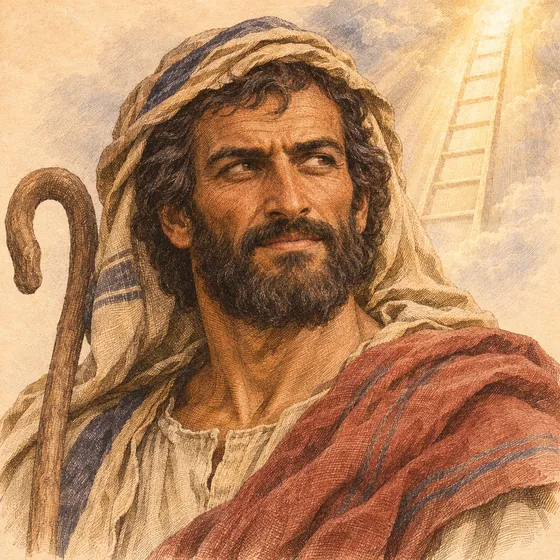
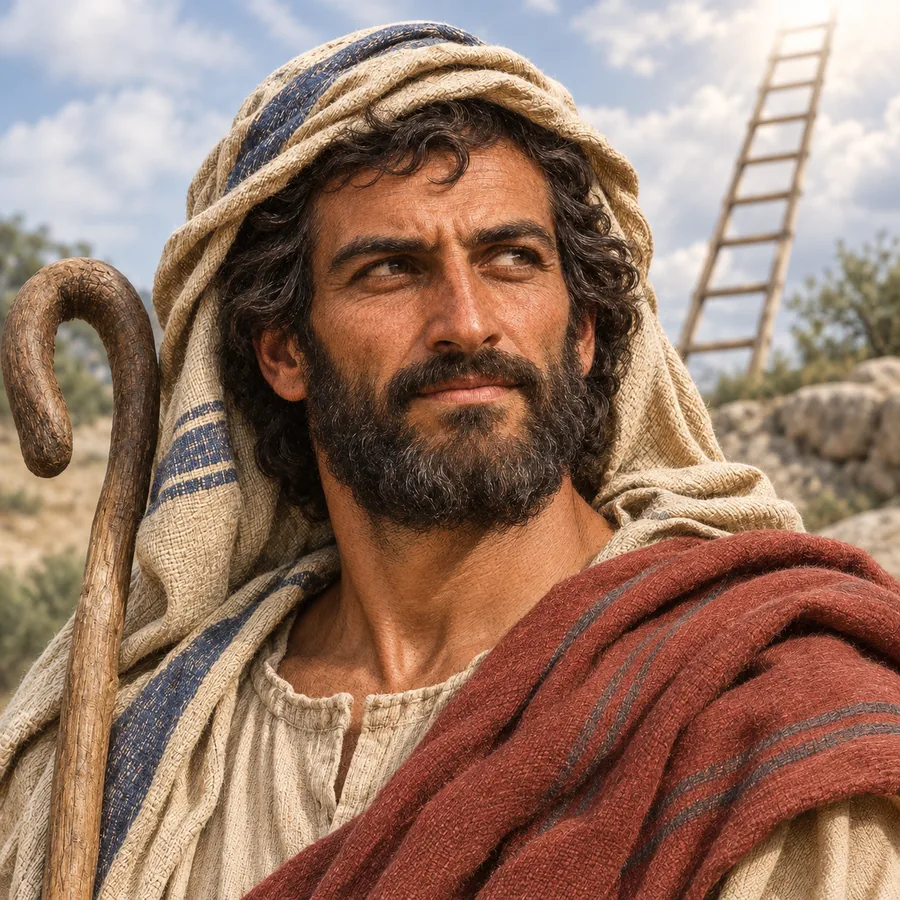

In Genesis 25–50, Isaac's son, who takes his brother's blessing, wrestles through the night with a mysterious man and is renamed Israel; his twelve sons are the ancestors of Israel's tribes.
See Genesis 27:36, Genesis 32:24, Genesis 32:28, Genesis 49:28.
 A ladder to a star marks Jacob in the reading view: his dream of a stairway reaching to heaven (Genesis 28:12).
Mentioned in 1,009 verses across 37 books, first in Judges 1:1. The verses below are the ones linked to this person (the Theographic dataset, with our sourced corrections).
How artists have pictured him
3 works from different centuries and traditions. Each shows how its time and place imagined Jacob, not how he looked.


In these stories
In the Bible
All 56 verses in Judges, in Bible order. Text from the Berean Standard Bible; verse numbers follow the KJV.
Judges
- Judges 1:1
After the death of Joshua, the Israelites inquired of the LORD, “Who will be the first to go up and fight for us against the Canaanites?”
- Judges 2:4
When the angel of the LORD had spoken these words to all the Israelites, the people lifted up their voices and wept.
- Judges 2:6
After Joshua had dismissed the people, the Israelites went out to take possession of the land, each to his own inheritance.
- Judges 2:11
And the Israelites did evil in the sight of the LORD and served the Baals.
- Judges 3:2
if only to teach warfare to the subsequent generations of Israel, especially to those who had not known it formerly:
- Judges 3:5
Thus the Israelites continued to live among the Canaanites, Hittites, Amorites, Perizzites, Hivites, and Jebusites.
- Judges 3:7
So the Israelites did evil in the sight of the LORD; they forgot the LORD their God and served the Baals and the Asherahs.
- Judges 3:8
Then the anger of the LORD burned against Israel, and He sold them into the hand of Cushan-rishathaim king of Aram-naharaim, and the Israelites served him eight years.
- Judges 3:9
But when the Israelites cried out to the LORD, He raised up Othniel son of Caleb’s younger brother Kenaz as a deliverer to save them.
- Judges 3:12
Once again the Israelites did evil in the sight of the LORD. So He gave Eglon king of Moab power over Israel, because they had done evil in the sight of the LORD.
- Judges 3:14
The Israelites served Eglon king of Moab eighteen years.
- Judges 3:15
And again they cried out to the LORD, and He raised up Ehud son of Gera, a left-handed Benjamite, as their deliverer. So they sent him with tribute to Eglon king of Moab.
- Judges 3:27
On arriving in Seirah, he blew the ram’s horn throughout the hill country of Ephraim. The Israelites came down with him from the hills, and he became their leader.
- Judges 4:1
After Ehud died, the Israelites again did evil in the sight of the LORD.
- Judges 4:3
Then the Israelites cried out to the LORD, because Jabin had nine hundred chariots of iron, and he had harshly oppressed the Israelites for twenty years.
- Judges 4:5
And she would sit under the Palm of Deborah between Ramah and Bethel in the hill country of Ephraim, where the Israelites would go up to her for judgment.
- Judges 4:23
On that day God subdued Jabin king of Canaan before the Israelites.
- Judges 4:24
And the hand of the Israelites grew stronger and stronger against Jabin king of Canaan until they destroyed him.
- Judges 6:1
Again the Israelites did evil in the sight of the LORD; so He delivered them into the hand of Midian for seven years,
- Judges 6:2
and the hand of Midian prevailed against Israel. Because of the Midianites, the Israelites prepared shelters for themselves in the mountains, caves, and strongholds.
- Judges 6:6
Israel was greatly impoverished by Midian, and the Israelites cried out to the LORD.
- Judges 6:7
Now when the Israelites cried out to the LORD because of Midian,
- Judges 6:8
He sent them a prophet, who told them, “This is what the LORD, the God of Israel, says: I brought you up out of Egypt, out of the house of slavery.
- Judges 8:28
In this way Midian was subdued before the Israelites and did not raise its head again. So the land had rest for forty years in the days of Gideon,
- Judges 8:33
And as soon as Gideon was dead, the Israelites turned and prostituted themselves with the Baals, and they set up Baal-berith as their god.
- Judges 8:34
The Israelites failed to remember the LORD their God who had delivered them from the hands of all their enemies on every side.
- Judges 10:6
And again the Israelites did evil in the sight of the LORD. They served the Baals, the Ashtoreths, the gods of Aram, Sidon, and Moab, and the gods of the Ammonites and Philistines. Thus they forsook the LORD and did not serve Him.
- Judges 10:8
who that very year harassed and oppressed the Israelites, and did so for eighteen years to all the Israelites on the other side of the Jordan in Gilead, the land of the Amorites.
- Judges 10:10
Then the Israelites cried out to the LORD, saying, “We have sinned against You, for we have indeed forsaken our God and served the Baals.”
- Judges 10:11
The LORD replied, “When the Egyptians, Amorites, Ammonites, Philistines,
- Judges 10:15
“We have sinned,” the Israelites said to the LORD. “Deal with us as You see fit; but please deliver us today!”
- Judges 10:17
Then the Ammonites were called to arms and camped in Gilead, and the Israelites assembled and camped at Mizpah.
- Judges 11:27
I have not sinned against you, but you have done me wrong by waging war against me. May the LORD, the Judge, decide today between the Israelites and the Ammonites.”
- Judges 11:33
With a great blow he devastated twenty cities from Aroer to the vicinity of Minnith, as far as Abel-keramim. So the Ammonites were subdued before the Israelites.
- Judges 13:1
Again the Israelites did evil in the sight of the LORD, so He delivered them into the hand of the Philistines for forty years.
- Judges 19:12
But his master replied, “We will not turn aside to the city of foreigners, where there are no Israelites. We will go on to Gibeah.”
- Judges 19:30
And everyone who saw it said, “Nothing like this has been seen or done from the day the Israelites came out of the land of Egypt until this day. Think it over, take counsel, and speak up!”
- Judges 20:1
Then all the Israelites from Dan to Beersheba and from the land of Gilead came out, and the congregation assembled as one man before the LORD at Mizpah.
- Judges 20:3
(Meanwhile the Benjamites heard that the Israelites had gone up to Mizpah.) And the Israelites asked, “Tell us, how did this wicked thing happen?”
- Judges 20:7
Behold, all you Israelites, give your advice and verdict here and now.”
- Judges 20:13
Hand over the wicked men of Gibeah so we can put them to death and purge Israel of this evil.” But the Benjamites refused to heed the voice of their fellow Israelites.
- Judges 20:14
And from their cities they came together at Gibeah to go out and fight against the Israelites.
- Judges 20:18
The Israelites set out, went up to Bethel, and inquired of God, “Who of us shall go up first to fight against the Benjamites?” “Judah will be first,” the LORD replied.
- Judges 20:19
The next morning the Israelites set out and camped near Gibeah.
- Judges 20:23
They went up and wept before the LORD until evening, inquiring of Him, “Should we again draw near for battle against our brothers the Benjamites?” And the LORD answered, “Go up against them.”
- Judges 20:24
On the second day the Israelites advanced against the Benjamites.
- Judges 20:25
That same day the Benjamites came out against them from Gibeah and cut down another 18,000 Israelites, all of them armed with swords.
- Judges 20:26
Then the Israelites, all the people, went up to Bethel, where they sat weeping before the LORD. That day they fasted until evening and presented burnt offerings and peace offerings to the LORD.
- Judges 20:27
And the Israelites inquired of the LORD. (In those days the ark of the covenant of God was there,
- Judges 20:30
On the third day the Israelites went up against the Benjamites and arrayed themselves against Gibeah as they had done before.
- Judges 20:32
“We are defeating them as before,” said the Benjamites. But the Israelites said, “Let us retreat and draw them away from the city onto the roads.”
- Judges 20:35
The LORD defeated Benjamin in the presence of Israel, and on that day the Israelites slaughtered 25,100 Benjamites, all armed with swords.
- Judges 21:5
The Israelites asked, “Who among all the tribes of Israel did not come to the assembly before the LORD?” For they had taken a solemn oath that anyone who failed to come up before the LORD at Mizpah would surely be put to death.
- Judges 21:6
And the Israelites grieved for their brothers, the Benjamites, and said, “Today a tribe is cut off from Israel.
- Judges 21:18
But we cannot give them our daughters as wives.” For the Israelites had sworn, “Cursed is he who gives a wife to a Benjamite.”
- Judges 21:24
And at that time, each of the Israelites returned from there to his own tribe and clan, each to his own inheritance.
Events
Events the dataset lists Jacob (Israel) as taking part in. Dates follow its Ussher–Jones reckoning (one of several traditional counts), not established history.
- c. 1836 BCBirth of Jacob and Esau
- c. 1836 BCLifetime of Jacob
- c. 1758 BCBirth of Reuben
- c. 1757 BCBirth of Simeon
- c. 1756 BCBirth of Levi
- c. 1755 BCBirth of Judah
- c. 1755 BCBirth of Dan
- c. 1754 BCBirth of Naphtali
- c. 1753 BCBirth of Gad
- c. 1752 BCBirth of Asher
- c. 1752 BCBirth of Issachar
- c. 1751 BCBirth of Zebulon
Dictionary
From Easton’s Bible Dictionary (1897), as attached to this record by Theographic. The entry is for the name and can describe more than one person who bore it. Easton wrote in 1897, and some of his views are now debated.
Read Easton’s entry
One who follows on another’s heels; supplanter, (Gen. 25:26; 27:36; Hos. 12:2-4), the second born of the twin sons of Isaac by Rebekah. He was born probably at Lahai-roi, when his father was fifty-nine and Abraham one hundred and fifty-nine years old. Like his father, he was of a quiet and gentle disposition, and when he grew up followed the life of a shepherd, while his brother Esau became an enterprising hunter. His dealing with Esau, however, showed much mean selfishness and cunning (Gen. 25:29-34).
When Isaac was about 160 years of age, Jacob and his mother conspired to deceive the aged patriarch ([Gen. 27](/gen#Gen.27)), with the view of procuring the transfer of the birthright to himself. The birthright secured to him who possessed it (1) superior rank in his family (Gen. 49:3); (2) a double portion of the paternal inheritance (Deut. 21:17); (3) the priestly office in the family (Num. 8:17-19); and (4) the promise of the Seed in which all nations of the earth were to be blessed (Gen. 22:18).
Soon after his acquisition of his father’s blessing ([Gen. 27](/gen#Gen.27)), Jacob became conscious of his guilt; and afraid of the anger of Esau, at the suggestion of Rebekah Isaac sent him away to Haran, 400 miles or more, to find a wife among his cousins, the family of Laban, the Syrian (28). There he met with Rachel (29). Laban would not consent to give him his daughter in marriage till he had served seven years; but to Jacob these years “seemed but a few days, for the love he had to her.” But when the seven years were expired, Laban craftily deceived Jacob, and gave him his daughter Leah. Other seven years of service had to be completed probably before he obtained the beloved Rachel. But “life-long sorrow, disgrace, and trials, in the retributive providence of God, followed as a consequence of this double union.”
At the close of the fourteen years of service, Jacob desired to return to his parents, but at the entreaty of Laban he tarried yet six years with him, tending his flocks (31:41). He then set out with his family and property “to go to Isaac his father in the land of Canaan” ([Gen. 31](/gen#Gen.31)). Laban was angry when he heard that Jacob had set out on his journey, and pursued after him, overtaking him in seven days. The meeting was of a painful kind. After much recrimination and reproach directed against Jacob, Laban is at length pacified, and taking an affectionate farewell of his daughters, returns to his home in Padanaram. And now all connection of the Israelites with Mesopotamia is at an end.
Soon after parting with Laban he is met by a company of angels, as if to greet him on his return and welcome him back to the Land of Promise (32:1, 2). He called the name of the place Mahanaim, i.e., “the double camp,” probably his own camp and that of the angels. The vision of angels was the counterpart of that he had formerly seen at Bethel, when, twenty years before, the weary, solitary traveller, on his way to Padan-aram, saw the angels of God ascending and descending on the ladder whose top reached to heaven (28:12).
He now hears with dismay of the approach of his brother Esau with a band of 400 men to meet him. In great agony of mind he prepares for the worst. He feels that he must now depend only on God, and he betakes himself to him in earnest prayer, and sends on before him a munificent present to Esau, “a present to my lord Esau from thy servant Jacob.” Jacob’s family were then transported across the Jabbok; but he himself remained behind, spending the night in communion with God. While thus engaged, there appeared one in the form of a man who wrestled with him. In this mysterious contest Jacob prevailed, and as a memorial of it his name was changed to Israel (wrestler with God); and the place where this occured he called Peniel, “for”, said he, “I have seen God face to face, and my life is preserved” (32:25-31).
After this anxious night, Jacob went on his way, halting, mysteriously weakened by the conflict, but strong in the assurance of the divine favour. Esau came forth and met him; but his spirit of revenge was appeased, and the brothers met as friends, and during the remainder of their lives they maintained friendly relations. After a brief sojourn at Succoth, Jacob moved forward and pitched his tent near Shechem (q.v.), 33:18; but at length, under divine directions, he moved to Bethel, where he made an altar unto God (35:6, 7), and where God appeared to him and renewed the Abrahamic covenant. While journeying from Bethel to Ephrath (the Canaanitish name of Bethlehem), Rachel died in giving birth to her second son Benjamin (35:16-20), fifteen or sixteen years after the birth of Joseph. He then reached the old family residence at Mamre, to wait on the dying bed of his father Isaac. The complete reconciliation between Esau and Jacob was shown by their uniting in the burial of the patriarch (35:27-29).
Jacob was soon after this deeply grieved by the loss of his beloved son Joseph through the jealousy of his brothers (37:33). Then follows the story of the famine, and the successive goings down into Egypt to buy corn (42), which led to the discovery of the long-lost Joseph, and the patriarch’s going down with all his household, numbering about seventy souls (Ex. 1:5; Deut. 10:22; Acts 7:14), to sojourn in the land of Goshen. Here Jacob, “after being strangely tossed about on a very rough ocean, found at last a tranquil harbour, where all the best affections of his nature were gently exercised and largely unfolded” ([Gen. 48](/gen#Gen.48)). At length the end of his checkered course draws nigh, and he summons his sons to his bedside that he may bless them. Among his last words he repeats the story of Rachel’s death, although forty years had passed away since that event took place, as tenderly as if it had happened only yesterday; and when “he had made an end of charging his sons, he gathered up his feet into the bed, and yielded up the ghost” (49:33). His body was embalmed and carried with great pomp into the land of Canaan, and buried beside his wife Leah in the cave of Machpelah, according to his dying charge. There, probably, his embalmed body remains to this day (50:1-13).
The history of Jacob is referred to by the prophets Hosea (12:3, 4, 12) and Malachi (1:2). In Micah 1:5 the name is a poetic synonym for Israel, the kingdom of the ten tribes. There are, besides the mention of his name along with those of the other patriarchs, distinct references to events of his life in Paul’s epistles (Rom. 9:11-13; Heb. 12:16; 11:21). See references to his vision at Bethel and his possession of land at Shechem in John 1:51; 4:5, 12; also to the famine which was the occasion of his going down into Egypt in Acts 7:12 (See LUZ; BETHEL.)