Person
Jacob (Israel)
Also called Israel
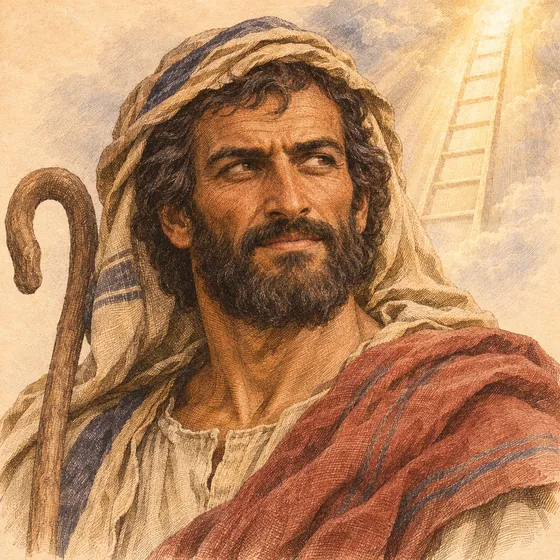
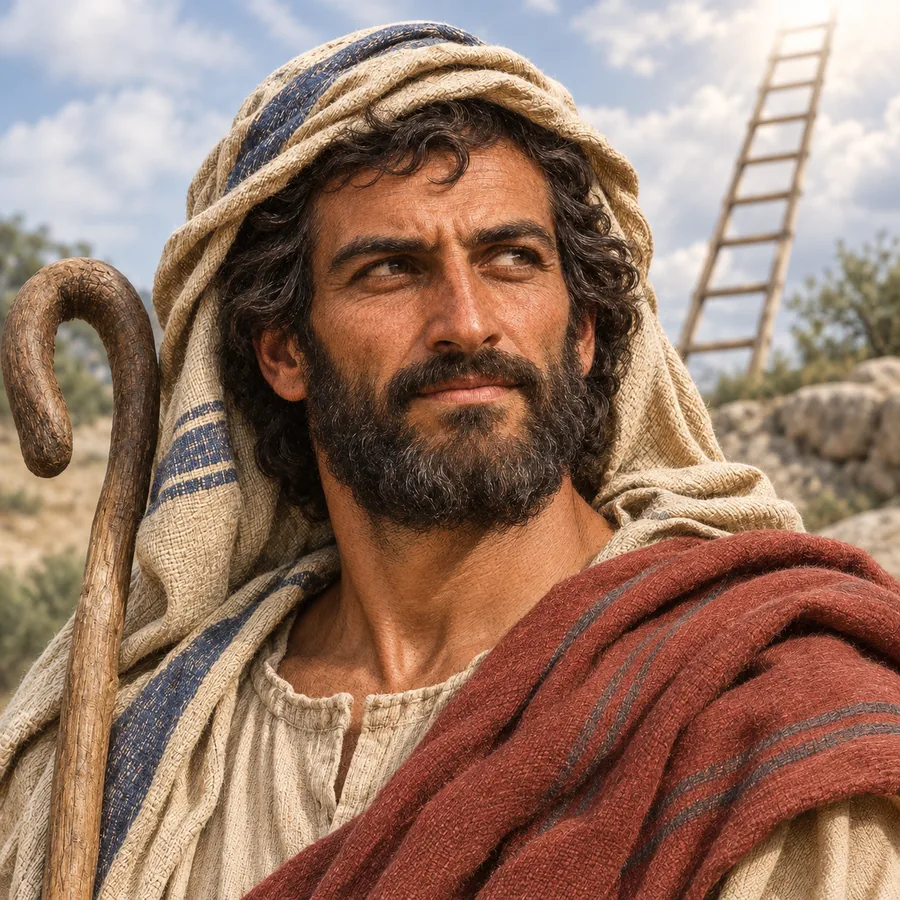
In Genesis 25–50, Isaac's son, who takes his brother's blessing, wrestles through the night with a mysterious man and is renamed Israel; his twelve sons are the ancestors of Israel's tribes.
See Genesis 27:36, Genesis 32:24, Genesis 32:28, Genesis 49:28.
 A ladder to a star marks Jacob in the reading view: his dream of a stairway reaching to heaven (Genesis 28:12).
Mentioned in 1,009 verses across 37 books, first in Deuteronomy 1:3. The verses below are the ones linked to this person (the Theographic dataset, with our sourced corrections).
How artists have pictured him
3 works from different centuries and traditions. Each shows how its time and place imagined Jacob, not how he looked.


In these stories
In the Bible
All 29 verses in Deuteronomy, in Bible order. Text from the Berean Standard Bible; verse numbers follow the KJV.
Deuteronomy
- Deuteronomy 1:3
In the fortieth year, on the first day of the eleventh month, Moses proclaimed to the Israelites all that the LORD had commanded him concerning them.
- Deuteronomy 1:8
See, I have placed the land before you. Enter and possess the land that the LORD swore He would give to your fathers Abraham, Isaac, and Jacob, and to their descendants after them.”
- Deuteronomy 3:18
At that time I commanded you: “The LORD your God has given you this land to possess. All your men of valor are to cross over, armed for battle, ahead of your brothers, the Israelites.
- Deuteronomy 4:44
This is the law that Moses set before the Israelites.
- Deuteronomy 4:45
These are the testimonies, statutes, and ordinances that Moses proclaimed to them after they had come out of Egypt,
- Deuteronomy 4:46
while they were in the valley across the Jordan facing Beth-peor in the land of Sihon king of the Amorites, who lived in Heshbon and was defeated by Moses and the Israelites after they had come out of Egypt.
- Deuteronomy 6:10
And when the LORD your God brings you into the land He swore to your fathers, to Abraham, Isaac, and Jacob, that He would give you—a land with great and splendid cities that you did not build,
- Deuteronomy 9:5
It is not because of your righteousness or uprightness of heart that you are going in to possess their land, but it is because of their wickedness that the LORD your God is driving out these nations before you, to keep the promise He swore to your fathers, to Abraham, Isaac, and Jacob.
- Deuteronomy 9:27
Remember Your servants Abraham, Isaac, and Jacob. Overlook the stubbornness of this people and the wickedness of their sin.
- Deuteronomy 10:6
The Israelites traveled from Beeroth Bene-jaakan to Moserah, where Aaron died and was buried, and Eleazar his son succeeded him as priest.
- Deuteronomy 24:7
If a man is caught kidnapping one of his Israelite brothers, whether he treats him as a slave or sells him, the kidnapper must die. So you must purge the evil from among you.
- Deuteronomy 29:1
These are the words of the covenant that the LORD commanded Moses to make with the Israelites in the land of Moab, in addition to the covenant He had made with them at Horeb.
- Deuteronomy 29:13
and so that He may establish you today as His people, and He may be your God as He promised you and as He swore to your fathers, to Abraham, Isaac, and Jacob.
- Deuteronomy 30:20
and that you may love the LORD your God, obey Him, and hold fast to Him. For He is your life, and He will prolong your life in the land that the LORD swore to give to your fathers, to Abraham, Isaac, and Jacob.”
- Deuteronomy 31:19
Now therefore, write down for yourselves this song and teach it to the Israelites; have them recite it, so that it may be a witness for Me against them.
- Deuteronomy 31:22
So that very day Moses wrote down this song and taught it to the Israelites.
- Deuteronomy 31:23
Then the LORD commissioned Joshua son of Nun and said, “Be strong and courageous, for you will bring the Israelites into the land that I swore to give them, and I will be with you.”
- Deuteronomy 32:8
When the Most High gave the nations their inheritance, when He divided the sons of man, He set the boundaries of the peoples according to the number of the sons of God.
- Deuteronomy 32:9
But the LORD’s portion is His people, Jacob His allotted inheritance.
- Deuteronomy 32:49
“Go up into the Abarim Range to Mount Nebo, in the land of Moab across from Jericho, and view the land of Canaan, which I am giving to the Israelites as their own possession.
- Deuteronomy 32:51
For at the waters of Meribah-kadesh in the Wilderness of Zin, both of you broke faith with Me among the Israelites by failing to treat Me as holy in their presence.
- Deuteronomy 32:52
Although you shall see from a distance the land that I am giving the Israelites, you shall not enter it.”
- Deuteronomy 33:1
This is the blessing that Moses the man of God pronounced upon the Israelites before his death.
- Deuteronomy 33:4
the law that Moses gave us, the possession of the assembly of Jacob.
- Deuteronomy 33:10
He will teach Your ordinances to Jacob and Your law to Israel; he will set incense before You and whole burnt offerings on Your altar.
- Deuteronomy 33:28
So Israel dwells securely; the fountain of Jacob lives untroubled in a land of grain and new wine, where even the heavens drip with dew.
- Deuteronomy 34:4
And the LORD said to him, “This is the land that I swore to give Abraham, Isaac, and Jacob when I said, ‘I will give it to your descendants.’ I have let you see it with your own eyes, but you will not cross into it.”
- Deuteronomy 34:8
The Israelites grieved for Moses in the plains of Moab thirty days, until the time of weeping and mourning for Moses came to an end.
- Deuteronomy 34:9
Now Joshua son of Nun was filled with the spirit of wisdom because Moses had laid his hands on him. So the Israelites obeyed him and did as the LORD had commanded Moses.
Events
Events the dataset lists Jacob (Israel) as taking part in. Dates follow its Ussher–Jones reckoning (one of several traditional counts), not established history.
- c. 1836 BCBirth of Jacob and Esau
- c. 1836 BCLifetime of Jacob
- c. 1758 BCBirth of Reuben
- c. 1757 BCBirth of Simeon
- c. 1756 BCBirth of Levi
- c. 1755 BCBirth of Judah
- c. 1755 BCBirth of Dan
- c. 1754 BCBirth of Naphtali
- c. 1753 BCBirth of Gad
- c. 1752 BCBirth of Asher
- c. 1752 BCBirth of Issachar
- c. 1751 BCBirth of Zebulon
Dictionary
From Easton’s Bible Dictionary (1897), as attached to this record by Theographic. The entry is for the name and can describe more than one person who bore it. Easton wrote in 1897, and some of his views are now debated.
Read Easton’s entry
One who follows on another’s heels; supplanter, (Gen. 25:26; 27:36; Hos. 12:2-4), the second born of the twin sons of Isaac by Rebekah. He was born probably at Lahai-roi, when his father was fifty-nine and Abraham one hundred and fifty-nine years old. Like his father, he was of a quiet and gentle disposition, and when he grew up followed the life of a shepherd, while his brother Esau became an enterprising hunter. His dealing with Esau, however, showed much mean selfishness and cunning (Gen. 25:29-34).
When Isaac was about 160 years of age, Jacob and his mother conspired to deceive the aged patriarch ([Gen. 27](/gen#Gen.27)), with the view of procuring the transfer of the birthright to himself. The birthright secured to him who possessed it (1) superior rank in his family (Gen. 49:3); (2) a double portion of the paternal inheritance (Deut. 21:17); (3) the priestly office in the family (Num. 8:17-19); and (4) the promise of the Seed in which all nations of the earth were to be blessed (Gen. 22:18).
Soon after his acquisition of his father’s blessing ([Gen. 27](/gen#Gen.27)), Jacob became conscious of his guilt; and afraid of the anger of Esau, at the suggestion of Rebekah Isaac sent him away to Haran, 400 miles or more, to find a wife among his cousins, the family of Laban, the Syrian (28). There he met with Rachel (29). Laban would not consent to give him his daughter in marriage till he had served seven years; but to Jacob these years “seemed but a few days, for the love he had to her.” But when the seven years were expired, Laban craftily deceived Jacob, and gave him his daughter Leah. Other seven years of service had to be completed probably before he obtained the beloved Rachel. But “life-long sorrow, disgrace, and trials, in the retributive providence of God, followed as a consequence of this double union.”
At the close of the fourteen years of service, Jacob desired to return to his parents, but at the entreaty of Laban he tarried yet six years with him, tending his flocks (31:41). He then set out with his family and property “to go to Isaac his father in the land of Canaan” ([Gen. 31](/gen#Gen.31)). Laban was angry when he heard that Jacob had set out on his journey, and pursued after him, overtaking him in seven days. The meeting was of a painful kind. After much recrimination and reproach directed against Jacob, Laban is at length pacified, and taking an affectionate farewell of his daughters, returns to his home in Padanaram. And now all connection of the Israelites with Mesopotamia is at an end.
Soon after parting with Laban he is met by a company of angels, as if to greet him on his return and welcome him back to the Land of Promise (32:1, 2). He called the name of the place Mahanaim, i.e., “the double camp,” probably his own camp and that of the angels. The vision of angels was the counterpart of that he had formerly seen at Bethel, when, twenty years before, the weary, solitary traveller, on his way to Padan-aram, saw the angels of God ascending and descending on the ladder whose top reached to heaven (28:12).
He now hears with dismay of the approach of his brother Esau with a band of 400 men to meet him. In great agony of mind he prepares for the worst. He feels that he must now depend only on God, and he betakes himself to him in earnest prayer, and sends on before him a munificent present to Esau, “a present to my lord Esau from thy servant Jacob.” Jacob’s family were then transported across the Jabbok; but he himself remained behind, spending the night in communion with God. While thus engaged, there appeared one in the form of a man who wrestled with him. In this mysterious contest Jacob prevailed, and as a memorial of it his name was changed to Israel (wrestler with God); and the place where this occured he called Peniel, “for”, said he, “I have seen God face to face, and my life is preserved” (32:25-31).
After this anxious night, Jacob went on his way, halting, mysteriously weakened by the conflict, but strong in the assurance of the divine favour. Esau came forth and met him; but his spirit of revenge was appeased, and the brothers met as friends, and during the remainder of their lives they maintained friendly relations. After a brief sojourn at Succoth, Jacob moved forward and pitched his tent near Shechem (q.v.), 33:18; but at length, under divine directions, he moved to Bethel, where he made an altar unto God (35:6, 7), and where God appeared to him and renewed the Abrahamic covenant. While journeying from Bethel to Ephrath (the Canaanitish name of Bethlehem), Rachel died in giving birth to her second son Benjamin (35:16-20), fifteen or sixteen years after the birth of Joseph. He then reached the old family residence at Mamre, to wait on the dying bed of his father Isaac. The complete reconciliation between Esau and Jacob was shown by their uniting in the burial of the patriarch (35:27-29).
Jacob was soon after this deeply grieved by the loss of his beloved son Joseph through the jealousy of his brothers (37:33). Then follows the story of the famine, and the successive goings down into Egypt to buy corn (42), which led to the discovery of the long-lost Joseph, and the patriarch’s going down with all his household, numbering about seventy souls (Ex. 1:5; Deut. 10:22; Acts 7:14), to sojourn in the land of Goshen. Here Jacob, “after being strangely tossed about on a very rough ocean, found at last a tranquil harbour, where all the best affections of his nature were gently exercised and largely unfolded” ([Gen. 48](/gen#Gen.48)). At length the end of his checkered course draws nigh, and he summons his sons to his bedside that he may bless them. Among his last words he repeats the story of Rachel’s death, although forty years had passed away since that event took place, as tenderly as if it had happened only yesterday; and when “he had made an end of charging his sons, he gathered up his feet into the bed, and yielded up the ghost” (49:33). His body was embalmed and carried with great pomp into the land of Canaan, and buried beside his wife Leah in the cave of Machpelah, according to his dying charge. There, probably, his embalmed body remains to this day (50:1-13).
The history of Jacob is referred to by the prophets Hosea (12:3, 4, 12) and Malachi (1:2). In Micah 1:5 the name is a poetic synonym for Israel, the kingdom of the ten tribes. There are, besides the mention of his name along with those of the other patriarchs, distinct references to events of his life in Paul’s epistles (Rom. 9:11-13; Heb. 12:16; 11:21). See references to his vision at Bethel and his possession of land at Shechem in John 1:51; 4:5, 12; also to the famine which was the occasion of his going down into Egypt in Acts 7:12 (See LUZ; BETHEL.)