Person
Joseph (son of Jacob)
Also called Zaphnath-paaneah
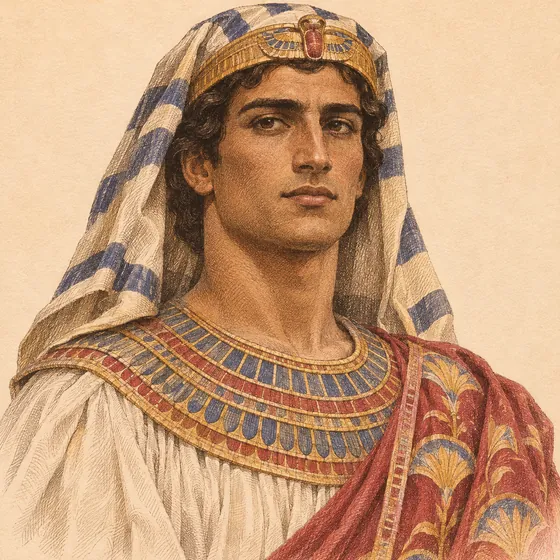
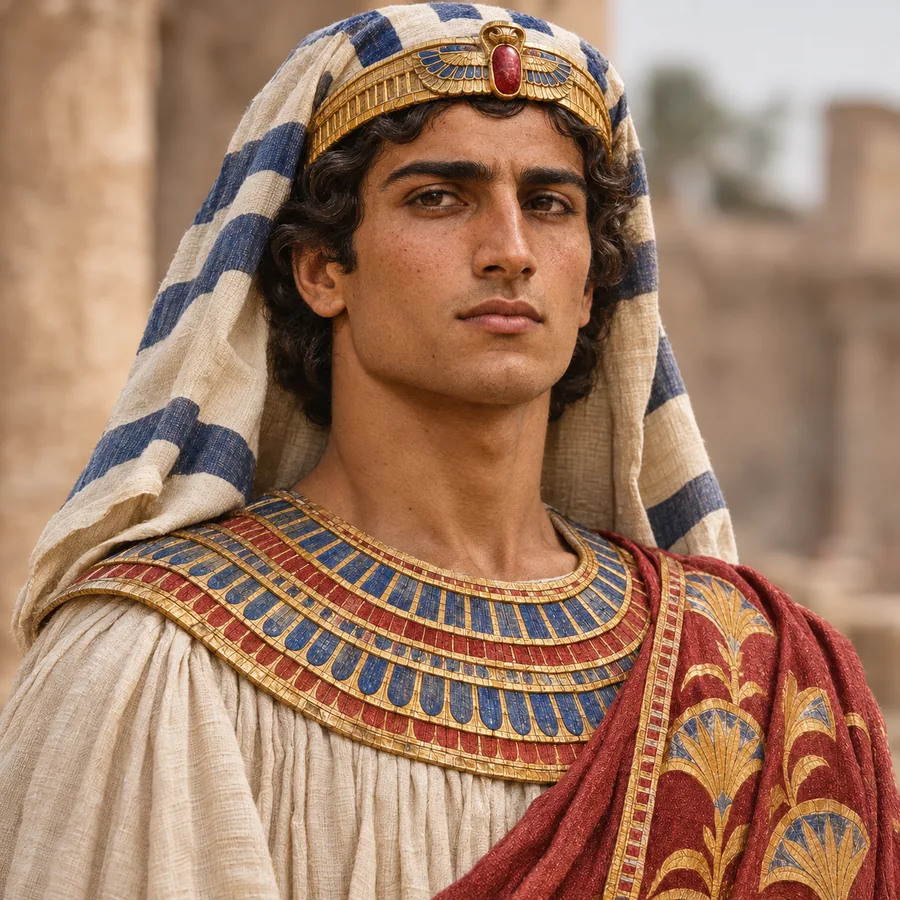

In Genesis 37–50, Jacob's favoured son, sold by his brothers; in Egypt he interprets Pharaoh's dreams, rises to power and saves his family from famine.
See Genesis 37:3, Genesis 37:28, Genesis 41:41, Genesis 45:5.
 An ornate robe marks Joseph in the reading view: the special robe his father made him (the Hebrew word is uncertain; “of many colours” is the King James rendering) (Genesis 37:3).
Mentioned in 199 verses across 19 books, first in Genesis 30:24. The verses below are the ones linked to this person (the Theographic dataset, with our sourced corrections).
How artists have pictured him
3 works from different centuries and traditions. Each shows how its time and place imagined Joseph, not how he looked.


In these stories
Questions about this
In the Bible
The first 10 of 199 verses, in Bible order. Text from the Berean Standard Bible; verse numbers follow the KJV.
Genesis
- Genesis 30:24
She named him Joseph, and said, “May the LORD add to me another son.”
- Genesis 30:25
Now after Rachel had given birth to Joseph, Jacob said to Laban, “Send me on my way so I can return to my homeland.
- Genesis 33:2
He put the maidservants and their children in front, Leah and her children next, and Rachel and Joseph at the rear.
- Genesis 33:7
Leah and her children also approached and bowed down, and then Joseph and Rachel approached and bowed down.
- Genesis 35:24
The sons of Rachel were Joseph and Benjamin.
- Genesis 37:2
This is the account of Jacob. When Joseph was seventeen years old, he was tending the flock with his brothers, the sons of his father’s wives Bilhah and Zilpah, and he brought their father a bad report about them.
- Genesis 37:3
Now Israel loved Joseph more than his other sons, because Joseph had been born to him in his old age; so he made him a robe of many colors.
- Genesis 37:5
Then Joseph had a dream, and when he told it to his brothers, they hated him even more.
- Genesis 37:13
Israel said to him, “Are not your brothers pasturing the flocks at Shechem? Get ready; I am sending you to them.” “I am ready,” Joseph replied.
- Genesis 37:17
“They have moved on from here,” the man answered. “I heard them say, ‘Let us go to Dothan.’” So Joseph set out after his brothers and found them at Dothan.
Events
Events the dataset lists Joseph (son of Jacob) as taking part in. Dates follow its Ussher–Jones reckoning (one of several traditional counts), not established history.
- c. 1745 BCBirth of Joseph
- c. 1745 BCLifetime of Joseph
- c. 1728 BCJoseph sold to Egypt
- c. 1718 BCJoseph imprisoned
- c. 1715 BCJoseph Promoted in Egypt
- c. 1715 BC7 years of plenty
- c. 1708 BC7 years of famine
- c. 1706 BCJoseph's brothers return to Egypt
- c. 1635 BCDeath of Joseph
Dictionary
From Easton’s Bible Dictionary (1897), as attached to this record by Theographic. The entry is for the name and can describe more than one person who bore it. Easton wrote in 1897, and some of his views are now debated.
Read Easton’s entry
The elder of the two sons of Jacob by Rachel (Gen. 30:23, 24), who, on the occasion of his birth, said, “God hath taken away [Heb. ‘asaph] my reproach.” “The Lord shall add [Heb. yoseph] to me another son” (Gen. 30:24). He was a child of probably six years of age when his father returned from Haran to Canaan and took up his residence in the old patriarchal town of Hebron. “Now Israel loved Joseph more than all his children, because he was the son of his old age,” and he “made him a long garment with sleeves” (Gen. 37:3, R.V. marg.), i.e., a garment long and full, such as was worn by the children of nobles. This seems to be the correct rendering of the words. The phrase, however, may also be rendered, “a coat of many pieces”, i.e., a patchwork of many small pieces of divers colours.
When he was about seventeen years old Joseph incurred the jealous hatred of his brothers (Gen. 37:4). They “hated him, and could not speak peaceably unto him.” Their anger was increased when he told them his dreams (37:11).
Jacob desiring to hear tidings of his sons, who had gone to Shechem with their flocks, some 60 miles from Hebron, sent Joseph as his messenger to make inquiry regarding them. Joseph found that they had left Shechem for Dothan, whither he followed them. As soon as they saw him coming they began to plot against him, and would have killed him had not Reuben interposed. They ultimately sold him to a company of Ishmaelite merchants for twenty pieces (shekels) of silver (about $2, 10s.), ten pieces less than the current value of a slave, for “they cared little what they had for him, if so be they were rid of him.” These merchants were going down with a varied assortment of merchandise to the Egyptian market, and thither they conveyed him, and ultimately sold him as a slave to Potiphar, an “officer of Pharaoh’s, and captain of the guard” (Gen. 37:36). “The Lord blessed the Egyptian’s house for Joseph’s sake,” and Potiphar made him overseer over his house. At length a false charge having been brought against him by Potiphar’s wife, he was at once cast into the state prison (39; 40), where he remained for at least two years. After a while the “chief of the cupbearers” and the “chief of the bakers” of Pharaoh’s household were cast into the same prison (40:2). Each of these new prisoners dreamed a dream in the same night, which Joseph interpreted, the event occurring as he had said.
This led to Joseph’s being remembered subsequently by the chief butler when Pharaoh also dreamed. At his suggestion Joseph was brought from prison to interpret the king’s dreams. Pharaoh was well pleased with Joseph’s wisdom in interpreting his dreams, and with his counsel with reference to the events then predicted; and he set him over all the land of Egypt (Gen. 41:46), and gave him the name of Zaphnath-paaneah. He was married to Asenath, the daughter of the priest of On, and thus became a member of the priestly class. Joseph was now about thirty years of age.
As Joseph had interpreted, seven years of plenty came, during which he stored up great abundance of corn in granaries built for the purpose. These years were followed by seven years of famine “over all the face of the earth,” when “all countries came into Egypt to Joseph to buy corn” (Gen. 41:56, 57; 47:13, 14). Thus “Joseph gathered up all the money that was in the land of Egypt, and in the land of Canaan, for the corn which they bought.” Afterwards all the cattle and all the land, and at last the Egyptians themselves, became the property of Pharaoh.
During this period of famine Joseph’s brethren also came down to Egypt to buy corn. The history of his dealings with them, and of the manner in which he at length made himself known to them, is one of the most interesting narratives that can be read ([Gen. 42](/gen#Gen.42)-45). Joseph directed his brethren to return and bring Jacob and his family to the land of Egypt, saying, “I will give you the good of the land of Egypt, and ye shall eat the fat of the land. Regard not your stuff; for the good of all the land is yours.” Accordingly Jacob and his family, to the number of threescore and ten souls, together with “all that they had,” went down to Egypt. They were settled in the land of Goshen, where Joseph met his father, and “fell on his neck, and wept on his neck a good while” (Gen. 46:29).
The excavations of Dr. Naville have shown the land of Goshen to be the Wady Tumilat, between Ismailia and Zagazig. In Goshen (Egyptian Qosem) they had pasture for their flocks, were near the Asiatic frontier of Egypt, and were out of the way of the Egyptian people. An inscription speaks of it as a district given up to the wandering shepherds of Asia.
Jacob at length died, and in fulfilment of a promise which he had exacted, Joseph went up to Canaan to bury his father in “the field of Ephron the Hittite” (Gen. 47:29-31; 50:1-14). This was the last recorded act of Joseph, who again returned to Egypt.
“The ‘Story of the Two Brothers,’ an Egyptian romance written for the son of the Pharaoh of the Oppression, contains an episode very similar to the Biblical account of Joseph’s treatment by Potiphar’s wife. Potiphar and Potipherah are the Egyptian Pa-tu-pa-Ra, ‘the gift of the sun-god.’ The name given to Joseph, Zaphnath-paaneah, is probably the Egyptian Zaf-nti-pa-ankh, ‘nourisher of the living one,’ i.e., of the Pharaoh. There are many instances in the inscriptions of foreigners in Egypt receiving Egyptian names, and rising to the highest offices of state.”
By his wife Asenath, Joseph had two sons, Manasseh and Ephraim (Gen. 41:50). Joseph having obtained a promise from his brethren that when the time should come that God would “bring them unto the land which he sware to Abraham, to Isaac, and to Jacob,” they would carry up his bones out of Egypt, at length died, at the age of one hundred and ten years; and “they embalmed him, and he was put in a coffin” (Gen. 50:26). This promise was faithfully observed. Their descendants, long after, when the Exodus came, carried the body about with them during their forty years’ wanderings, and at length buried it in Shechem, in the parcel of ground which Jacob bought from the sons of Hamor (Josh. 24:32; comp. Gen. 33:19). With the death of Joseph the patriarchal age of the history of Israel came to a close.
The Pharaoh of Joseph’s elevation was probably Apepi, or Apopis, the last of the Hyksos kings. Some, however, think that Joseph came to Egypt in the reign of Thothmes III. (see PHARAOH), long after the expulsion of the Hyksos.
The name Joseph denotes the two tribes of Ephraim and Manasseh in Deut. 33:13-17; the kingdom of Israel in Ezek. 37:16, 19, Amos 5:6; and the whole covenant people of Israel in Ps. 81:4.