Person · one of several with this name
Joshua
Also called Jehoshua, Oshea, Jesus, Jeshua, Hoshea
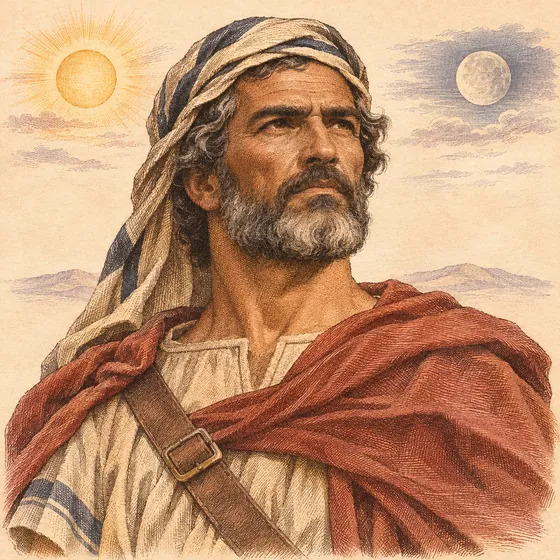
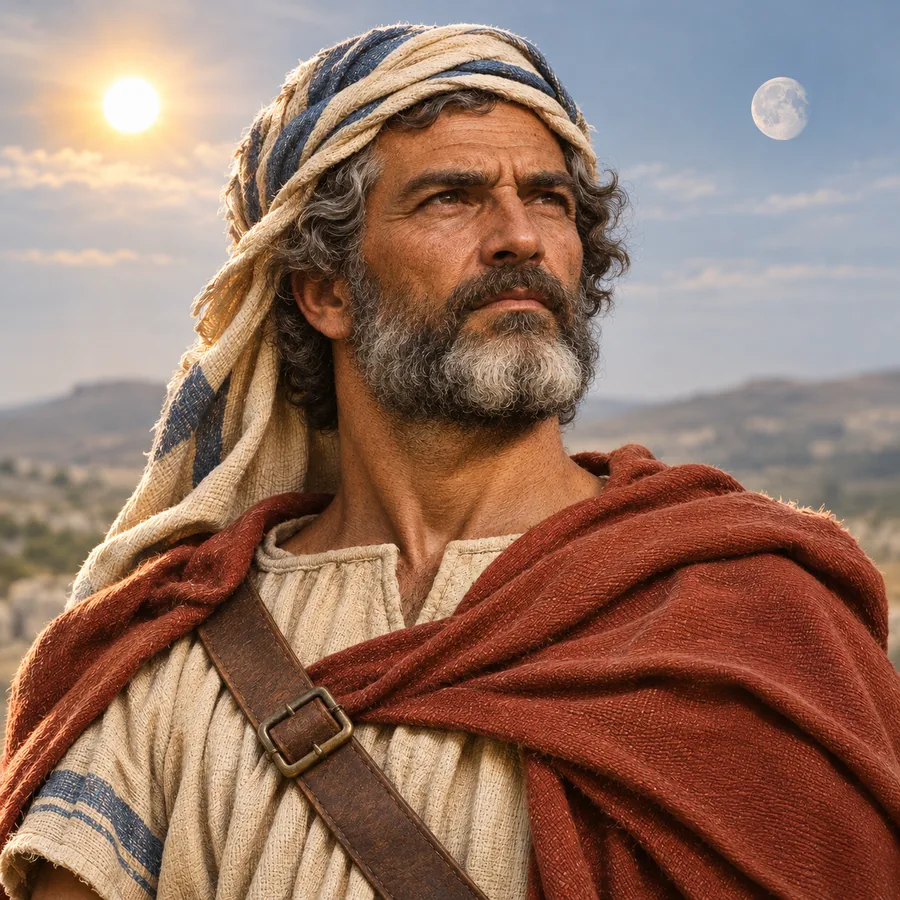

Moses's assistant and successor, who in the book of Joshua leads Israel across the Jordan and in the conquest of Canaan.
See Exodus 33:11, Deuteronomy 34:9, Joshua 1:2.
 The sun and moon standing still marks Joshua in the reading view: “Sun, stand thou still upon Gibeon; and thou, Moon, in the valley of Ajalon” (Joshua 10:12, Joshua 10:13).
Mentioned in 189 verses across 9 books, first in Exodus 17:9. The verses below are the ones linked to this person (the Theographic dataset, with our sourced corrections).
How artists have pictured him
3 works from different centuries and traditions. Each shows how its time and place imagined Joshua, not how he looked.


In these stories
Questions about this
In the Bible
The first 10 of 189 verses, in Bible order. Text from the Berean Standard Bible; verse numbers follow the KJV.
Exodus
- Exodus 17:9
So Moses said to Joshua, “Choose some of our men and go out to fight the Amalekites. Tomorrow I will stand on the hilltop with the staff of God in my hand.”
- Exodus 17:10
Joshua did as Moses had instructed him and fought against the Amalekites, while Moses, Aaron, and Hur went up to the top of the hill.
- Exodus 17:13
So Joshua overwhelmed Amalek and his army with the sword.
- Exodus 17:14
Then the LORD said to Moses, “Write this on a scroll as a reminder and recite it to Joshua, because I will utterly blot out the memory of Amalek from under heaven.”
- Exodus 24:13
So Moses set out with Joshua his attendant and went up on the mountain of God.
- Exodus 32:17
When Joshua heard the sound of the people shouting, he said to Moses, “The sound of war is in the camp.”
- Exodus 33:11
Thus the LORD would speak to Moses face to face, as a man speaks to his friend. Then Moses would return to the camp, but his young assistant Joshua son of Nun would not leave the tent.
Numbers
- Numbers 11:28
Joshua son of Nun, the attendant to Moses since youth, spoke up and said, “Moses, my lord, stop them!”
- Numbers 13:8
from the tribe of Ephraim, Hoshea son of Nun;
- Numbers 13:16
These were the names of the men Moses sent to spy out the land; and Moses gave to Hoshea son of Nun the name Joshua.
Events
Events the dataset lists Joshua as taking part in. Dates follow its Ussher–Jones reckoning (one of several traditional counts), not established history.
- c. 1521 BCLifetime of Joshua
- c. 1451 BCCrossing the Jordan into Canaan
- c. 1451 BCWar with Canaanites
- c. 1445 BCDividing the land
- c. 1424 BCDeath of Joshua
Dictionary
From Easton’s Bible Dictionary (1897), as attached to this record by Theographic. The entry is for the name and can describe more than one person who bore it. Easton wrote in 1897, and some of his views are now debated.
Read Easton’s entry
Jehovah is his help, or Jehovah the Saviour. The son of Nun, of the tribe of Ephraim, the successor of Moses as the leader of Israel. He is called Jehoshua in Num. 13:16 (A.V.), and Jesus in Acts 7:45 and Heb. 4:8 (R.V., Joshua).
He was born in Egypt, and was probably of the age of Caleb, with whom he is generally associated. He shared in all the events of the Exodus, and held the place of commander of the host of the Israelites at their great battle against the Amalekites in Rephidim (Ex. 17:8-16). He became Moses’ minister or servant, and accompanied him part of the way when he ascended Mount Sinai to receive the two tables (Ex. 32:17). He was also one of the twelve who were sent on by Moses to explore the land of Canaan (Num. 13:16, 17), and only he and Caleb gave an encouraging report. Under the direction of God, Moses, before his death, invested Joshua in a public and solemn manner with authority over the people as his successor (Deut. 31:23). The people were encamped at Shittim when he assumed the command (Josh. 1:1); and crossing the Jordan, they encamped at Gilgal, where, having circumcised the people, he kept the Passover, and was visited by the Captain of the Lord’s host, who spoke to him encouraging words (1:1-9).
Now began the wars of conquest which Joshua carried on for many years, the record of which is in the book which bears his name. Six nations and thirty-one kings were conquered by him (Josh. 11:18-23; 12:24). Having thus subdued the Canaanites, Joshua divided the land among the tribes, Timnath-serah in Mount Ephraim being assigned to himself as his own inheritance.
His work being done, he died, at the age of one hundred and ten years, twenty-five years after having crossed the Jordan. He was buried in his own city of Timnath-serah ([Josh. 24](/josh#Josh.24)); and “the light of Israel for the time faded away.”
Joshua has been regarded as a type of Christ (Heb. 4:8) in the following particulars: (1) In the name common to both; (2) Joshua brings the people into the possession of the Promised Land, as Jesus brings his people to the heavenly Canaan; and (3) as Joshua succeeded Moses, so the Gospel succeeds the Law.
The character of Joshua is thus well sketched by Edersheim:, “Born a slave in Egypt, he must have been about forty years old at the time of the Exodus. Attached to the person of Moses, he led Israel in the first decisive battle against Amalek (Ex. 17:9, 13), while Moses in the prayer of faith held up to heaven the God-given ‘rod.’ It was no doubt on that occasion that his name was changed from Oshea, ‘help,’ to Jehoshua, ‘Jehovah is help’ (Num. 13:16). And this name is the key to his life and work. Alike in bringing the people into Canaan, in his wars, and in the distribution of the land among the tribes, from the miraculous crossing of Jordan and taking of Jericho to his last address, he was the embodiment of his new name, ‘Jehovah is help.’ To this outward calling his character also corresponded. It is marked by singleness of purpose, directness, and decision...He sets an object before him, and unswervingly follows it” (Bible Hist., iii. 103)