Person
David
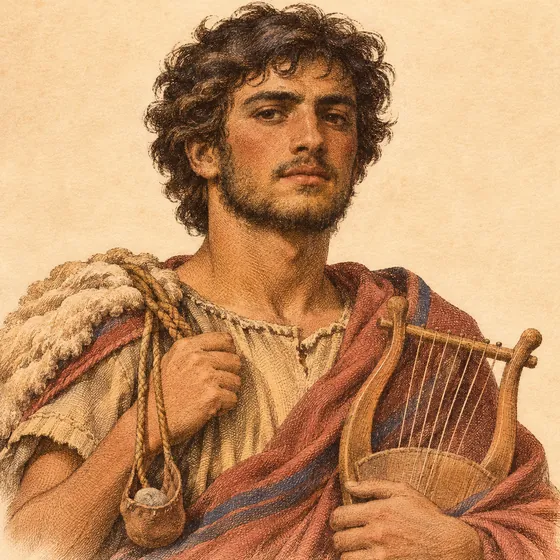
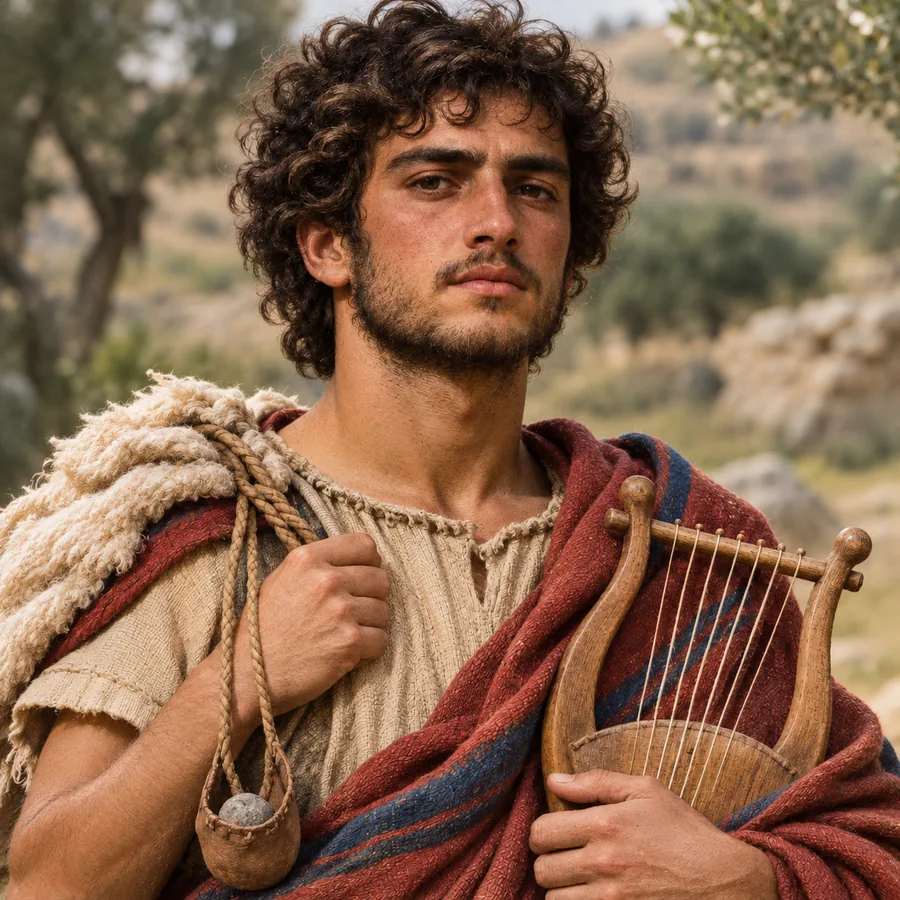

In 1 Samuel to 1 Kings, a shepherd who kills Goliath and becomes Israel's second king; he is called “the sweet psalmist of Israel”.
See 1 Samuel 17:50, 2 Samuel 5:3, 2 Samuel 23:1.
 A lyre and a sling marks David in the reading view: he played the lyre for Saul, and slung the stone at Goliath (1 Samuel 16:23, 1 Samuel 17:49).
Mentioned in 896 verses across 28 books, first in 2 Samuel 1:1. The verses below are the ones linked to this person (the Theographic dataset, with our sourced corrections).
How artists have pictured him
3 works from different centuries and traditions. Each shows how its time and place imagined David, not how he looked.


In these stories
Questions about this
In the Bible
All 226 verses in 2 Samuel, in Bible order. Text from the Berean Standard Bible; verse numbers follow the KJV.
2 Samuel
- 2 Samuel 1:1
After the death of Saul, David returned from the slaughter of the Amalekites and stayed in Ziklag two days.
- 2 Samuel 1:2
On the third day a man with torn clothes and dust on his head arrived from Saul’s camp. When he came to David, he fell to the ground to pay him homage.
- 2 Samuel 1:3
“Where have you come from?” David asked. “I have escaped from the Israelite camp,” he replied.
- 2 Samuel 1:4
“What was the outcome?” David asked. “Please tell me.” “The troops fled from the battle,” he replied. “Many of them fell and died. And Saul and his son Jonathan are also dead.”
- 2 Samuel 1:5
Then David asked the young man who had brought him the report, “How do you know that Saul and his son Jonathan are dead?”
- 2 Samuel 1:11
Then David took hold of his own clothes and tore them, and all the men who were with him did the same.
- 2 Samuel 1:13
And David inquired of the young man who had brought him the report, “Where are you from?” “I am the son of a foreigner,” he answered. “I am an Amalekite.”
- 2 Samuel 1:14
So David asked him, “Why were you not afraid to lift your hand to destroy the LORD’s anointed?”
- 2 Samuel 1:15
Then David summoned one of the young men and said, “Go, execute him!” So the young man struck him down, and he died.
- 2 Samuel 1:16
For David had said to the Amalekite, “Your blood be on your own head because your own mouth has testified against you, saying, ‘I killed the LORD’s anointed.’”
- 2 Samuel 1:17
Then David took up this lament for Saul and his son Jonathan,
- 2 Samuel 2:1
Some time later, David inquired of the LORD, “Should I go up to one of the towns of Judah?” “Go up,” the LORD answered. Then David asked, “Where should I go?” “To Hebron,” replied the LORD.
- 2 Samuel 2:2
So David went there with his two wives, Ahinoam of Jezreel and Abigail the widow of Nabal of Carmel.
- 2 Samuel 2:3
David also took the men who were with him, each with his household, and they settled in the towns near Hebron.
- 2 Samuel 2:4
Then the men of Judah came to Hebron, and there they anointed David king over the house of Judah. And they told David, “It was the men of Jabesh-gilead who buried Saul.”
- 2 Samuel 2:5
So David sent messengers to the men of Jabesh-gilead to tell them, “The LORD bless you, because you showed this kindness to Saul your lord when you buried him.
- 2 Samuel 2:10
Saul’s son Ish-bosheth was forty years old when he began to reign over Israel, and he reigned for two years. The house of Judah, however, followed David.
- 2 Samuel 2:11
And the length of time that David was king in Hebron over the house of Judah was seven years and six months.
- 2 Samuel 2:13
So Joab son of Zeruiah, along with the servants of David, marched out and met them by the pool of Gibeon. And the two camps took up positions on opposite sides of the pool.
- 2 Samuel 2:15
So they got up and were counted off—twelve for Benjamin and Ish-bosheth son of Saul, and twelve for David.
- 2 Samuel 2:17
The battle that day was intense, and Abner and the men of Israel were defeated by the servants of David.
- 2 Samuel 2:30
When Joab returned from pursuing Abner, he gathered all the troops. In addition to Asahel, nineteen of David’s servants were missing,
- 2 Samuel 2:31
but they had struck down 360 Benjamites who were with Abner.
- 2 Samuel 3:1
Now the war between the house of Saul and the house of David was protracted. And David grew stronger and stronger, while the house of Saul grew weaker and weaker.
- 2 Samuel 3:2
And sons were born to David in Hebron: His firstborn was Amnon, by Ahinoam of Jezreel;
- 2 Samuel 3:5
and his sixth was Ithream, by David’s wife Eglah. These sons were born to David in Hebron.
- 2 Samuel 3:6
During the war between the house of Saul and the house of David, Abner had continued to strengthen his position in the house of Saul.
- 2 Samuel 3:8
Abner was furious over Ish-bosheth’s accusation. “Am I the head of a dog that belongs to Judah?” he asked. “All this time I have been loyal to the house of your father Saul, to his brothers, and to his friends. I have not delivered you into the hand of David, but now you accuse me of wrongdoing with this woman!
- 2 Samuel 3:9
May God punish Abner, and ever so severely, if I do not do for David what the LORD has sworn to him:
- 2 Samuel 3:10
to transfer the kingdom from the house of Saul and to establish the throne of David over Israel and Judah, from Dan to Beersheba.”
- 2 Samuel 3:12
Then Abner sent messengers in his place to say to David, “To whom does the land belong? Make your covenant with me, and surely my hand will be with you to bring all Israel over to you.”
- 2 Samuel 3:14
Then David sent messengers to say to Ish-bosheth son of Saul, “Give me back my wife, Michal, whom I betrothed to myself for a hundred Philistine foreskins.”
- 2 Samuel 3:17
Now Abner conferred with the elders of Israel and said, “In the past you sought David as your king.
- 2 Samuel 3:18
Now take action, because the LORD has said to David, ‘Through My servant David I will save My people Israel from the hands of the Philistines and of all their enemies.’”
- 2 Samuel 3:19
Abner also spoke to the Benjamites and went to Hebron to tell David all that seemed good to Israel and to the whole house of Benjamin.
- 2 Samuel 3:20
When Abner and twenty of his men came to David at Hebron, David held a feast for them.
- 2 Samuel 3:21
Then Abner said to David, “Let me go at once, and I will gather all Israel to my lord the king, that they may make a covenant with you, and that you may rule over all that your heart desires.” So David dismissed Abner, and he went in peace.
- 2 Samuel 3:22
Just then David’s soldiers and Joab returned from a raid, bringing with them a great plunder. But Abner was not with David in Hebron because David had sent him on his way in peace.
- 2 Samuel 3:26
As soon as Joab had left David, he sent messengers after Abner, who brought him back from the well of Sirah; but David was unaware of it.
- 2 Samuel 3:28
Afterward, David heard about this and said, “I and my kingdom are forever guiltless before the LORD concerning the blood of Abner son of Ner.
- 2 Samuel 3:31
Then David ordered Joab and all the people with him, “Tear your clothes, put on sackcloth, and mourn before Abner.” And King David himself walked behind the funeral bier.
- 2 Samuel 3:35
Then all the people came and urged David to eat something while it was still day, but David took an oath, saying, “May God punish me, and ever so severely, if I taste bread or anything else before the sun sets!”
- 2 Samuel 4:8
They brought the head of Ish-bosheth to David at Hebron and said to the king, “Here is the head of Ish-bosheth son of Saul, your enemy who sought your life. Today the LORD has granted vengeance to my lord the king against Saul and his offspring.”
- 2 Samuel 4:9
But David answered Rechab and his brother Baanah, the sons of Rimmon the Beerothite, “As surely as the LORD lives, who has redeemed my life from all distress,
- 2 Samuel 4:12
So David commanded his young men, and they killed Rechab and Baanah. They cut off their hands and feet and hung their bodies by the pool in Hebron, but they took the head of Ish-bosheth and buried it in Abner’s tomb in Hebron.
- 2 Samuel 5:1
Then all the tribes of Israel came to David at Hebron and said, “Here we are, your own flesh and blood.
- 2 Samuel 5:3
So all the elders of Israel came to the king at Hebron, where King David made with them a covenant before the LORD. And they anointed him king over Israel.
- 2 Samuel 5:4
David was thirty years old when he became king, and he reigned forty years.
- 2 Samuel 5:6
Now the king and his men marched to Jerusalem against the Jebusites who inhabited the land. The Jebusites said to David: “You will never get in here. Even the blind and lame can repel you.” For they thought, “David cannot get in here.”
- 2 Samuel 5:7
Nevertheless, David captured the fortress of Zion (that is, the City of David).
- 2 Samuel 5:8
On that day he said, “Whoever attacks the Jebusites must use the water shaft to reach the lame and blind who are despised by David.” That is why it is said, “The blind and the lame will never enter the palace.”
- 2 Samuel 5:9
So David took up residence in the fortress and called it the City of David. He built it up all the way around, from the supporting terraces inward.
- 2 Samuel 5:10
And David became greater and greater, for the LORD God of Hosts was with him.
- 2 Samuel 5:11
Now Hiram king of Tyre sent envoys to David, along with cedar logs, carpenters, and stonemasons, and they built a palace for David.
- 2 Samuel 5:12
And David realized that the LORD had established him as king over Israel and had exalted his kingdom for the sake of His people Israel.
- 2 Samuel 5:13
After he had arrived from Hebron, David took more concubines and wives from Jerusalem, and more sons and daughters were born to him.
- 2 Samuel 5:17
When the Philistines heard that David had been anointed king over Israel, they all went in search of him; but David learned of this and went down to the stronghold.
- 2 Samuel 5:19
So David inquired of the LORD, “Should I go up against the Philistines? Will You deliver them into my hand?” “Go,” replied the LORD, “for I will surely deliver the Philistines into your hand.”
- 2 Samuel 5:20
So David went to Baal-perazim, where he defeated the Philistines and said, “Like a bursting flood, the LORD has burst out against my enemies before me.” So he called that place Baal-perazim.
- 2 Samuel 5:21
There the Philistines abandoned their idols, and David and his men carried them away.
- 2 Samuel 5:23
So David inquired of the LORD, who answered, “Do not march straight up, but circle around behind them and attack them in front of the balsam trees.
- 2 Samuel 5:25
So David did as the LORD had commanded him, and he struck down the Philistines all the way from Gibeon to Gezer.
- 2 Samuel 6:1
David again assembled the chosen men of Israel, thirty thousand in all.
- 2 Samuel 6:2
And he and all his troops set out for Baale of Judah to bring up from there the ark of God, which is called by the Name— the name of the LORD of Hosts, who is enthroned between the cherubim that are on it.
- 2 Samuel 6:5
David and all the house of Israel were celebrating before the LORD with all kinds of wood instruments, harps, stringed instruments, tambourines, sistrums, and cymbals.
- 2 Samuel 6:8
Then David became angry because the LORD had burst forth against Uzzah; so he named that place Perez-uzzah, as it is called to this day.
- 2 Samuel 6:9
That day David feared the LORD and asked, “How can the ark of the LORD ever come to me?”
- 2 Samuel 6:10
So he was unwilling to move the ark of the LORD to the City of David; instead, he took it aside to the house of Obed-edom the Gittite.
- 2 Samuel 6:12
Now it was reported to King David, “The LORD has blessed the house of Obed-edom and all that belongs to him, because of the ark of God.” So David went and had the ark of God brought up from the house of Obed-edom into the City of David with rejoicing.
- 2 Samuel 6:14
And David, wearing a linen ephod, danced with all his might before the LORD,
- 2 Samuel 6:15
while he and all the house of Israel brought up the ark of the LORD with shouting and the sounding of the ram’s horn.
- 2 Samuel 6:16
As the ark of the LORD was entering the City of David, Saul’s daughter Michal looked down from a window and saw King David leaping and dancing before the LORD, and she despised him in her heart.
- 2 Samuel 6:17
So they brought the ark of the LORD and set it in its place inside the tent that David had pitched for it. Then David offered burnt offerings and peace offerings before the LORD.
- 2 Samuel 6:18
When David had finished sacrificing the burnt offerings and peace offerings, he blessed the people in the name of the LORD of Hosts.
- 2 Samuel 6:20
As soon as David returned home to bless his own household, Saul’s daughter Michal came out to meet him. “How the king of Israel has distinguished himself today!” she said. “He has uncovered himself today in the sight of the maidservants of his subjects, like a vulgar person would do.”
- 2 Samuel 6:21
But David said to Michal, “I was dancing before the LORD, who chose me over your father and all his house when He appointed me ruler over the LORD’s people Israel. I will celebrate before the LORD,
- 2 Samuel 7:5
“Go and tell My servant David that this is what the LORD says: Are you the one to build for Me a house to dwell in?
- 2 Samuel 7:8
Now then, you are to tell My servant David that this is what the LORD of Hosts says: I took you from the pasture, from following the flock, to be the ruler over My people Israel.
- 2 Samuel 7:17
So Nathan relayed to David all the words of this entire vision.
- 2 Samuel 7:18
Then King David went in, sat before the LORD, and said, “Who am I, O Lord GOD, and what is my house, that You have brought me this far?
- 2 Samuel 7:20
What more can David say to You? For You know Your servant, O Lord GOD.
- 2 Samuel 7:26
so that Your name will be magnified forever when it is said, ‘The LORD of Hosts is God over Israel.’ And the house of Your servant David will be established before You.
- 2 Samuel 8:1
Some time later, David defeated the Philistines, subdued them, and took Metheg-ammah from the hand of the Philistines.
- 2 Samuel 8:2
David also defeated the Moabites, made them lie down on the ground, and measured them off with a cord. He measured off with two lengths those to be put to death, and with one length those to be spared. So the Moabites became subject to David and brought him tribute.
- 2 Samuel 8:3
David also defeated Hadadezer son of Rehob, king of Zobah, who had marched out to restore his dominion along the Euphrates River.
- 2 Samuel 8:4
David captured from him a thousand chariots, seven thousand charioteers, and twenty thousand foot soldiers, and he hamstrung all the horses except a hundred he kept for the chariots.
- 2 Samuel 8:5
When the Arameans of Damascus came to help King Hadadezer of Zobah, David struck down twenty-two thousand men.
- 2 Samuel 8:6
Then he placed garrisons in Aram of Damascus, and the Arameans became subject to David and brought him tribute. So the LORD made David victorious wherever he went.
- 2 Samuel 8:7
And David took the gold shields that belonged to the officers of Hadadezer and brought them to Jerusalem.
- 2 Samuel 8:8
And from Betah and Berothai, cities of Hadadezer, King David took a large amount of bronze.
- 2 Samuel 8:9
When King Toi of Hamath heard that David had defeated the entire army of Hadadezer,
- 2 Samuel 8:10
he sent his son Joram to greet King David and bless him for fighting and defeating Hadadezer, who had been at war with Toi. Joram brought with him articles of silver and gold and bronze,
- 2 Samuel 8:11
and King David dedicated these to the LORD, along with the silver and gold he had dedicated from all the nations he had subdued—
- 2 Samuel 8:13
And David made a name for himself when he returned from striking down eighteen thousand Edomites in the Valley of Salt.
- 2 Samuel 8:14
He placed garrisons throughout Edom, and all the Edomites were subject to David. So the LORD made David victorious wherever he went.
- 2 Samuel 8:15
Thus David reigned over all Israel and administered justice and righteousness for all his people:
- 2 Samuel 8:18
Benaiah son of Jehoiada was over the Cherethites and Pelethites; and David’s sons were priestly leaders.
- 2 Samuel 9:1
Then David asked, “Is there anyone left from the house of Saul to whom I can show kindness for the sake of Jonathan?”
- 2 Samuel 9:2
And there was a servant of Saul’s family named Ziba. They summoned him to David, and the king inquired, “Are you Ziba?” “I am your servant,” he replied.
- 2 Samuel 9:5
So King David had him brought from the house of Machir son of Ammiel in Lo-debar.
- 2 Samuel 9:6
And when Mephibosheth son of Jonathan, the son of Saul, came to David, he fell facedown in reverence. Then David said, “Mephibosheth!” “I am your servant,” he replied.
- 2 Samuel 9:7
“Do not be afraid,” said David, “for surely I will show you kindness for the sake of your father Jonathan. I will restore to you all the land of your grandfather Saul, and you will always eat at my table.”
- 2 Samuel 10:2
And David said, “I will show kindness to Hanun son of Nahash, just as his father showed kindness to me.” So David sent some of his servants to console Hanun concerning his father. But when they arrived in the land of the Ammonites,
- 2 Samuel 10:3
the princes of the Ammonites said to Hanun their lord, “Just because David has sent you comforters, do you really believe he is showing respect for your father? Has not David instead sent his servants to explore the city, spy it out, and overthrow it?”
- 2 Samuel 10:4
So Hanun took David’s servants, shaved off half of each man’s beard, cut off their garments at the hips, and sent them away.
- 2 Samuel 10:5
When this was reported to David, he sent messengers to meet the men, since they had been thoroughly humiliated. The king told them, “Stay in Jericho until your beards have grown back, and then return.”
- 2 Samuel 10:6
When the Ammonites realized that they had become a stench to David, they hired twenty thousand Aramean foot soldiers from Beth-rehob and Zoba, as well as a thousand men from the king of Maacah and twelve thousand men from Tob.
- 2 Samuel 10:7
On hearing this, David sent Joab and the entire army of mighty men.
- 2 Samuel 10:17
When this was reported to David, he gathered all Israel, crossed the Jordan, and went to Helam. Then the Arameans arrayed themselves against David and fought against him.
- 2 Samuel 10:18
But the Arameans fled before Israel, and David killed seven hundred charioteers and forty thousand foot soldiers. He also struck down Shobach the commander of their army, who died there.
- 2 Samuel 11:1
In the spring, at the time when kings march out to war, David sent out Joab and his servants with the whole army of Israel. They destroyed the Ammonites and besieged Rabbah, but David remained in Jerusalem.
- 2 Samuel 11:2
One evening David got up from his bed and strolled around on the roof of the palace. And from the roof he saw a woman bathing—a very beautiful woman.
- 2 Samuel 11:3
So David sent and inquired about the woman, and he was told, “This is Bathsheba, the daughter of Eliam and the wife of Uriah the Hittite.”
- 2 Samuel 11:4
Then David sent messengers to get her, and when she came to him, he slept with her. (Now she had just purified herself from her uncleanness.) Then she returned home.
- 2 Samuel 11:5
And the woman conceived and sent word to David, saying, “I am pregnant.”
- 2 Samuel 11:6
At this, David sent orders to Joab: “Send me Uriah the Hittite.” So Joab sent him to David.
- 2 Samuel 11:7
When Uriah came to him, David asked how Joab and the troops were doing with the war.
- 2 Samuel 11:8
Then he said to Uriah, “Go down to your house and wash your feet.” So Uriah left the palace, and a gift from the king followed him.
- 2 Samuel 11:10
And David was told, “Uriah did not go home.” “Haven’t you just arrived from a journey?” David asked Uriah. “Why didn’t you go home?”
- 2 Samuel 11:11
Uriah answered, “The ark and Israel and Judah are dwelling in tents, and my master Joab and his soldiers are camped in the open field. How can I go to my house to eat and drink and sleep with my wife? As surely as you live, and as your soul lives, I will not do such a thing!”
- 2 Samuel 11:12
“Stay here one more day,” David said to Uriah, “and tomorrow I will send you back.” So Uriah stayed in Jerusalem that day and the next.
- 2 Samuel 11:13
Then David invited Uriah to eat and drink with him, and he got Uriah drunk. And in the evening Uriah went out to lie down on his cot with his master’s servants, but he did not go home.
- 2 Samuel 11:14
The next morning David wrote a letter to Joab and sent it with Uriah.
- 2 Samuel 11:17
And when the men of the city came out and fought against Joab, some of David’s servants fell, and Uriah the Hittite also died.
- 2 Samuel 11:18
Joab sent to David a full account of the battle
- 2 Samuel 11:22
So the messenger set out and reported to David all that Joab had sent him to say.
- 2 Samuel 11:23
The messenger said to David, “The men overpowered us and came out against us in the field, but we drove them back to the entrance of the gate.
- 2 Samuel 11:25
Then David told the messenger, “Say this to Joab: ‘Do not let this matter upset you, for the sword devours one as well as another. Strengthen your attack against the city and demolish it.’ Encourage him with these words.”
- 2 Samuel 11:27
And when the time of mourning was over, David had her brought to his house, and she became his wife and bore him a son. But the thing that David had done was evil in the sight of the LORD.
- 2 Samuel 12:1
Then the LORD sent Nathan to David, and when he arrived, he said, “There were two men in a certain city, one rich and the other poor.
- 2 Samuel 12:5
David burned with anger against the man and said to Nathan: “As surely as the LORD lives, the man who did this deserves to die!
- 2 Samuel 12:7
Then Nathan said to David, “You are that man! This is what the LORD, the God of Israel, says: ‘I anointed you king over Israel, and I delivered you from the hand of Saul.
- 2 Samuel 12:13
Then David said to Nathan, “I have sinned against the LORD.” “The LORD has taken away your sin,” Nathan replied. “You will not die.
- 2 Samuel 12:15
After Nathan had gone home, the LORD struck the child that Uriah’s wife had borne to David, and he became ill.
- 2 Samuel 12:16
David pleaded with God for the boy. He fasted and went into his house and spent the night lying in sackcloth on the ground.
- 2 Samuel 12:18
On the seventh day the child died. But David’s servants were afraid to tell him that the child was dead, for they said, “Look, while the child was alive, we spoke to him, and he would not listen to us. So how can we tell him the child is dead? He may even harm himself.”
- 2 Samuel 12:19
When David saw that his servants were whispering to one another, he perceived that the child was dead. So he asked his servants, “Is the child dead?” “He is dead,” they replied.
- 2 Samuel 12:20
Then David got up from the ground, washed and anointed himself, changed his clothes, and went into the house of the LORD and worshiped. Then he went to his own house, and at his request they set food before him, and he ate.
- 2 Samuel 12:24
Then David comforted his wife Bathsheba, and he went to her and lay with her. So she gave birth to a son, and they named him Solomon. Now the LORD loved the child
- 2 Samuel 12:27
Then Joab sent messengers to David to say, “I have fought against Rabbah and have captured the water supply of the city.
- 2 Samuel 12:29
So David assembled all the troops and went to Rabbah; and he fought against it and captured it.
- 2 Samuel 12:30
Then he took the crown from the head of their king. It weighed a talent of gold and was set with precious stones, and it was placed on David’s head. And David took a great amount of plunder from the city.
- 2 Samuel 12:31
David brought out the people who were there and put them to work with saws, iron picks, and axes, and he made them work at the brick kilns. He did the same to all the Ammonite cities. Then David and all his troops returned to Jerusalem.
- 2 Samuel 13:1
After some time, David’s son Amnon fell in love with Tamar, the beautiful sister of David’s son Absalom.
- 2 Samuel 13:3
Now Amnon had a friend named Jonadab, the son of David’s brother Shimeah. Jonadab was a very shrewd man,
- 2 Samuel 13:7
Then David sent word to Tamar at the palace: “Please go to the house of Amnon your brother and prepare a meal for him.”
- 2 Samuel 13:21
When King David heard all this, he was furious.
- 2 Samuel 13:30
While they were on the way, a report reached David: “Absalom has struck down all the sons of the king; not one of them is left!”
- 2 Samuel 13:32
But Jonadab, the son of David’s brother Shimeah, spoke up: “My lord must not think they have killed all the sons of the king, for only Amnon is dead. In fact, Absalom has planned this since the day Amnon violated his sister Tamar.
- 2 Samuel 13:37
Now Absalom fled and went to Talmai son of Ammihud, the king of Geshur. But David mourned for his son every day.
- 2 Samuel 13:39
And King David longed to go to Absalom, for he had been consoled over Amnon’s death.
- 2 Samuel 15:12
While Absalom was offering the sacrifices, he sent for Ahithophel the Gilonite, David’s counselor, to come from his hometown of Giloh. So the conspiracy gained strength, and Absalom’s following kept increasing.
- 2 Samuel 15:13
Then a messenger came to David and reported, “The hearts of the men of Israel are with Absalom.”
- 2 Samuel 15:14
And David said to all the servants with him in Jerusalem, “Arise and let us flee, or we will not escape from Absalom! We must leave quickly, or he will soon overtake us, heap disaster on us, and put the city to the sword.”
- 2 Samuel 15:22
“March on then,” said David to Ittai. So Ittai the Gittite marched past with all his men and all the little ones who were with him.
- 2 Samuel 15:30
But David continued up the Mount of Olives, weeping as he went up. His head was covered, and he was walking barefoot. And all the people with him covered their heads and went up, weeping as they went.
- 2 Samuel 15:31
Now someone told David: “Ahithophel is among the conspirators with Absalom.” So David pleaded, “O LORD, please turn the counsel of Ahithophel into foolishness!”
- 2 Samuel 15:32
When David came to the summit, where he used to worship God, Hushai the Archite was there to meet him with his robe torn and dust on his head.
- 2 Samuel 15:33
David said to him, “If you go on with me, you will be a burden to me.
- 2 Samuel 15:37
So David’s friend Hushai arrived in Jerusalem just as Absalom was entering the city.
- 2 Samuel 16:1
When David had gone a little beyond the summit, Ziba the servant of Mephibosheth was there to meet him. He had a pair of saddled donkeys loaded with two hundred loaves of bread, a hundred clusters of raisins, a hundred summer fruits, and a skin of wine.
- 2 Samuel 16:5
As King David approached Bahurim, a man from the family of the house of Saul was just coming out. His name was Shimei son of Gera, and as he approached, he kept yelling out curses.
- 2 Samuel 16:6
He threw stones at David and at all the servants of the king, though the troops and all the mighty men were on David’s right and left.
- 2 Samuel 16:10
But the king replied, “What have I to do with you, O sons of Zeruiah? If he curses me because the LORD told him, ‘Curse David,’ who can ask, ‘Why did you do this?’”
- 2 Samuel 16:11
Then David said to Abishai and to all his servants, “Behold, my own son, my own flesh and blood, seeks my life. How much more, then, this Benjamite! Leave him alone and let him curse me, for the LORD has told him so.
- 2 Samuel 16:13
So David and his men proceeded along the road as Shimei went along the ridge of the hill opposite him. As Shimei went, he yelled curses, threw stones, and flung dust at David.
- 2 Samuel 16:16
And David’s friend Hushai the Archite went to Absalom and said to him, “Long live the king! Long live the king!”
- 2 Samuel 16:23
Now in those days the advice of Ahithophel was like the consultation of the word of God. Such was the regard that both David and Absalom had for Ahithophel’s advice.
- 2 Samuel 17:1
Furthermore, Ahithophel said to Absalom, “Let me choose twelve thousand men and set out tonight in pursuit of David.
- 2 Samuel 17:16
Now send quickly and tell David, ‘Do not spend the night at the fords of the wilderness, but be sure to cross over. Otherwise the king and all the people with him will be swallowed up.’”
- 2 Samuel 17:17
Now Jonathan and Ahimaaz were staying at En-rogel, where a servant girl would come and pass along information to them. They in turn would go and inform King David, for they dared not be seen entering the city.
- 2 Samuel 17:21
After the men had gone, Ahimaaz and Jonathan climbed up out of the well and went to inform King David, saying, “Get up and cross over the river at once, for Ahithophel has given this advice against you.”
- 2 Samuel 17:22
So David and all the people with him got up and crossed the Jordan. By daybreak, there was no one left who had not crossed the Jordan.
- 2 Samuel 17:24
Then David went to Mahanaim, and Absalom crossed the Jordan with all the men of Israel.
- 2 Samuel 17:27
When David came to Mahanaim, he was met by Shobi son of Nahash from Rabbah of the Ammonites, Machir son of Ammiel from Lo-debar, and Barzillai the Gileadite from Rogelim.
- 2 Samuel 17:29
honey, curds, sheep, and cheese from the herd for David and his people to eat. For they said, “The people have become hungry, exhausted, and thirsty in the wilderness.”
- 2 Samuel 18:1
Then David reviewed his troops and appointed over them commanders of hundreds and of thousands.
- 2 Samuel 18:2
He sent out the troops, a third under Joab, a third under Joab’s brother Abishai son of Zeruiah, and a third under Ittai the Gittite. And the king said to the troops, “I will surely march out with you as well.”
- 2 Samuel 18:7
There the people of Israel were defeated by David’s servants, and the slaughter was great that day—twenty thousand men.
- 2 Samuel 18:9
Now Absalom was riding on his mule when he met the servants of David, and as the mule went under the thick branches of a large oak, Absalom’s head was caught fast in the tree. The mule under him kept going, so that he was suspended in midair.
- 2 Samuel 18:24
Now David was sitting between the two gates when the watchman went up to the roof of the gateway by the wall, looked out, and saw a man running alone.
- 2 Samuel 19:11
Then King David sent this message to Zadok and Abiathar, the priests: “Say to the elders of Judah, ‘Why should you be the last to restore the king to his palace, since the talk of all Israel has reached the king at his quarters?
- 2 Samuel 19:16
Then Shimei son of Gera, a Benjamite from Bahurim, hurried down with the men of Judah to meet King David,
- 2 Samuel 19:22
And David replied, “Sons of Zeruiah, what have I to do with you, that you should be my adversaries today? Should any man be put to death in Israel today? Am I not indeed aware that today I am king over Israel?”
- 2 Samuel 19:41
Soon all the men of Israel came to the king and asked, “Why did our brothers, the men of Judah, take you away secretly and bring the king and his household across the Jordan, together with all of David’s men?”
- 2 Samuel 19:43
“We have ten shares in the king,” answered the men of Israel, “so we have more claim to David than you. Why then do you despise us? Were we not the first to speak of restoring our king?” But the men of Judah pressed even harder than the men of Israel.
- 2 Samuel 20:1
Now a worthless man named Sheba son of Bichri, a Benjamite, happened to be there, and he blew the ram’s horn and shouted: “We have no share in David, no inheritance in Jesse’s son. Every man to his tent, O Israel!”
- 2 Samuel 20:2
So all the men of Israel deserted David to follow Sheba son of Bichri. But the men of Judah stayed by their king all the way from the Jordan to Jerusalem.
- 2 Samuel 20:3
When David returned to his palace in Jerusalem, he took the ten concubines he had left to care for the palace, and he placed them in a house under guard. He provided for them, but he no longer slept with them. They were confined until the day of their death, living as widows.
- 2 Samuel 20:6
And David said to Abishai, “Now Sheba the son of Bichri will do us more harm than Absalom. Take your lord’s servants and pursue him, or he will find fortified cities and elude us.”
- 2 Samuel 20:11
One of Joab’s young men stood near Amasa and said, “Whoever favors Joab, and whoever is for David, let him follow Joab!”
- 2 Samuel 20:21
That is not the case. But a man named Sheba son of Bichri, from the hill country of Ephraim, has lifted up his hand against the king, against David. Deliver him alone, and I will depart from the city.” “Look,” the woman replied, “his head will be thrown to you over the wall.”
- 2 Samuel 20:26
and Ira the Jairite was David’s priest.
- 2 Samuel 21:1
During the reign of David there was a famine for three successive years, and David sought the face of the LORD. And the LORD said, “It is because of the blood shed by Saul and his family, because he killed the Gibeonites.”
- 2 Samuel 21:3
So David asked the Gibeonites, “What shall I do for you? How can I make amends so that you may bless the inheritance of the LORD?”
- 2 Samuel 21:7
Now the king spared Mephibosheth son of Jonathan, the son of Saul, because of the oath before the LORD between David and Jonathan son of Saul.
- 2 Samuel 21:11
When David was told what Saul’s concubine Rizpah, daughter of Aiah, had done,
- 2 Samuel 21:12
he went and took the bones of Saul and his son Jonathan from the men of Jabesh-gilead, who had stolen them from the public square of Beth-shan where the Philistines had hung the bodies after they had struck down Saul at Gilboa.
- 2 Samuel 21:15
Once again the Philistines waged war against Israel, and David and his servants went down and fought against the Philistines; but David became exhausted.
- 2 Samuel 21:16
Then Ishbi-benob, a descendant of Rapha, whose bronze spear weighed three hundred shekels and who was bearing a new sword, resolved to kill David.
- 2 Samuel 21:17
But Abishai son of Zeruiah came to his aid, struck the Philistine, and killed him. Then David’s men swore to him, “You must never again go out with us to battle, so that the lamp of Israel may not be extinguished.”
- 2 Samuel 21:21
and when he taunted Israel, Jonathan the son of David’s brother Shimei killed him.
- 2 Samuel 21:22
So these four descendants of Rapha in Gath fell at the hands of David and his servants.
- 2 Samuel 22:1
And David sang this song to the LORD on the day the LORD had delivered him from the hand of all his enemies and from the hand of Saul.
- 2 Samuel 22:51
Great salvation He brings to His king. He shows loving devotion to His anointed, to David and his descendants forever.”
- 2 Samuel 23:1
These are the last words of David: “The oracle of David son of Jesse, the oracle of the man raised on high, the one anointed by the God of Jacob, and the sweet psalmist of Israel:
- 2 Samuel 23:8
These are the names of David’s mighty men: Josheb-basshebeth the Tahchemonite was chief of the Three. He wielded his spear against eight hundred men, whom he killed at one time.
- 2 Samuel 23:9
Next in command was Eleazar son of Dodo the Ahohite. As one of the three mighty men, he went with David to taunt the Philistines who had gathered for battle at Pas-dammim. The men of Israel retreated,
- 2 Samuel 23:13
At harvest time, three of the thirty chief men went down to David at the cave of Adullam, while a company of Philistines was encamped in the Valley of Rephaim.
- 2 Samuel 23:14
At that time David was in the stronghold, and the garrison of the Philistines was at Bethlehem.
- 2 Samuel 23:15
David longed for water and said, “Oh, that someone would get me a drink of water from the well near the gate of Bethlehem!”
- 2 Samuel 23:16
So the three mighty men broke through the Philistine camp, drew water from the well near the gate of Bethlehem, and brought it back to David. But he refused to drink it; instead, he poured it out to the LORD,
- 2 Samuel 23:23
He was most honored among the Thirty, but he did not become one of the Three. And David appointed him over his guard.
- 2 Samuel 24:1
Again the anger of the LORD burned against Israel, and He stirred up David against them, saying, “Go and take a census of Israel and Judah.”
- 2 Samuel 24:10
After David had numbered the troops, his conscience was stricken and he said to the LORD, “I have sinned greatly in what I have done. Now, O LORD, I beg You to take away the iniquity of Your servant, for I have acted very foolishly.”
- 2 Samuel 24:11
When David got up in the morning, a revelation from the LORD had come to Gad the prophet, David’s seer:
- 2 Samuel 24:12
“Go and tell David that this is what the LORD says: ‘I am offering you three options. Choose one of them, and I will carry it out against you.’”
- 2 Samuel 24:13
So Gad went and said to David, “Do you choose to endure three years of famine in your land, three months of fleeing the pursuit of your enemies, or three days of plague upon your land? Now then, think it over and decide how I should reply to Him who sent me.”
- 2 Samuel 24:14
David answered Gad, “I am deeply distressed. Please, let us fall into the hand of the LORD, for His mercies are great; but do not let me fall into the hands of men.”
- 2 Samuel 24:17
When David saw the angel striking down the people, he said to the LORD, “Surely I, the shepherd, have sinned and acted wickedly. But these sheep, what have they done? Please, let Your hand fall upon me and my father’s house.”
- 2 Samuel 24:18
And that day Gad came to David and said to him, “Go up and build an altar to the LORD on the threshing floor of Araunah the Jebusite.”
- 2 Samuel 24:19
So David went up at the word of Gad, just as the LORD had commanded.
- 2 Samuel 24:21
“Why has my lord the king come to his servant?” Araunah said. “To buy your threshing floor,” David replied, “that I may build an altar to the LORD, so that the plague upon the people may be halted.”
- 2 Samuel 24:22
Araunah said to David, “My lord the king may take whatever seems good and offer it up. Here are the oxen for a burnt offering and the threshing sledges and ox yokes for the wood.
- 2 Samuel 24:24
“No,” replied the king, “I insist on paying a price, for I will not offer to the LORD my God burnt offerings that cost me nothing.” So David bought the threshing floor and the oxen for fifty shekels of silver.
- 2 Samuel 24:25
And there he built an altar to the LORD and offered burnt offerings and peace offerings. Then the LORD answered the prayers on behalf of the land, and the plague upon Israel was halted.
Events
Events the dataset lists David as taking part in. Dates follow its Ussher–Jones reckoning (one of several traditional counts), not established history.
- c. 1067 BCDavid Kills Goliath
- c. 1055 BCReign of David
- c. 1015 BCDeath of David
Dictionary
From Easton’s Bible Dictionary (1897), as attached to this record by Theographic. The entry is for the name and can describe more than one person who bore it. Easton wrote in 1897, and some of his views are now debated.
Read Easton’s entry
Beloved, the eighth and youngest son of Jesse, a citizen of Bethlehem. His father seems to have been a man in humble life. His mother’s name is not recorded. Some think she was the Nahash of 2 Sam. 17:25. As to his personal appearance, we only know that he was red-haired, with beautiful eyes and a fair face (1 Sam. 16:12; 17:42).
His early occupation was that of tending his father’s sheep on the uplands of Judah. From what we know of his after history, doubtless he frequently beguiled his time, when thus engaged, with his shepherd’s flute, while he drank in the many lessons taught him by the varied scenes spread around him. His first recorded exploits were his encounters with the wild beasts of the field. He mentions that with his own unaided hand he slew a lion and also a bear, when they came out against his flock, beating them to death in open conflict with his club (1 Sam. 17:34, 35).
While David, in the freshness of ruddy youth, was thus engaged with his flocks, Samuel paid an unexpected visit to Bethlehem, having been guided thither by divine direction (1 Sam. 16:1-13). There he offered up sacrifice, and called the elders of Israel and Jesse’s family to the sacrificial meal. Among all who appeared before him he failed to discover the one he sought. David was sent for, and the prophet immediately recognized him as the chosen of God, chosen to succeed Saul, who was now departing from the ways of God, on the throne of the kingdom. He accordingly, in anticipation, poured on his head the anointing oil. David went back again to his shepherd life, but “the Spirit of the Lord came upon David from that day forward,” and “the Spirit of the Lord departed from Saul” (1 Sam. 16:13, 14).
Not long after this David was sent for to soothe with his harp the troubled spirit of Saul, who suffered from a strange melancholy dejection. He played before the king so skilfully that Saul was greatly cheered, and began to entertain great affection for the young shepherd. After this he went home to Bethlehem. But he soon again came into prominence. The armies of the Philistines and of Israel were in battle array in the valley of Elah, some 16 miles south-west of Bethlehem; and David was sent by his father with provisions for his three brothers, who were then fighting on the side of the king. On his arrival in the camp of Israel, David (now about twenty years of age) was made aware of the state of matters when the champion of the Philistines, Goliath of Gath, came forth to defy Israel. David took his sling, and with a well-trained aim threw a stone “out of the brook,” which struck the giant’s forehead, so that he fell senseless to the ground. David then ran and slew him, and cut off his head with his own sword ([1 Sam. 17](/1sam#1Sam.17)). The result was a great victory to the Israelites, who pursued the Philistines to the gates of Gath and Ekron.
David’s popularity consequent on this heroic exploit awakened Saul’s jealousy (1 Sam. 18:6-16), which he showed in various ways. He conceived a bitter hatred toward him, and by various stratagems sought his death ([1 Sam. 18](/1sam#1Sam.18)-30). The deep-laid plots of the enraged king, who could not fail to observe that David “prospered exceedingly,” all proved futile, and only endeared the young hero the more to the people, and very specially to Jonathan, Saul’s son, between whom and David a life-long warm friendship was formed.
A fugitive. To escape from the vengeance of Saul, David fled to Ramah (1 Sam. 19:12-18) to Samuel, who received him, and he dwelt among the sons of the prophets, who were there under Samuel’s training. It is supposed by some that the sixth, seventh, and eleventh Psalms were composed by him at this time. This place was only 3 miles from the residence of Saul, who soon discovered whither the fugitive had gone, and tried ineffectually to bring him back. Jonathan made a fruitless effort to bring his father to a better state of mind toward David ([1 Sam. 20](/1sam#1Sam.20)), who, being made aware of the fact, saw no hope of safety but in flight to a distance. We accordingly find him first at Nob (21:1-9) and then at Gath, the chief city of the Philistines. The king of the Philistines would not admit him into his service, as he expected that he would, and David accordingly now betook himself to the stronghold of Adullam (22:1-4; 1 Chr. 12:8-18). Here in a short time 400 men gathered around him and acknowledged him as their leader. It was at this time that David, amid the harassment and perils of his position, cried, “Oh that one would give me drink of the water of the well of Bethlehem;” when three of his heroes broke through the lines of the Philistines and brought him the water for which he longed (2 Sam. 23:13-17), but which he would not drink.
In his rage at the failure of all his efforts to seize David, Saul gave orders for the massacre of the entire priestly family at Nob, “persons who wore a linen ephod”, to the number of eighty-five persons, who were put to death by Doeg the Edomite. The sad tidings of the massacre were brought to David by Abiathar, a son of Ahimelech, the only one who escaped. Comp. [Ps. 52](/ps#Ps.52).
Hearing that Keilah, a town on the western frontier, was harassed by the Philistines, David with his men relieved it (1 Sam. 23:1-14); and then, for fear of Saul, he fled to the strongholds in the “hill country” of Judah. Comp. [Ps. 31](/ps#Ps.31). While encamped there, in the forest in the district of Ziph, he was visited by Jonathan, who spoke to him words of encouragement (23:16-18). The two now parted never to meet again. Saul continued his pursuit of David, who narrowly escaped from him at this time, and fled to the crags and ravines of Engedi, on the western shore of the Dead Sea (1 Sam. 23:29). Here Saul, who still pursued him with his army, narrowly escaped, through the generous forbearance of David, and was greatly affected by what David had done for him. He returned home from pursuing him, and David betook himself to Maon, where, with his 600 men, he maintained himself by contributions gathered from the district. Here occurred the incident connected with Nabal and his wife Abigail ([1 Sam. 25](/1sam#1Sam.25)), whom David married after Nabal’s death.
Saul again went forth ([1 Sam. 26](/1sam#1Sam.26)) in pursuit of David, who had hid himself “in the hill Hachilah, which is before Jeshimon,” in the wilderness of Ziph, and was a second time spared through his forbearance. He returned home, professing shame and penitence for the way in which he had treated David, and predicting his elevation to the throne.
Fighting against Israel. Harassed by the necessity of moving from place to place through fear of Saul, David once more sought refuge among the Philistines ([1 Sam. 27](/1sam#1Sam.27)). He was welcomed by the king, who assigned him Ziklag as his residence. Here David lived among his followers for some time as an independent chief engaged in frequent war with the Amalekites and other tribes on the south of Judah.
Achish summoned David with his men to join his army against Saul; but the lords of the Philistines were suspicious of David’s loyalty, and therefore he was sent back to Ziklag, which he found to his dismay may had been pillaged and burnt during his brief absence. David pursued after the raiders, the Amalekites, and completely routed them. On his return to Ziklag tidings reached him of Saul’s death ([2 Sam. 1](/2sam#2Sam.1)). An Amalekite brought Saul’s crown and bracelet and laid them at his feet. David and his men rent their clothes and mourned for Saul, who had been defeated in battle near Mount Gilboa. David composed a beautiful elegy, the most beautiful of all extant Hebrew odes, a “lamentation over Saul and over Jonathan his son” (2 Sam. 1:18-27). It bore the title of “The Bow,” and was to be taught to the children, that the memory of Saul and Jonathan might be preserved among them. “Behold, it is written in the book of Jasher” (q.v.).
David king over Judah. David and his men now set out for Hebron under divine direction (2 Sam. 2:1-4). There they were cordially welcomed, and he was at once anointed as king. He was now about thirty years of age.
But his title to the throne was not undisputed. Abner took Ish-bosheth, Saul’s only remaining son, over the Jordan to Mahanaim, and there crowned him as king. Then began a civil war in Israel. The first encounter between the two opposing armies, led on the one side by Abner, and on the other by Joab, took place at the pool of Gibeon. It resulted in the defeat of Abner. Other encounters, however, between Israel and Judah followed (2 Sam. 3:1, 5), but still success was on the side of David. For the space of seven and a half years David reigned in Hebron. Abner now sided with David, and sought to promote his advancement; but was treacherously put to death by Joab in revenge for his having slain his brother Asahel at Gibeon (3:22-39). This was greatly to David’s regret. He mourned for the death of Abner. Shortly after this Ish-bosheth was also treacherously put to death by two Canaanites of Beeroth; and there being now no rival, David was anointed king over all Israel (4:1-12).
David king over all Israel (2 Sam. 5:1-5; 1 Chr. 11:1-3). The elders of Israel now repaired to Hebron and offered allegiance to David in name of all the people, among whom the greatest enthusiasm prevailed. He was anointed king over all Israel, and sought out a new seat of government, more suitable than Hebron, as the capital of his empire. At this time there was a Jebusite fortress, “the stronghold”, on the hill of Zion, called also Jebus. This David took from the Jebusites, and made it Israel’s capital, and established here his residence, and afterwards built for himself a palace by the aid of Tyrian tradesmen. The Philistines, who had for some time observed a kind of truce, now made war against David; but were defeated in battle at a place afterwards called, in remembrance of the victory, Baal-perazim. Again they invaded the land, and were a second time routed by him. He thus delivered Israel from their enemies.
David now resolved to bring up the ark of the covenant to his new capital ([2 Sam. 6](/2sam#2Sam.6)). It was in the house of Abinadab at Kirjath-jearim, about 7 miles from Jerusalem, where it had been for many years, from the time when the Philistines had sent it home ([1 Sam. 6](/1sam#1Sam.6); [7](/1sam#1Sam.7)). In consequence of the death of Uzzah (for it was a divine ordinance that only the Levites should handle the ark, [Num. 4](/num#Num.4)), who had put forth his hand to steady the ark when the cart in which it was being conveyed shook by reason of the roughness of the road, David stayed the procession, and conveyed the ark into the house of Obed-edom, a Philistine from Gath. After three months David brought the ark from the house of Obed-edom up to Jerusalem. Comp. [Ps. 24](/ps#Ps.24). Here it was placed in a new tent or tabernacle which David erected for the purpose. About seventy years had passed since it had stood in the tabernacle at Shiloh. The old tabernacle was now at Gibeah, at which Zadok ministered. David now ([1 Chr. 16](/1chr#1Chr.16)) carefully set in order all the ritual of divine worship at Jerusalem, along with Abiathar the high priest. A new religious era began. The service of praise was for the first time introduced into public worship. Zion became henceforth “God’s holy hill.”
David’s wars. David now entered on a series of conquests which greatly extended and strengthened his kingdom ([2 Sam. 8](/2sam#2Sam.8)). In a few years the whole territory from the Euphrates to the river of Egypt, and from Gaza on the west to Thapsacus on the east, was under his sway (2 Sam. 8:3-13; [10](/2sam#2Sam.10)).
David’s fall. He had now reached the height of his glory. He ruled over a vast empire, and his capital was enriched with the spoils of many lands. But in the midst of all this success he fell, and his character became stained with the sin of adultery (2 Sam. 11:2-27). It has been noted as characteristic of the Bible that while his military triumphs are recorded in a few verses, the sad story of his fall is given in detail, a story full of warning, and therefore recorded. This crime, in the attempt to conceal it, led to anoter. He was guilty of murder. Uriah, whom he had foully wronged, an officer of the Gibborim, the corps of heros (23:39), was, by his order, “set in the front of the hottest battle” at the siege of Rabbah, in order that he might be put to death. Nathan the prophet (2 Sam. 7:1-17; 12:1-23) was sent by God to bring home his crimes to the conscience of the guilty monarch. He became a true penitent. He bitterly bewailed his sins before God. The thirty-second and fifty-first Psalms reveal the deep struggles of his soul, and his spiritual recovery.
Bathsheba became his wife after Uriah’s death. Her first-born son died, according to the word of the prophet. She gave birth to a second son, whom David called Solomon, and who ultimately succeeded him on the throne (2 Sam. 12:24, 25).
Peace. After the successful termination of all his wars, David formed the idea of building a temple for the ark of God. This he was not permitted to carry into execution, because he had been a man of war. God, however, sent Nathan to him with a gracious message (2 Sam. 7:1-16). On receiving it he went into the sanctuary, the tent where the ark was, and sat before the Lord, and poured out his heart in words of devout thanksgiving (18-29). The building of the temple was reserved for his son Solomon, who would be a man of peace (1 Chr. 22:9; 28:3).
A cloudy evening. Hitherto David’s carrer had been one of great prosperity and success. Now cloudy and dark days came. His eldest son Amnon, whose mother was Ahinoam of Jezreel, was guilty of a great and shameful crime ([2 Sam. 13](/2sam#2Sam.13)). This was the beginning of the disasters of his later years. After two years Absalom terribly avenged the crime against Tamar, and put Amnon to death. This brought sore trouble to David’s heart. Absalom, afraid of the consequences of his guilt, fled to Geshur beyond Jordan, where he remained for three years, when he was brought back through the intrigue of Joab ([2 Sam. 14](/2sam#2Sam.14)).
After this there fell upon the land the calamity of three years’ famine (2 Sam. 21:1-14). This was soon after followed by a pestilence, brought upon the land as a punishment for David’s sinful pride in numbering the people ([2 Sam. 24](/2sam#2Sam.24)), in which no fewer than 70,000 perished in the space of three days.
Rebellion of Absalom. The personal respect for David was sadly lowered by the incident of Bathsheba. There was a strong popular sentiment against the taking of the census, and the outburst of the plague in connection with it deepened the feeling of jealously that had begun to manifest itself among some of the tribes against David. Absalom, taking full advantage of this state of things, gradually gained over the people, and at length openly rebelled against his father, and usurped the throne. Ahithophel was Absalom’s chief counsellor. The revolt began in Hebron, the capital of Judah. Absalom was there proclaimed king. David was now in imminent danger, and he left Jerusalem (2 Sam. 15:13-20), and once more became a fugitive. It was a momentous day in Israel. The incidents of it are recorded with a fulness of detail greater than of any other day in Old Testament history. David fled with his followers to Mahanarm, on the east of Jordan. An unnatural civil war broke out. After a few weeks the rival armies were mustered and organized. They met in hostile array at the wood of Ephraim (2 Sam. 18:1-8). Absalom’s army was defeated, and himself put to death by the hand of Joab (9-18). The tidings of the death of his rebellious son filled the heart of David with the most poignant grief. He “went up to the chamber over the gate, and wept” (33), giving utterance to the heart-broken cry, “Would God I had died for thee, O Absalom, my son, my son!” Peace was now restored, and David returned to Jerusalem and resumed the direction of affairs. An unhappy dispute arose between the men of Judah and the men of Israel (19:41-43). Sheba, a Benjamite, headed a revolt of the men of Israel. He was pursued to Abelbeth-maachah, and was there put to death, and so the revolt came to an end.
The end. After the suppression of the rebellion of Absalom and that of Sheba, ten comparatively peaceful years of David’s life passed away. During those years he seems to have been principally engaged in accumulating treasures of every kind for the great temple at Jerusalem, which it was reserved to his successor to build ([1 Chr. 22](/1chr#1Chr.22); [28](/1chr#1Chr.28); [29](/1chr#1Chr.29)), a house which was to be “exceeding magnifical, of fame and of glory throughout all countries” (22:5). The exciting and laborious life he had spent, and the dangers and trials through which he had passed, had left him an enfeebled man, prematurely old. It became apparent that his life was now drawing to its close. A new palace conspiracy broke out as to who should be his successor. Joab favoured Adonijah. The chiefs of his party met at the “Fuller’s spring,” in the valley of Kidron, to proclaim him king; but Nathan hastened on a decision on the part of David in favour of Solomon, and so the aim of Adonijah’s party failed. Solomon was brought to Jerusalem, and was anointed king and seated on his father’s throne (1 Kings 1:11-53). David’s last words are a grand utterance, revealing his unfailing faith in God, and his joyful confidence in his gracious covenant promises (2 Sam. 23:1-7).
After a reign of forty years and six months (2 Sam. 5:5; 1 Chr. 3:4) David died (B.C. 1015) at the age of seventy years, “and was buried in the city of David.” His tomb is still pointed out on Mount Zion.
Both in his prophetical and in his regal character David was a type of the Messiah (1 Sam. 16:13). The book of Psalms commonly bears the title of the “Psalms of David,” from the circumstance that he was the largest contributor (about eighty psalms) to the collection.
“The greatness of David was felt when he was gone. He had lived in harmony with both the priesthood and the prophets; a sure sign that the spirit of his government had been throughly loyal to the higher aims of the theocracy. The nation had not been oppressed by him, but had been left in the free enjoyment of its ancient liberties. As far as his power went he had striven to act justly to all (2 Sam. 8:15). His weak indulgence to his sons, and his own great sin besides, had been bitterly atoned, and were forgotten at his death in the remembrance of his long-tried worth. He had reigned thirty-three years in Jerusalem and seven and a half at Hebron (2 Sam. 5:5). Israel at his accession had reached the lowest point of national depression; its new-born unity rudely dissolved; its territory assailed by the Philistines. But he had left it an imperial power, with dominions like those of Egypt or Assyria. The sceptre of Solomon was already, before his father’s death, owned from the Mediterranean to the Euphrates, and from the Orontes to the Red Sea.”, Geikie’s Hours etc., iii.