Person
David
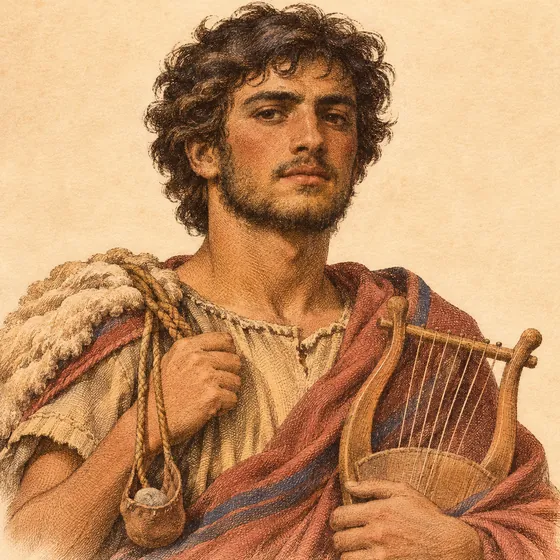

In 1 Samuel to 1 Kings, a shepherd who kills Goliath and becomes Israel's second king; he is called “the sweet psalmist of Israel”.
See 1 Samuel 17:50, 2 Samuel 5:3, 2 Samuel 23:1.
 A lyre and a sling marks David in the reading view: he played the lyre for Saul, and slung the stone at Goliath (1 Samuel 16:23, 1 Samuel 17:49).
Mentioned in 896 verses across 28 books, first in 2 Chronicles 1:1. The verses below are the ones linked to this person (the Theographic dataset, with our sourced corrections).
How artists have pictured him
3 works from different centuries and traditions. Each shows how its time and place imagined David, not how he looked.


In these stories
Questions about this
In the Bible
All 66 verses in 2 Chronicles, in Bible order. Text from the Berean Standard Bible; verse numbers follow the KJV.
2 Chronicles
- 2 Chronicles 1:1
Now Solomon son of David established himself securely over his kingdom, and the LORD his God was with him and highly exalted him.
- 2 Chronicles 1:4
Now David had brought the ark of God from Kiriath-jearim to the place he had prepared for it, because he had pitched a tent for it in Jerusalem.
- 2 Chronicles 1:8
Solomon replied to God: “You have shown much loving devotion to my father David, and You have made me king in his place.
- 2 Chronicles 1:9
Now, O LORD God, let Your promise to my father David be fulfilled. For You have made me king over a people as numerous as the dust of the earth.
- 2 Chronicles 2:3
Then Solomon sent word to Hiram king of Tyre: “Do for me as you did for my father David when you sent him cedars to build himself a house to live in.
- 2 Chronicles 2:7
Send me, therefore, a craftsman skilled in engraving to work with gold and silver, with bronze and iron, and with purple, crimson, and blue yarn. He will work with my craftsmen in Judah and Jerusalem, whom my father David provided.
- 2 Chronicles 2:12
And Hiram added: “Blessed be the LORD, the God of Israel, who made the heavens and the earth! He has given King David a wise son with insight and understanding, who will build a temple for the LORD and a royal palace for himself.
- 2 Chronicles 2:14
He is the son of a woman from the daughters of Dan, and his father is a man of Tyre. He is skilled in work with gold and silver, bronze and iron, stone and wood, purple, blue, and crimson yarn, and fine linen. He is experienced in every kind of engraving and can execute any design that is given him. He will work with your craftsmen and with those of my lord, your father David.
- 2 Chronicles 2:17
Solomon numbered all the foreign men in the land of Israel following the census his father David had conducted, and there were found to be 153,600 in all.
- 2 Chronicles 3:1
Then Solomon began to build the house of the LORD in Jerusalem on Mount Moriah, where the LORD had appeared to his father David. This was the place that David had prepared on the threshing floor of Ornan the Jebusite.
- 2 Chronicles 5:1
So all the work that Solomon had performed for the house of the LORD was completed. Then Solomon brought in the items his father David had dedicated—the silver, the gold, and all the furnishings—and he placed them in the treasuries of the house of God.
- 2 Chronicles 5:2
At that time Solomon assembled in Jerusalem the elders of Israel—all the tribal heads and family leaders of the Israelites—to bring up the ark of the covenant of the LORD from Zion, the City of David.
- 2 Chronicles 6:4
and said: “Blessed be the LORD, the God of Israel, who has fulfilled with His own hand what He spoke with His mouth to my father David, saying,
- 2 Chronicles 6:6
But now I have chosen Jerusalem for My Name to be there, and I have chosen David to be over My people Israel.’
- 2 Chronicles 6:7
Now it was in the heart of my father David to build a house for the Name of the LORD, the God of Israel.
- 2 Chronicles 6:8
But the LORD said to my father David, ‘Since it was in your heart to build a house for My Name, you have done well to have this in your heart.
- 2 Chronicles 6:10
Now the LORD has fulfilled the word that He spoke. I have succeeded my father David, and I sit on the throne of Israel, as the LORD promised. I have built the house for the Name of the LORD, the God of Israel.
- 2 Chronicles 6:15
You have kept Your promise to Your servant, my father David. What You spoke with Your mouth You have fulfilled with Your hand this day.
- 2 Chronicles 6:16
Therefore now, O LORD, God of Israel, keep for Your servant, my father David, what You promised when You said: ‘You will never fail to have a man to sit before Me on the throne of Israel, if only your descendants guard their way to walk in My law as you have walked before Me.’
- 2 Chronicles 6:17
And now, O LORD, God of Israel, please confirm what You promised to Your servant David.
- 2 Chronicles 6:42
O LORD God, do not reject Your anointed one. Remember Your loving devotion to Your servant David.”
- 2 Chronicles 7:6
The priests stood at their posts, as did the Levites with the musical instruments of the LORD, which King David had made for giving thanks to the LORD and with which David had offered praise, saying, “For His loving devotion endures forever.” Across from the Levites, the priests sounded trumpets, and all the Israelites were standing.
- 2 Chronicles 7:10
On the twenty-third day of the seventh month, Solomon sent the people away to their homes, joyful and glad of heart for the good things that the LORD had done for David, for Solomon, and for His people Israel.
- 2 Chronicles 7:17
And as for you, if you walk before Me as your father David walked, doing all I have commanded you, and if you keep My statutes and ordinances,
- 2 Chronicles 7:18
then I will establish your royal throne, as I covenanted with your father David when I said, ‘You will never fail to have a man to rule over Israel.’
- 2 Chronicles 8:11
Solomon brought the daughter of Pharaoh up from the City of David to the palace he had built for her. For he said, “My wife must not live in the house of David king of Israel, because the places the ark of the LORD has entered are holy.”
- 2 Chronicles 8:14
In keeping with the ordinances of his father David, Solomon appointed the divisions of the priests over their service, and the Levites for their duties to offer praise and to minister before the priests according to the daily requirement. He also appointed gatekeepers by their divisions at each gate, for this had been the command of David, the man of God.
- 2 Chronicles 9:31
And Solomon rested with his fathers and was buried in the city of his father David. And his son Rehoboam reigned in his place.
- 2 Chronicles 10:16
When all Israel saw that the king had refused to listen to them, they answered the king: “What portion do we have in David, and what inheritance in the son of Jesse? To your tents, O Israel! Look now to your own house, O David!” So all the Israelites went home,
- 2 Chronicles 10:19
So to this day Israel has been in rebellion against the house of David.
- 2 Chronicles 11:17
So they strengthened the kingdom of Judah and supported Rehoboam son of Solomon for three years, because they walked for three years in the way of David and Solomon.
- 2 Chronicles 11:18
And Rehoboam married Mahalath, who was the daughter of David’s son Jerimoth and of Abihail, the daughter of Jesse’s son Eliab.
- 2 Chronicles 12:16
And Rehoboam rested with his fathers and was buried in the City of David. And his son Abijah reigned in his place.
- 2 Chronicles 13:5
Do you not know that the LORD, the God of Israel, has given the kingship of Israel to David and his descendants forever by a covenant of salt?
- 2 Chronicles 13:6
Yet Jeroboam son of Nebat, a servant of Solomon son of David, rose up and rebelled against his master.
- 2 Chronicles 13:8
And now you think you can resist the kingdom of the LORD, which is in the hands of David’s descendants. You are indeed a vast army, and you have with you the golden calves that Jeroboam made for you as gods.
- 2 Chronicles 14:1
Then Abijah rested with his fathers and was buried in the City of David. And his son Asa reigned in his place, and in his days the land was at peace for ten years.
- 2 Chronicles 16:14
And he was buried in the tomb that he had cut out for himself in the City of David. They laid him on a bier that was full of spices and various blended perfumes; then they made a great fire in his honor.
- 2 Chronicles 17:3
Now the LORD was with Jehoshaphat because he walked in the earlier ways of his father David. He did not seek out the Baals,
- 2 Chronicles 21:1
And Jehoshaphat rested with his fathers and was buried with them in the City of David. And his son Jehoram reigned in his place.
- 2 Chronicles 21:7
Yet the LORD was unwilling to destroy the house of David, because of the covenant He had made with David, and since He had promised to maintain a lamp for David and his descendants forever.
- 2 Chronicles 21:12
Then a letter came to Jehoram from Elijah the prophet, which stated: “This is what the LORD, the God of your father David, says: ‘You have not walked in the ways of your father Jehoshaphat or of Asa king of Judah,
- 2 Chronicles 21:20
Jehoram was thirty-two years old when he became king, and he reigned in Jerusalem eight years. He died, to no one’s regret, and was buried in the City of David, but not in the tombs of the kings.
- 2 Chronicles 23:3
the whole assembly made a covenant with the king in the house of God. “Behold, the king’s son!” said Jehoiada. “He must reign, just as the LORD promised concerning the descendants of David.
- 2 Chronicles 23:9
Then Jehoiada the priest gave to the commanders of hundreds the spears and the large and small shields of King David that were in the house of God.
- 2 Chronicles 23:18
Moreover, Jehoiada put the oversight of the house of the LORD into the hands of the Levitical priests, whom David had appointed over the house of the LORD, to offer burnt offerings to the LORD as is written in the Law of Moses, with rejoicing and song, as ordained by David.
- 2 Chronicles 24:16
And Jehoiada was buried with the kings in the City of David, because he had done what was good in Israel for God and His temple.
- 2 Chronicles 24:25
And when the Arameans had withdrawn, they left Joash severely wounded. His own servants conspired against him for shedding the blood of the son of Jehoiada the priest, and they killed him on his bed. So he died and was buried in the City of David, but not in the tombs of the kings.
- 2 Chronicles 27:9
And Jotham rested with his fathers and was buried in the City of David. And his son Ahaz reigned in his place.
- 2 Chronicles 28:1
Ahaz was twenty years old when he became king, and he reigned in Jerusalem sixteen years. And unlike David his father, he did not do what was right in the eyes of the LORD.
- 2 Chronicles 29:2
And he did what was right in the eyes of the LORD, just as his father David had done.
- 2 Chronicles 29:25
Hezekiah stationed the Levites in the house of the LORD with cymbals, harps, and lyres according to the command of David, of Gad the king’s seer, and of Nathan the prophet. For the command had come from the LORD through His prophets.
- 2 Chronicles 29:26
The Levites stood with the instruments of David, and the priests with the trumpets.
- 2 Chronicles 29:27
And Hezekiah ordered that the burnt offering be sacrificed on the altar. When the burnt offering began, the song of the LORD and the trumpets began as well, accompanied by the instruments of David king of Israel.
- 2 Chronicles 29:30
Then King Hezekiah and his officials ordered the Levites to sing praises to the LORD in the words of David and of Asaph the seer. So they sang praises with gladness and bowed their heads and worshiped.
- 2 Chronicles 30:26
So there was great rejoicing in Jerusalem, for nothing like this had happened there since the days of Solomon son of David king of Israel.
- 2 Chronicles 32:5
Then Hezekiah worked resolutely to rebuild all the broken sections of the wall and to raise up towers on it. He also built an outer wall and reinforced the supporting terraces of the City of David, and he produced an abundance of weapons and shields.
- 2 Chronicles 32:30
It was Hezekiah who blocked the upper outlet of the Spring of Gihon and channeled it down to the west side of the City of David. And Hezekiah prospered in all that he did.
- 2 Chronicles 32:33
And Hezekiah rested with his fathers and was buried in the upper tombs of David’s descendants. All Judah and the people of Jerusalem paid him honor at his death. And his son Manasseh reigned in his place.
- 2 Chronicles 33:7
Manasseh even took the carved image he had made and set it up in the house of God, of which God had said to David and his son Solomon, “In this temple and in Jerusalem, which I have chosen out of all the tribes of Israel, I will establish My Name forever.
- 2 Chronicles 33:14
After this, Manasseh rebuilt the outer wall of the City of David from west of Gihon in the valley to the entrance of the Fish Gate, and he brought it around the hill of Ophel and heightened it considerably. He also stationed military commanders in all the fortified cities of Judah.
- 2 Chronicles 34:2
And he did what was right in the eyes of the LORD and walked in the ways of his father David; he did not turn aside to the right or to the left.
- 2 Chronicles 34:3
In the eighth year of his reign, while he was still young, Josiah began to seek the God of his father David, and in the twelfth year he began to cleanse Judah and Jerusalem of the high places, the Asherah poles, the carved idols, and the cast images.
- 2 Chronicles 35:3
To the Levites who taught all Israel and were holy to the LORD, Josiah said: “Put the holy ark in the temple built by Solomon son of David king of Israel. It is not to be carried around on your shoulders. Now serve the LORD your God and His people Israel.
- 2 Chronicles 35:4
Prepare yourselves by families in your divisions, according to the instructions written by David king of Israel and Solomon his son.
- 2 Chronicles 35:15
The singers, the descendants of Asaph, were at their stations according to the command of David, Asaph, Heman, and Jeduthun the king’s seer. And the gatekeepers at each gate did not need to leave their position, because their fellow Levites made preparations for them.
Events
Events the dataset lists David as taking part in. Dates follow its Ussher–Jones reckoning (one of several traditional counts), not established history.
- c. 1067 BCDavid Kills Goliath
- c. 1055 BCReign of David
- c. 1015 BCDeath of David
Dictionary
From Easton’s Bible Dictionary (1897), as attached to this record by Theographic. The entry is for the name and can describe more than one person who bore it. Easton wrote in 1897, and some of his views are now debated.
Read Easton’s entry
Beloved, the eighth and youngest son of Jesse, a citizen of Bethlehem. His father seems to have been a man in humble life. His mother’s name is not recorded. Some think she was the Nahash of 2 Sam. 17:25. As to his personal appearance, we only know that he was red-haired, with beautiful eyes and a fair face (1 Sam. 16:12; 17:42).
His early occupation was that of tending his father’s sheep on the uplands of Judah. From what we know of his after history, doubtless he frequently beguiled his time, when thus engaged, with his shepherd’s flute, while he drank in the many lessons taught him by the varied scenes spread around him. His first recorded exploits were his encounters with the wild beasts of the field. He mentions that with his own unaided hand he slew a lion and also a bear, when they came out against his flock, beating them to death in open conflict with his club (1 Sam. 17:34, 35).
While David, in the freshness of ruddy youth, was thus engaged with his flocks, Samuel paid an unexpected visit to Bethlehem, having been guided thither by divine direction (1 Sam. 16:1-13). There he offered up sacrifice, and called the elders of Israel and Jesse’s family to the sacrificial meal. Among all who appeared before him he failed to discover the one he sought. David was sent for, and the prophet immediately recognized him as the chosen of God, chosen to succeed Saul, who was now departing from the ways of God, on the throne of the kingdom. He accordingly, in anticipation, poured on his head the anointing oil. David went back again to his shepherd life, but “the Spirit of the Lord came upon David from that day forward,” and “the Spirit of the Lord departed from Saul” (1 Sam. 16:13, 14).
Not long after this David was sent for to soothe with his harp the troubled spirit of Saul, who suffered from a strange melancholy dejection. He played before the king so skilfully that Saul was greatly cheered, and began to entertain great affection for the young shepherd. After this he went home to Bethlehem. But he soon again came into prominence. The armies of the Philistines and of Israel were in battle array in the valley of Elah, some 16 miles south-west of Bethlehem; and David was sent by his father with provisions for his three brothers, who were then fighting on the side of the king. On his arrival in the camp of Israel, David (now about twenty years of age) was made aware of the state of matters when the champion of the Philistines, Goliath of Gath, came forth to defy Israel. David took his sling, and with a well-trained aim threw a stone “out of the brook,” which struck the giant’s forehead, so that he fell senseless to the ground. David then ran and slew him, and cut off his head with his own sword ([1 Sam. 17](/1sam#1Sam.17)). The result was a great victory to the Israelites, who pursued the Philistines to the gates of Gath and Ekron.
David’s popularity consequent on this heroic exploit awakened Saul’s jealousy (1 Sam. 18:6-16), which he showed in various ways. He conceived a bitter hatred toward him, and by various stratagems sought his death ([1 Sam. 18](/1sam#1Sam.18)-30). The deep-laid plots of the enraged king, who could not fail to observe that David “prospered exceedingly,” all proved futile, and only endeared the young hero the more to the people, and very specially to Jonathan, Saul’s son, between whom and David a life-long warm friendship was formed.
A fugitive. To escape from the vengeance of Saul, David fled to Ramah (1 Sam. 19:12-18) to Samuel, who received him, and he dwelt among the sons of the prophets, who were there under Samuel’s training. It is supposed by some that the sixth, seventh, and eleventh Psalms were composed by him at this time. This place was only 3 miles from the residence of Saul, who soon discovered whither the fugitive had gone, and tried ineffectually to bring him back. Jonathan made a fruitless effort to bring his father to a better state of mind toward David ([1 Sam. 20](/1sam#1Sam.20)), who, being made aware of the fact, saw no hope of safety but in flight to a distance. We accordingly find him first at Nob (21:1-9) and then at Gath, the chief city of the Philistines. The king of the Philistines would not admit him into his service, as he expected that he would, and David accordingly now betook himself to the stronghold of Adullam (22:1-4; 1 Chr. 12:8-18). Here in a short time 400 men gathered around him and acknowledged him as their leader. It was at this time that David, amid the harassment and perils of his position, cried, “Oh that one would give me drink of the water of the well of Bethlehem;” when three of his heroes broke through the lines of the Philistines and brought him the water for which he longed (2 Sam. 23:13-17), but which he would not drink.
In his rage at the failure of all his efforts to seize David, Saul gave orders for the massacre of the entire priestly family at Nob, “persons who wore a linen ephod”, to the number of eighty-five persons, who were put to death by Doeg the Edomite. The sad tidings of the massacre were brought to David by Abiathar, a son of Ahimelech, the only one who escaped. Comp. [Ps. 52](/ps#Ps.52).
Hearing that Keilah, a town on the western frontier, was harassed by the Philistines, David with his men relieved it (1 Sam. 23:1-14); and then, for fear of Saul, he fled to the strongholds in the “hill country” of Judah. Comp. [Ps. 31](/ps#Ps.31). While encamped there, in the forest in the district of Ziph, he was visited by Jonathan, who spoke to him words of encouragement (23:16-18). The two now parted never to meet again. Saul continued his pursuit of David, who narrowly escaped from him at this time, and fled to the crags and ravines of Engedi, on the western shore of the Dead Sea (1 Sam. 23:29). Here Saul, who still pursued him with his army, narrowly escaped, through the generous forbearance of David, and was greatly affected by what David had done for him. He returned home from pursuing him, and David betook himself to Maon, where, with his 600 men, he maintained himself by contributions gathered from the district. Here occurred the incident connected with Nabal and his wife Abigail ([1 Sam. 25](/1sam#1Sam.25)), whom David married after Nabal’s death.
Saul again went forth ([1 Sam. 26](/1sam#1Sam.26)) in pursuit of David, who had hid himself “in the hill Hachilah, which is before Jeshimon,” in the wilderness of Ziph, and was a second time spared through his forbearance. He returned home, professing shame and penitence for the way in which he had treated David, and predicting his elevation to the throne.
Fighting against Israel. Harassed by the necessity of moving from place to place through fear of Saul, David once more sought refuge among the Philistines ([1 Sam. 27](/1sam#1Sam.27)). He was welcomed by the king, who assigned him Ziklag as his residence. Here David lived among his followers for some time as an independent chief engaged in frequent war with the Amalekites and other tribes on the south of Judah.
Achish summoned David with his men to join his army against Saul; but the lords of the Philistines were suspicious of David’s loyalty, and therefore he was sent back to Ziklag, which he found to his dismay may had been pillaged and burnt during his brief absence. David pursued after the raiders, the Amalekites, and completely routed them. On his return to Ziklag tidings reached him of Saul’s death ([2 Sam. 1](/2sam#2Sam.1)). An Amalekite brought Saul’s crown and bracelet and laid them at his feet. David and his men rent their clothes and mourned for Saul, who had been defeated in battle near Mount Gilboa. David composed a beautiful elegy, the most beautiful of all extant Hebrew odes, a “lamentation over Saul and over Jonathan his son” (2 Sam. 1:18-27). It bore the title of “The Bow,” and was to be taught to the children, that the memory of Saul and Jonathan might be preserved among them. “Behold, it is written in the book of Jasher” (q.v.).
David king over Judah. David and his men now set out for Hebron under divine direction (2 Sam. 2:1-4). There they were cordially welcomed, and he was at once anointed as king. He was now about thirty years of age.
But his title to the throne was not undisputed. Abner took Ish-bosheth, Saul’s only remaining son, over the Jordan to Mahanaim, and there crowned him as king. Then began a civil war in Israel. The first encounter between the two opposing armies, led on the one side by Abner, and on the other by Joab, took place at the pool of Gibeon. It resulted in the defeat of Abner. Other encounters, however, between Israel and Judah followed (2 Sam. 3:1, 5), but still success was on the side of David. For the space of seven and a half years David reigned in Hebron. Abner now sided with David, and sought to promote his advancement; but was treacherously put to death by Joab in revenge for his having slain his brother Asahel at Gibeon (3:22-39). This was greatly to David’s regret. He mourned for the death of Abner. Shortly after this Ish-bosheth was also treacherously put to death by two Canaanites of Beeroth; and there being now no rival, David was anointed king over all Israel (4:1-12).
David king over all Israel (2 Sam. 5:1-5; 1 Chr. 11:1-3). The elders of Israel now repaired to Hebron and offered allegiance to David in name of all the people, among whom the greatest enthusiasm prevailed. He was anointed king over all Israel, and sought out a new seat of government, more suitable than Hebron, as the capital of his empire. At this time there was a Jebusite fortress, “the stronghold”, on the hill of Zion, called also Jebus. This David took from the Jebusites, and made it Israel’s capital, and established here his residence, and afterwards built for himself a palace by the aid of Tyrian tradesmen. The Philistines, who had for some time observed a kind of truce, now made war against David; but were defeated in battle at a place afterwards called, in remembrance of the victory, Baal-perazim. Again they invaded the land, and were a second time routed by him. He thus delivered Israel from their enemies.
David now resolved to bring up the ark of the covenant to his new capital ([2 Sam. 6](/2sam#2Sam.6)). It was in the house of Abinadab at Kirjath-jearim, about 7 miles from Jerusalem, where it had been for many years, from the time when the Philistines had sent it home ([1 Sam. 6](/1sam#1Sam.6); [7](/1sam#1Sam.7)). In consequence of the death of Uzzah (for it was a divine ordinance that only the Levites should handle the ark, [Num. 4](/num#Num.4)), who had put forth his hand to steady the ark when the cart in which it was being conveyed shook by reason of the roughness of the road, David stayed the procession, and conveyed the ark into the house of Obed-edom, a Philistine from Gath. After three months David brought the ark from the house of Obed-edom up to Jerusalem. Comp. [Ps. 24](/ps#Ps.24). Here it was placed in a new tent or tabernacle which David erected for the purpose. About seventy years had passed since it had stood in the tabernacle at Shiloh. The old tabernacle was now at Gibeah, at which Zadok ministered. David now ([1 Chr. 16](/1chr#1Chr.16)) carefully set in order all the ritual of divine worship at Jerusalem, along with Abiathar the high priest. A new religious era began. The service of praise was for the first time introduced into public worship. Zion became henceforth “God’s holy hill.”
David’s wars. David now entered on a series of conquests which greatly extended and strengthened his kingdom ([2 Sam. 8](/2sam#2Sam.8)). In a few years the whole territory from the Euphrates to the river of Egypt, and from Gaza on the west to Thapsacus on the east, was under his sway (2 Sam. 8:3-13; [10](/2sam#2Sam.10)).
David’s fall. He had now reached the height of his glory. He ruled over a vast empire, and his capital was enriched with the spoils of many lands. But in the midst of all this success he fell, and his character became stained with the sin of adultery (2 Sam. 11:2-27). It has been noted as characteristic of the Bible that while his military triumphs are recorded in a few verses, the sad story of his fall is given in detail, a story full of warning, and therefore recorded. This crime, in the attempt to conceal it, led to anoter. He was guilty of murder. Uriah, whom he had foully wronged, an officer of the Gibborim, the corps of heros (23:39), was, by his order, “set in the front of the hottest battle” at the siege of Rabbah, in order that he might be put to death. Nathan the prophet (2 Sam. 7:1-17; 12:1-23) was sent by God to bring home his crimes to the conscience of the guilty monarch. He became a true penitent. He bitterly bewailed his sins before God. The thirty-second and fifty-first Psalms reveal the deep struggles of his soul, and his spiritual recovery.
Bathsheba became his wife after Uriah’s death. Her first-born son died, according to the word of the prophet. She gave birth to a second son, whom David called Solomon, and who ultimately succeeded him on the throne (2 Sam. 12:24, 25).
Peace. After the successful termination of all his wars, David formed the idea of building a temple for the ark of God. This he was not permitted to carry into execution, because he had been a man of war. God, however, sent Nathan to him with a gracious message (2 Sam. 7:1-16). On receiving it he went into the sanctuary, the tent where the ark was, and sat before the Lord, and poured out his heart in words of devout thanksgiving (18-29). The building of the temple was reserved for his son Solomon, who would be a man of peace (1 Chr. 22:9; 28:3).
A cloudy evening. Hitherto David’s carrer had been one of great prosperity and success. Now cloudy and dark days came. His eldest son Amnon, whose mother was Ahinoam of Jezreel, was guilty of a great and shameful crime ([2 Sam. 13](/2sam#2Sam.13)). This was the beginning of the disasters of his later years. After two years Absalom terribly avenged the crime against Tamar, and put Amnon to death. This brought sore trouble to David’s heart. Absalom, afraid of the consequences of his guilt, fled to Geshur beyond Jordan, where he remained for three years, when he was brought back through the intrigue of Joab ([2 Sam. 14](/2sam#2Sam.14)).
After this there fell upon the land the calamity of three years’ famine (2 Sam. 21:1-14). This was soon after followed by a pestilence, brought upon the land as a punishment for David’s sinful pride in numbering the people ([2 Sam. 24](/2sam#2Sam.24)), in which no fewer than 70,000 perished in the space of three days.
Rebellion of Absalom. The personal respect for David was sadly lowered by the incident of Bathsheba. There was a strong popular sentiment against the taking of the census, and the outburst of the plague in connection with it deepened the feeling of jealously that had begun to manifest itself among some of the tribes against David. Absalom, taking full advantage of this state of things, gradually gained over the people, and at length openly rebelled against his father, and usurped the throne. Ahithophel was Absalom’s chief counsellor. The revolt began in Hebron, the capital of Judah. Absalom was there proclaimed king. David was now in imminent danger, and he left Jerusalem (2 Sam. 15:13-20), and once more became a fugitive. It was a momentous day in Israel. The incidents of it are recorded with a fulness of detail greater than of any other day in Old Testament history. David fled with his followers to Mahanarm, on the east of Jordan. An unnatural civil war broke out. After a few weeks the rival armies were mustered and organized. They met in hostile array at the wood of Ephraim (2 Sam. 18:1-8). Absalom’s army was defeated, and himself put to death by the hand of Joab (9-18). The tidings of the death of his rebellious son filled the heart of David with the most poignant grief. He “went up to the chamber over the gate, and wept” (33), giving utterance to the heart-broken cry, “Would God I had died for thee, O Absalom, my son, my son!” Peace was now restored, and David returned to Jerusalem and resumed the direction of affairs. An unhappy dispute arose between the men of Judah and the men of Israel (19:41-43). Sheba, a Benjamite, headed a revolt of the men of Israel. He was pursued to Abelbeth-maachah, and was there put to death, and so the revolt came to an end.
The end. After the suppression of the rebellion of Absalom and that of Sheba, ten comparatively peaceful years of David’s life passed away. During those years he seems to have been principally engaged in accumulating treasures of every kind for the great temple at Jerusalem, which it was reserved to his successor to build ([1 Chr. 22](/1chr#1Chr.22); [28](/1chr#1Chr.28); [29](/1chr#1Chr.29)), a house which was to be “exceeding magnifical, of fame and of glory throughout all countries” (22:5). The exciting and laborious life he had spent, and the dangers and trials through which he had passed, had left him an enfeebled man, prematurely old. It became apparent that his life was now drawing to its close. A new palace conspiracy broke out as to who should be his successor. Joab favoured Adonijah. The chiefs of his party met at the “Fuller’s spring,” in the valley of Kidron, to proclaim him king; but Nathan hastened on a decision on the part of David in favour of Solomon, and so the aim of Adonijah’s party failed. Solomon was brought to Jerusalem, and was anointed king and seated on his father’s throne (1 Kings 1:11-53). David’s last words are a grand utterance, revealing his unfailing faith in God, and his joyful confidence in his gracious covenant promises (2 Sam. 23:1-7).
After a reign of forty years and six months (2 Sam. 5:5; 1 Chr. 3:4) David died (B.C. 1015) at the age of seventy years, “and was buried in the city of David.” His tomb is still pointed out on Mount Zion.
Both in his prophetical and in his regal character David was a type of the Messiah (1 Sam. 16:13). The book of Psalms commonly bears the title of the “Psalms of David,” from the circumstance that he was the largest contributor (about eighty psalms) to the collection.
“The greatness of David was felt when he was gone. He had lived in harmony with both the priesthood and the prophets; a sure sign that the spirit of his government had been throughly loyal to the higher aims of the theocracy. The nation had not been oppressed by him, but had been left in the free enjoyment of its ancient liberties. As far as his power went he had striven to act justly to all (2 Sam. 8:15). His weak indulgence to his sons, and his own great sin besides, had been bitterly atoned, and were forgotten at his death in the remembrance of his long-tried worth. He had reigned thirty-three years in Jerusalem and seven and a half at Hebron (2 Sam. 5:5). Israel at his accession had reached the lowest point of national depression; its new-born unity rudely dissolved; its territory assailed by the Philistines. But he had left it an imperial power, with dominions like those of Egypt or Assyria. The sceptre of Solomon was already, before his father’s death, owned from the Mediterranean to the Euphrates, and from the Orontes to the Red Sea.”, Geikie’s Hours etc., iii.