Person
Abraham
Also called Abram
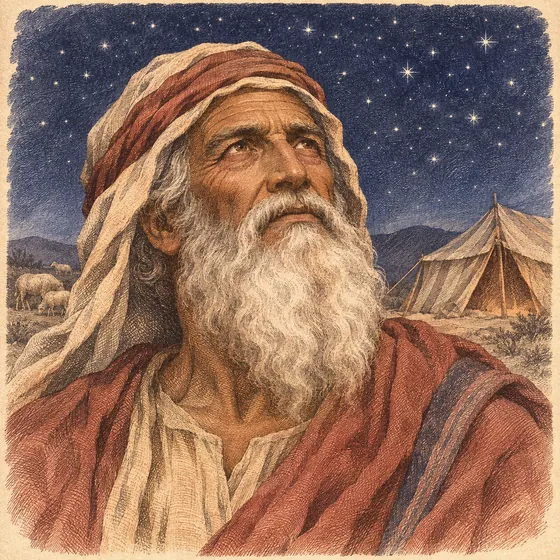
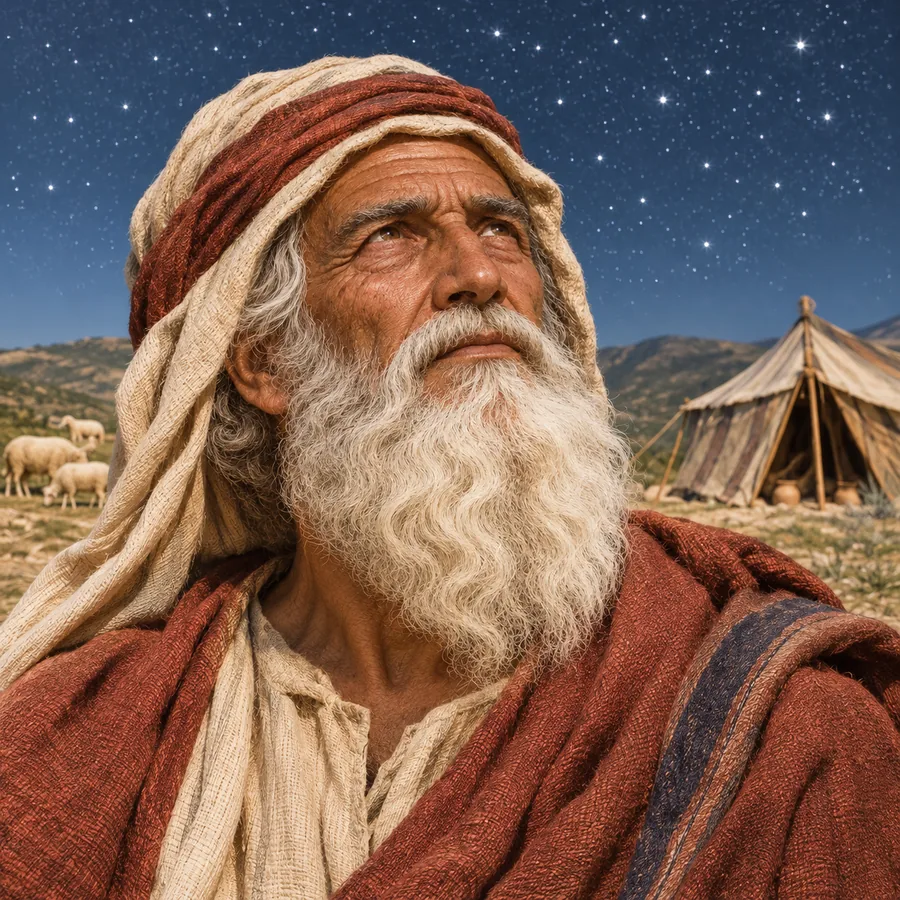

In Genesis 12–25, he leaves his homeland at God's call and is promised a land and descendants as many as the stars.
See Genesis 12:1, Genesis 15:5, Genesis 17:8.
 Stars over a tent marks Abraham in the reading view: “Look now toward heaven, and tell the stars”; he lived in tents (Genesis 15:5, Hebrews 11:9).
Mentioned in 277 verses across 27 books, first in Genesis 11:26. The verses below are the ones linked to this person (the Theographic dataset, with our sourced corrections).
How artists have pictured him
3 works from different centuries and traditions. Each shows how its time and place imagined Abraham, not how he looked.


In these stories
Questions about this
In the Bible
All 165 verses in Genesis, in Bible order. Text from the Berean Standard Bible; verse numbers follow the KJV.
Genesis
- Genesis 11:26
When Terah was 70 years old, he became the father of Abram, Nahor, and Haran.
- Genesis 11:27
This is the account of Terah. Terah became the father of Abram, Nahor, and Haran. And Haran became the father of Lot.
- Genesis 11:29
And Abram and Nahor took wives for themselves. Abram’s wife was named Sarai, and Nahor’s wife was named Milcah; she was the daughter of Haran, who was the father of both Milcah and Iscah.
- Genesis 11:31
And Terah took his son Abram, his grandson Lot son of Haran, and his daughter-in-law Sarai the wife of Abram, and they set out from Ur of the Chaldeans for the land of Canaan. But when they arrived in Haran, they settled there.
- Genesis 12:1
Then the LORD said to Abram, “Leave your country, your kindred, and your father’s household, and go to the land I will show you.
- Genesis 12:4
So Abram departed, as the LORD had directed him, and Lot went with him. Abram was seventy-five years old when he left Haran.
- Genesis 12:5
And Abram took his wife Sarai, his nephew Lot, and all the possessions and people they had acquired in Haran, and set out for the land of Canaan. When they came to the land of Canaan,
- Genesis 12:6
Abram traveled through the land as far as the site of the Oak of Moreh at Shechem. And at that time the Canaanites were in the land.
- Genesis 12:7
Then the LORD appeared to Abram and said, “I will give this land to your offspring.” So Abram built an altar there to the LORD, who had appeared to him.
- Genesis 12:9
And Abram journeyed on toward the Negev.
- Genesis 12:10
Now there was a famine in the land. So Abram went down to Egypt to live there for a while because the famine was severe.
- Genesis 12:14
So when Abram entered Egypt, the Egyptians saw that the woman was very beautiful.
- Genesis 12:16
He treated Abram well on her account, and Abram acquired sheep and cattle, male and female donkeys, menservants and maidservants, and camels.
- Genesis 12:17
The LORD, however, afflicted Pharaoh and his household with severe plagues because of Abram’s wife Sarai.
- Genesis 12:18
So Pharaoh summoned Abram and asked, “What have you done to me? Why didn’t you tell me she was your wife?
- Genesis 13:1
So Abram went up out of Egypt into the Negev—he and his wife and all his possessions—and Lot was with him.
- Genesis 13:2
And Abram had become extremely wealthy in livestock and silver and gold.
- Genesis 13:4
to the site where he had built the altar. And there Abram called on the name of the LORD.
- Genesis 13:5
Now Lot, who was traveling with Abram, also had flocks and herds and tents.
- Genesis 13:7
And there was discord between the herdsmen of Abram and the herdsmen of Lot. At that time the Canaanites and the Perizzites were also living in the land.
- Genesis 13:8
So Abram said to Lot, “Please let there be no contention between you and me, or between your herdsmen and my herdsmen. After all, we are brothers.
- Genesis 13:12
Abram lived in the land of Canaan, but Lot settled in the cities of the plain and pitched his tent toward Sodom.
- Genesis 13:14
After Lot had departed, the LORD said to Abram, “Now lift up your eyes from the place where you are, and look to the north and south and east and west,
- Genesis 13:18
So Abram moved his tent and went to live near the Oaks of Mamre at Hebron, where he built an altar to the LORD.
- Genesis 14:12
They also carried off Abram’s nephew Lot and his possessions, since Lot was living in Sodom.
- Genesis 14:13
Then an escapee came and reported this to Abram the Hebrew. Now Abram was living near the Oaks of Mamre the Amorite, a brother of Eshcol and Aner, all of whom were bound by treaty to Abram.
- Genesis 14:14
And when Abram heard that his relative had been captured, he mobilized the 318 trained men born in his household, and they set out in pursuit as far as Dan.
- Genesis 14:19
and he blessed Abram and said: “Blessed be Abram by God Most High, Creator of heaven and earth,
- Genesis 14:21
The king of Sodom said to Abram, “Give me the people, but take the goods for yourself.”
- Genesis 14:22
But Abram replied to the king of Sodom, “I have raised my hand to the LORD God Most High, Creator of heaven and earth,
- Genesis 14:23
that I will not accept even a thread, or a strap of a sandal, or anything that belongs to you, lest you should say, ‘I have made Abram rich.’
- Genesis 15:1
After these events, the word of the LORD came to Abram in a vision: “Do not be afraid, Abram. I am your shield, your very great reward.”
- Genesis 15:2
But Abram replied, “O Lord GOD, what can You give me, since I remain childless, and the heir of my house is Eliezer of Damascus?”
- Genesis 15:3
Abram continued, “Behold, You have given me no offspring, so a servant in my household will be my heir.”
- Genesis 15:11
And the birds of prey descended on the carcasses, but Abram drove them away.
- Genesis 15:12
As the sun was setting, Abram fell into a deep sleep, and suddenly great terror and darkness overwhelmed him.
- Genesis 15:13
Then the LORD said to Abram, “Know for certain that your descendants will be strangers in a land that is not their own, and they will be enslaved and mistreated four hundred years.
- Genesis 15:18
On that day the LORD made a covenant with Abram, saying, “To your descendants I have given this land—from the river of Egypt to the great River Euphrates—
- Genesis 16:1
Now Abram’s wife Sarai had borne him no children, but she had an Egyptian maidservant named Hagar.
- Genesis 16:2
So Sarai said to Abram, “Look now, the LORD has prevented me from bearing children. Please go to my maidservant; perhaps I can build a family by her.” And Abram listened to the voice of Sarai.
- Genesis 16:3
So after he had lived in Canaan for ten years, his wife Sarai took her Egyptian maidservant Hagar and gave her to Abram to be his wife.
- Genesis 16:5
Then Sarai said to Abram, “May the wrong done to me be upon you! I delivered my servant into your arms, and ever since she saw that she was pregnant, she has treated me with contempt. May the LORD judge between you and me.”
- Genesis 16:6
“Here,” said Abram, “your servant is in your hands. Do whatever you want with her.” Then Sarai treated Hagar so harshly that she fled from her.
- Genesis 16:15
And Hagar bore Abram a son, and Abram gave the name Ishmael to the son she had borne.
- Genesis 16:16
Abram was eighty-six years old when Hagar bore Ishmael to him.
- Genesis 17:1
When Abram was ninety-nine years old, the LORD appeared to him and said, “I am God Almighty. Walk before Me and be blameless.
- Genesis 17:3
Then Abram fell facedown, and God said to him,
- Genesis 17:5
No longer will you be called Abram, but your name will be Abraham, for I have made you a father of many nations.
- Genesis 17:9
God also said to Abraham, “You must keep My covenant—you and your descendants in the generations after you.
- Genesis 17:15
Then God said to Abraham, “As for Sarai your wife, do not call her Sarai, for her name is to be Sarah.
- Genesis 17:17
Abraham fell facedown. Then he laughed and said to himself, “Can a child be born to a man who is a hundred years old? Can Sarah give birth at the age of ninety?”
- Genesis 17:18
And Abraham said to God, “O that Ishmael might live under Your blessing!”
- Genesis 17:22
When He had finished speaking with Abraham, God went up from him.
- Genesis 17:23
On that very day Abraham took his son Ishmael and all those born in his household or purchased with his money—every male among the members of Abraham’s household—and he circumcised them, just as God had told him.
- Genesis 17:24
So Abraham was ninety-nine years old when he was circumcised,
- Genesis 17:26
Abraham and his son Ishmael were circumcised on the same day.
- Genesis 18:6
So Abraham hurried into the tent and said to Sarah, “Quick! Prepare three seahs of fine flour, knead it, and bake some bread.”
- Genesis 18:7
Meanwhile, Abraham ran to the herd, selected a tender and choice calf, and gave it to a servant, who hurried to prepare it.
- Genesis 18:11
And Abraham and Sarah were already old and well along in years; Sarah had passed the age of childbearing.
- Genesis 18:13
And the LORD asked Abraham, “Why did Sarah laugh and say, ‘Can I really bear a child when I am old?’
- Genesis 18:16
When the men got up to leave, they looked out over Sodom, and Abraham walked along with them to see them off.
- Genesis 18:17
And the LORD said, “Shall I hide from Abraham what I am about to do?
- Genesis 18:18
Abraham will surely become a great and powerful nation, and through him all the nations of the earth will be blessed.
- Genesis 18:19
For I have chosen him, so that he will command his children and his household after him to keep the way of the LORD by doing what is right and just, in order that the LORD may bring upon Abraham what He has promised.”
- Genesis 18:22
And the two men turned away and went toward Sodom, but Abraham remained standing before the LORD.
- Genesis 18:23
Abraham stepped forward and said, “Will You really sweep away the righteous with the wicked?
- Genesis 18:27
Then Abraham answered, “Now that I have ventured to speak to the Lord—though I am but dust and ashes—
- Genesis 18:33
When the LORD had finished speaking with Abraham, He departed, and Abraham returned home.
- Genesis 19:27
Early the next morning, Abraham got up and returned to the place where he had stood before the LORD.
- Genesis 19:29
So when God destroyed the cities of the plain, He remembered Abraham, and He brought Lot out of the catastrophe that destroyed the cities where he had lived.
- Genesis 20:1
Now Abraham journeyed from there to the region of the Negev and settled between Kadesh and Shur. While he was staying in Gerar,
- Genesis 20:2
Abraham said of his wife Sarah, “She is my sister.” So Abimelech king of Gerar had Sarah brought to him.
- Genesis 20:9
Then Abimelech called Abraham and asked, “What have you done to us? How have I sinned against you, that you have brought such tremendous guilt upon me and my kingdom? You have done things to me that should not be done.”
- Genesis 20:10
Abimelech also asked Abraham, “What prompted you to do such a thing?”
- Genesis 20:11
Abraham replied, “I thought to myself, ‘Surely there is no fear of God in this place. They will kill me on account of my wife.’
- Genesis 20:14
So Abimelech brought sheep and cattle, menservants and maidservants, and he gave them to Abraham and restored his wife Sarah to him.
- Genesis 20:17
Then Abraham prayed to God, and God healed Abimelech and his wife and his maidservants, so that they could again bear children—
- Genesis 20:18
for on account of Abraham’s wife Sarah, the LORD had completely closed all the wombs in Abimelech’s household.
- Genesis 21:2
So Sarah conceived and bore a son to Abraham in his old age, at the very time God had promised.
- Genesis 21:3
And Abraham gave the name Isaac to the son Sarah bore to him.
- Genesis 21:4
When his son Isaac was eight days old, Abraham circumcised him, as God had commanded him.
- Genesis 21:5
Abraham was a hundred years old when his son Isaac was born to him.
- Genesis 21:7
She added, “Who would have told Abraham that Sarah would nurse children? Yet I have borne him a son in his old age.”
- Genesis 21:8
So the child grew and was weaned, and Abraham held a great feast on the day Isaac was weaned.
- Genesis 21:9
But Sarah saw that the son whom Hagar the Egyptian had borne to Abraham was mocking her son,
- Genesis 21:10
and she said to Abraham, “Expel the slave woman and her son, for the slave woman’s son will never share in the inheritance with my son Isaac!”
- Genesis 21:11
Now this matter distressed Abraham greatly because it concerned his son Ishmael.
- Genesis 21:12
But God said to Abraham, “Do not be distressed about the boy and your maidservant. Listen to everything that Sarah tells you, for through Isaac your offspring will be reckoned.
- Genesis 21:14
Early in the morning, Abraham got up, took bread and a skin of water, put them on Hagar’s shoulders, and sent her away with the boy. She left and wandered in the Wilderness of Beersheba.
- Genesis 21:22
At that time Abimelech and Phicol the commander of his army said to Abraham, “God is with you in all that you do.
- Genesis 21:24
And Abraham replied, “I swear it.”
- Genesis 21:25
But when Abraham complained to Abimelech about a well that Abimelech’s servants had seized,
- Genesis 21:27
So Abraham brought sheep and cattle and gave them to Abimelech, and the two men made a covenant.
- Genesis 21:28
Abraham separated seven ewe lambs from the flock,
- Genesis 21:29
and Abimelech asked him, “Why have you set apart these seven ewe lambs?”
- Genesis 21:33
And Abraham planted a tamarisk tree in Beersheba, and there he called upon the name of the LORD, the Eternal God.
- Genesis 21:34
And Abraham resided in the land of the Philistines for a long time.
- Genesis 22:1
Some time later God tested Abraham and said to him, “Abraham!” “Here I am,” he answered.
- Genesis 22:3
So Abraham got up early the next morning, saddled his donkey, and took along two of his servants and his son Isaac. He split the wood for a burnt offering and set out for the place God had designated.
- Genesis 22:4
On the third day Abraham looked up and saw the place in the distance.
- Genesis 22:5
“Stay here with the donkey,” Abraham told his servants. “The boy and I will go over there to worship, and then we will return to you.”
- Genesis 22:6
Abraham took the wood for the burnt offering and placed it on his son Isaac. He himself carried the fire and the sacrificial knife, and the two of them walked on together.
- Genesis 22:7
Then Isaac said to his father Abraham, “My father!” “Here I am, my son,” he replied. “The fire and the wood are here,” said Isaac, “but where is the lamb for the burnt offering?”
- Genesis 22:8
Abraham answered, “God Himself will provide the lamb for the burnt offering, my son.” And the two walked on together.
- Genesis 22:9
When they arrived at the place God had designated, Abraham built the altar there and arranged the wood. He bound his son Isaac and placed him on the altar, atop the wood.
- Genesis 22:10
Then Abraham reached out his hand and took the knife to slaughter his son.
- Genesis 22:11
Just then the angel of the LORD called out to him from heaven, “Abraham, Abraham!” “Here I am,” he replied.
- Genesis 22:13
Then Abraham looked up and saw behind him a ram in a thicket, caught by its horns. So he went and took the ram and offered it as a burnt offering in place of his son.
- Genesis 22:14
And Abraham called that place The LORD Will Provide. So to this day it is said, “On the mountain of the LORD it will be provided.”
- Genesis 22:15
And the angel of the LORD called to Abraham from heaven a second time,
- Genesis 22:19
Abraham went back to his servants, and they got up and set out together for Beersheba. And Abraham settled in Beersheba.
- Genesis 22:20
Some time later, Abraham was told, “Milcah has also borne sons to your brother Nahor:
- Genesis 22:23
And Bethuel became the father of Rebekah. Milcah bore these eight sons to Abraham’s brother Nahor.
- Genesis 23:2
She died in Kiriath-arba (that is, Hebron) in the land of Canaan, and Abraham went out to mourn and to weep for her.
- Genesis 23:3
Then Abraham got up from beside his dead wife and said to the Hittites,
- Genesis 23:5
The Hittites replied to Abraham,
- Genesis 23:7
Then Abraham rose and bowed down before the people of the land, the Hittites.
- Genesis 23:10
Now Ephron was sitting among the sons of Heth. So in the presence of all the Hittites who had come to the gate of his city, Ephron the Hittite answered Abraham,
- Genesis 23:12
Again Abraham bowed down before the people of the land
- Genesis 23:14
Ephron answered Abraham,
- Genesis 23:16
Abraham agreed to Ephron’s terms and weighed out for him the price he had named in the hearing of the Hittites: four hundred shekels of silver, according to the standard of the merchants.
- Genesis 23:18
to Abraham’s possession in the presence of all the Hittites who had come to the gate of his city.
- Genesis 23:19
After this, Abraham buried his wife Sarah in the cave of the field at Machpelah near Mamre (that is, Hebron) in the land of Canaan.
- Genesis 23:20
So the field and its cave were deeded by the Hittites to Abraham as a burial site.
- Genesis 24:1
By now Abraham was old and well along in years, and the LORD had blessed him in every way.
- Genesis 24:2
So Abraham instructed the chief servant of his household, who managed all he owned, “Place your hand under my thigh,
- Genesis 24:6
Abraham replied, “Make sure that you do not take my son back there.
- Genesis 24:9
So the servant placed his hand under the thigh of his master Abraham and swore an oath to him concerning this matter.
- Genesis 24:12
“O LORD, God of my master Abraham,” he prayed, “please grant me success today, and show kindness to my master Abraham.
- Genesis 24:15
Before the servant had finished praying, Rebekah came out with her jar on her shoulder. She was the daughter of Bethuel son of Milcah, the wife of Abraham’s brother Nahor.
- Genesis 24:27
saying, “Blessed be the LORD, the God of my master Abraham, who has not withheld His kindness and faithfulness from my master. As for me, the LORD has led me on the journey to the house of my master’s relatives.”
- Genesis 24:34
“I am Abraham’s servant,” he replied.
- Genesis 24:42
So when I came to the spring today, I prayed: O LORD, God of my master Abraham, if only You would make my journey a success!
- Genesis 24:48
Then I bowed down and worshiped the LORD; and I blessed the LORD, the God of my master Abraham, who led me on the right road to take the granddaughter of my master’s brother for his son.
- Genesis 24:52
When Abraham’s servant heard their words, he bowed down to the ground before the LORD.
- Genesis 24:59
So they sent their sister Rebekah on her way, along with her nurse and Abraham’s servant and his men.
- Genesis 25:1
Now Abraham had taken another wife, named Keturah,
- Genesis 25:5
Abraham left everything he owned to Isaac.
- Genesis 25:6
But while he was still alive, Abraham gave gifts to the sons of his concubines and sent them away from his son Isaac to the land of the east.
- Genesis 25:7
Abraham lived a total of 175 years.
- Genesis 25:8
And at a ripe old age he breathed his last and died, old and contented, and was gathered to his people.
- Genesis 25:10
This was the field that Abraham had bought from the Hittites. Abraham was buried there with his wife Sarah.
- Genesis 25:11
After Abraham’s death, God blessed his son Isaac, who lived near Beer-lahai-roi.
- Genesis 25:12
This is the account of Abraham’s son Ishmael, whom Hagar the Egyptian, Sarah’s maidservant, bore to Abraham.
- Genesis 25:19
This is the account of Abraham’s son Isaac. Abraham became the father of Isaac,
- Genesis 26:1
Now there was another famine in the land, subsequent to the one that had occurred in Abraham’s time. And Isaac went to Abimelech king of the Philistines at Gerar.
- Genesis 26:3
Stay in this land as a foreigner, and I will be with you and bless you. For I will give all these lands to you and your offspring, and I will confirm the oath that I swore to your father Abraham.
- Genesis 26:5
because Abraham listened to My voice and kept My charge, My commandments, My statutes, and My laws.”
- Genesis 26:15
So the Philistines took dirt and stopped up all the wells that his father’s servants had dug in the days of his father Abraham.
- Genesis 26:18
Isaac reopened the wells that had been dug in the days of his father Abraham, which the Philistines had stopped up after Abraham died. And he gave these wells the same names his father had given them.
- Genesis 26:24
and that night the LORD appeared to him and said, “I am the God of your father Abraham. Do not be afraid, for I am with you. I will bless you and multiply your descendants for the sake of My servant Abraham.”
- Genesis 28:4
And may He give the blessing of Abraham to you and your descendants, so that you may possess the land where you dwell as a foreigner, the land God gave to Abraham.”
- Genesis 28:9
Esau went to Ishmael and married Mahalath, the sister of Nebaioth and daughter of Abraham’s son Ishmael, in addition to the wives he already had.
- Genesis 28:13
And there at the top the LORD was standing and saying, “I am the LORD, the God of your father Abraham and the God of Isaac. I will give you and your descendants the land on which you now lie.
- Genesis 31:42
If the God of my father, the God of Abraham and the Fear of Isaac, had not been with me, surely by now you would have sent me away empty-handed. But God has seen my affliction and the toil of my hands, and last night He rendered judgment.”
- Genesis 31:53
May the God of Abraham and the God of Nahor, the God of their father, judge between us.” So Jacob swore by the Fear of his father Isaac.
- Genesis 32:9
Then Jacob declared, “O God of my father Abraham, God of my father Isaac, the LORD who told me, ‘Go back to your country and to your kindred, and I will make you prosper,’
- Genesis 35:12
The land that I gave to Abraham and Isaac I will give to you, and I will give this land to your descendants after you.”
- Genesis 35:27
Jacob returned to his father Isaac at Mamre, near Kiriath-arba (that is, Hebron), where Abraham and Isaac had stayed.
- Genesis 48:15
Then he blessed Joseph and said: “May the God before whom my fathers Abraham and Isaac walked, the God who has been my shepherd all my life to this day,
- Genesis 48:16
the angel who has redeemed me from all harm— may He bless these boys. And may they be called by my name and the names of my fathers Abraham and Isaac, and may they grow into a multitude upon the earth.”
- Genesis 49:30
The cave is in the field of Machpelah near Mamre, in the land of Canaan. This is the field Abraham purchased from Ephron the Hittite as a burial site.
- Genesis 49:31
There Abraham and his wife Sarah are buried, there Isaac and his wife Rebekah are buried, and there I buried Leah.
- Genesis 50:13
They carried him to the land of Canaan and buried him in the cave at Machpelah in the field near Mamre, which Abraham had purchased from Ephron the Hittite as a burial site.
- Genesis 50:24
Then Joseph said to his brothers, “I am about to die, but God will surely visit you and bring you up from this land to the land He promised on oath to Abraham, Isaac, and Jacob.”
Events
Events the dataset lists Abraham as taking part in. Dates follow its Ussher–Jones reckoning (one of several traditional counts), not established history.
- c. 1997 BCLifetime of Abraham
- c. 1996 BCBirth of Abraham
- c. 1921 BCAbraham enters Canaan
- c. 1921 BCAbrahamic Covenant
- c. 1921 BCAbraham goes to Egypt
- c. 1921 BCSojourn in Canaan and Egypt
- c. 1920 BCAbraham and Lot Separate
- c. 1910 BCBirth of Ishmael
- c. 1897 BCSodom Destroyed
- c. 1896 BCBirth of Isaac
- c. 1821 BCDeath of Abraham
Dictionary
From Easton’s Bible Dictionary (1897), as attached to this record by Theographic. The entry is for the name and can describe more than one person who bore it. Easton wrote in 1897, and some of his views are now debated.
Read Easton’s entry
Father of a multitude, son of Terah, named (Gen. 11:27) before his older brothers Nahor and Haran, because he was the heir of the promises. Till the age of seventy, Abram sojourned among his kindred in his native country of Chaldea. He then, with his father and his family and household, quitted the city of Ur, in which he had hitherto dwelt, and went some 300 miles north to Haran, where he abode fifteen years. The cause of his migration was a call from God (Acts 7:2-4). There is no mention of this first call in the Old Testament; it is implied, however, in [Gen. 12](/gen#Gen.12). While they tarried at Haran, Terah died at the age of 205 years. Abram now received a second and more definite call, accompanied by a promise from God (Gen. 12:1, 2); whereupon he took his departure, taking his nephew Lot with him, “not knowing whither he went” (Heb. 11:8). He trusted implicitly to the guidance of Him who had called him.
Abram now, with a large household of probably a thousand souls, entered on a migratory life, and dwelt in tents. Passing along the valley of the Jabbok, in the land of Canaan, he formed his first encampment at Sichem (Gen. 12:6), in the vale or oak-grove of Moreh, between Ebal on the north and Gerizim on the south. Here he received the great promise, “I will make of thee a great nation,” etc. (Gen. 12:2, 3, 7). This promise comprehended not only temporal but also spiritual blessings. It implied that he was the chosen ancestor of the great Deliverer whose coming had been long ago predicted (Gen. 3:15). Soon after this, for some reason not mentioned, he removed his tent to the mountain district between Bethel, then called Luz, and Ai, towns about two miles apart, where he built an altar to “Jehovah.” He again moved into the southern tract of Palestine, called by the Hebrews the Negeb; and was at length, on account of a famine, compelled to go down into Egypt. This took place in the time of the Hyksos, a Semitic race which now held the Egyptians in bondage. Here occurred that case of deception on the part of Abram which exposed him to the rebuke of Pharaoh (Gen. 12:18). Sarai was restored to him; and Pharaoh loaded him with presents, recommending him to withdraw from the country. He returned to Canaan richer than when he left it, “in cattle, in silver, and in gold” (Gen. 12:8; 13:2. Comp. Ps. 105:13, 14). The whole party then moved northward, and returned to their previous station near Bethel. Here disputes arose between Lot’s shepherds and those of Abram about water and pasturage. Abram generously gave Lot his choice of the pasture-ground. (Comp. 1 Cor. 6:7.) He chose the well-watered plain in which Sodom was situated, and removed thither; and thus the uncle and nephew were separated. Immediately after this Abram was cheered by a repetition of the promises already made to him, and then removed to the plain or “oak-grove” of Mamre, which is in Hebron. He finally settled here, pitching his tent under a famous oak or terebinth tree, called “the oak of Mamre” (Gen. 13:18). This was his third resting-place in the land.
Some fourteen years before this, while Abram was still in Chaldea, Palestine had been invaded by Chedorlaomer, King of Elam, who brought under tribute to him the five cities in the plain to which Lot had removed. This tribute was felt by the inhabitants of these cities to be a heavy burden, and after twelve years they revolted. This brought upon them the vengeance of Chedorlaomer, who had in league with him four other kings. He ravaged the whole country, plundering the towns, and carrying the inhabitants away as slaves. Among those thus treated was Lot. Hearing of the disaster that had fallen on his nephew, Abram immediately gathered from his own household a band of 318 armed men, and being joined by the Amoritish chiefs Mamre, Aner, and Eshcol, he pursued after Chedorlaomer, and overtook him near the springs of the Jordan. They attacked and routed his army, and pursued it over the range of Anti-Libanus as far as to Hobah, near Damascus, and then returned, bringing back all the spoils that had been carried away. Returning by way of Salem, i.e., Jerusalem, the king of that place, Melchizedek, came forth to meet them with refreshments. To him Abram presented a tenth of the spoils, in recognition of his character as a priest of the most high God (Gen. 14:18-20).
In a recently-discovered tablet, dated in the reign of the grandfather of Amraphel (Gen. 14:1), one of the witnesses is called “the Amorite, the son of Abiramu,” or Abram.
Having returned to his home at Mamre, the promises already made to him by God were repeated and enlarged (Gen. 13:14). “The word of the Lord” (an expression occurring here for the first time) “came to him” (15:1). He now understood better the future that lay before the nation that was to spring from him. Sarai, now seventy-five years old, in her impatience, persuaded Abram to take Hagar, her Egyptian maid, as a concubine, intending that whatever child might be born should be reckoned as her own. Ishmael was accordingly thus brought up, and was regarded as the heir of these promises ([Gen. 16](/gen#Gen.16)). When Ishmael was thirteen years old, God again revealed yet more explicitly and fully his gracious purpose; and in token of the sure fulfilment of that purpose the patriarch’s name was now changed from Abram to Abraham (Gen. 17:4, 5), and the rite of circumcision was instituted as a sign of the covenant. It was then announced that the heir to these covenant promises would be the son of Sarai, though she was now ninety years old; and it was directed that his name should be Isaac. At the same time, in commemoration of the promises, Sarai’s name was changed to Sarah. On that memorable day of God’s thus revealing his design, Abraham and his son Ishmael and all the males of his house were circumcised ([Gen. 17](/gen#Gen.17)). Three months after this, as Abraham sat in his tent door, he saw three men approaching. They accepted his proffered hospitality, and, seated under an oak-tree, partook of the fare which Abraham and Sarah provided. One of the three visitants was none other than the Lord, and the other two were angels in the guise of men. The Lord renewed on this occasion his promise of a son by Sarah, who was rebuked for her unbelief. Abraham accompanied the three as they proceeded on their journey. The two angels went on toward Sodom; while the Lord tarried behind and talked with Abraham, making known to him the destruction that was about to fall on that guilty city. The patriarch interceded earnestly in behalf of the doomed city. But as not even ten righteous persons were found in it, for whose sake the city would have been spared, the threatened destruction fell upon it; and early next morning Abraham saw the smoke of the fire that consumed it as the “smoke of a furnace” (Gen. 19:1-28).
After fifteen years’ residence at Mamre, Abraham moved southward, and pitched his tent among the Philistines, near to Gerar. Here occurred that sad instance of prevarication on his part in his relation to Abimelech the King ([Gen. 20](/gen#Gen.20)). Soon after this event, the patriarch left the vicinity of Gerar, and moved down the fertile valley about 25 miles to Beer-sheba. It was probably here that Isaac was born, Abraham being now an hundred years old. A feeling of jealousy now arose between Sarah and Hagar, whose son, Ishmael, was no longer to be regarded as Abraham’s heir. Sarah insisted that both Hagar and her son should be sent away. This was done, although it was a hard trial to Abraham (Gen. 21:12). (See HAGAR; ISHMAEL.)
At this point there is a blank in the patriarch’s history of perhaps twenty-five years. These years of peace and happiness were spent at Beer-sheba. The next time we see him his faith is put to a severe test by the command that suddenly came to him to go and offer up Isaac, the heir of all the promises, as a sacrifice on one of the mountains of Moriah. His faith stood the test (Heb. 11:17-19). He proceeded in a spirit of unhesitating obedience to carry out the command; and when about to slay his son, whom he had laid on the altar, his uplifted hand was arrested by the angel of Jehovah, and a ram, which was entangled in a thicket near at hand, was seized and offered in his stead. From this circumstance that place was called Jehovah-jireh, i.e., “The Lord will provide.” The promises made to Abraham were again confirmed (and this was the last recorded word of God to the patriarch); and he descended the mount with his son, and returned to his home at Beer-sheba (Gen. 22:19), where he resided for some years, and then moved northward to Hebron.
Some years after this Sarah died at Hebron, being 127 years old. Abraham acquired now the needful possession of a burying-place, the cave of Machpelah, by purchase from the owner of it, Ephron the Hittite ([Gen. 23](/gen#Gen.23)); and there he buried Sarah. His next care was to provide a wife for Isaac, and for this purpose he sent his steward, Eliezer, to Haran (or Charran, Acts 7:2), where his brother Nahor and his family resided (Gen. 11:31). The result was that Rebekah, the daughter of Nahor’s son Bethuel, became the wife of Isaac ([Gen. 24](/gen#Gen.24)). Abraham then himself took to wife Keturah, who became the mother of six sons, whose descendants were afterwards known as the “children of the east” (Judg. 6:3), and later as “Saracens.” At length all his wanderings came to an end. At the age of 175 years, 100 years after he had first entered the land of Canaan, he died, and was buried in the old family burying-place at Machpelah (Gen. 25:7-10).
The history of Abraham made a wide and deep impression on the ancient world, and references to it are interwoven in the religious traditions of almost all Eastern nations. He is called “the friend of God” (James 2:23), “faithful Abraham” (Gal. 3:9), “the father of us all” (Rom. 4:16).