Person
Moses
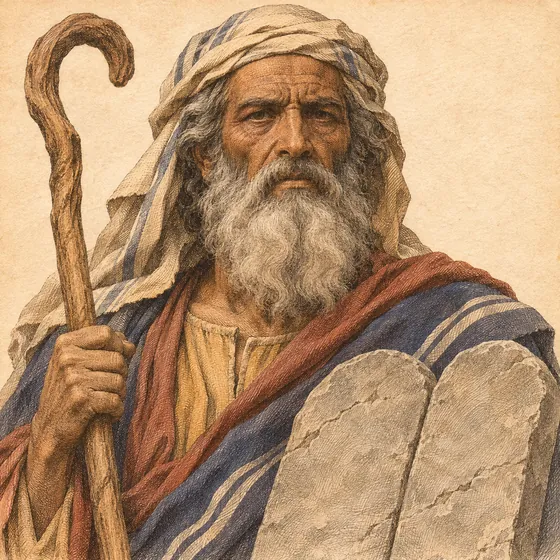
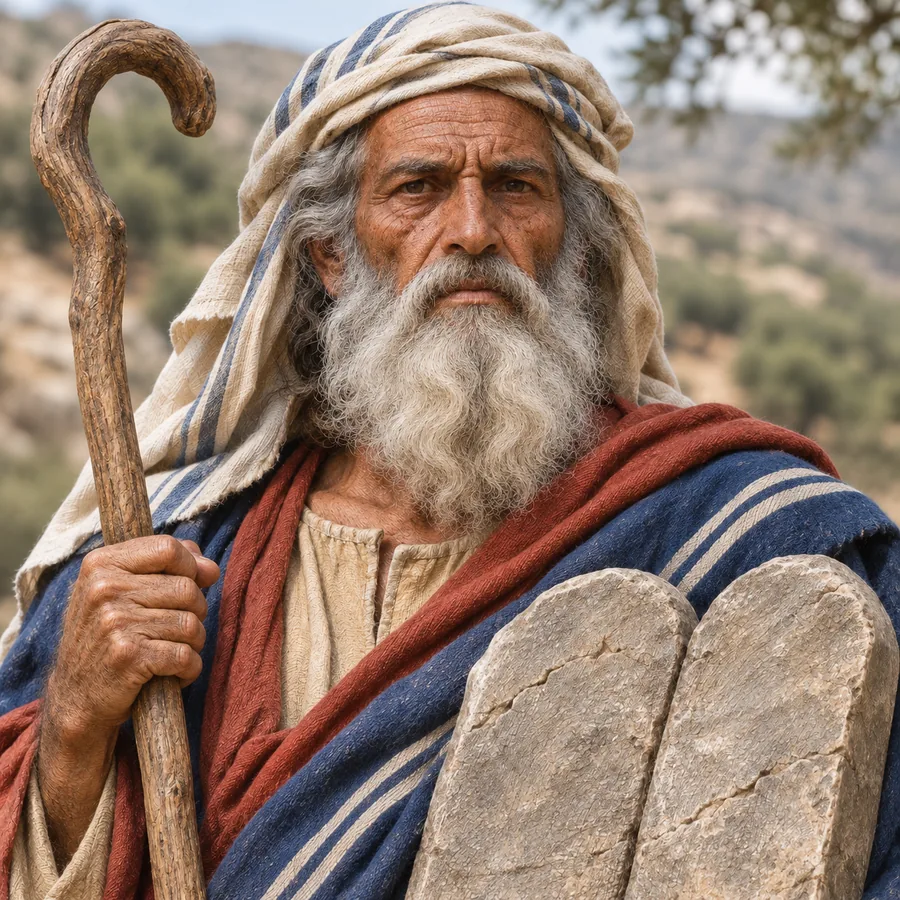
In Exodus to Deuteronomy, he leads the Israelites out of Egypt and receives the Law at Mount Sinai.
See Exodus 3:10, Exodus 14:21, Exodus 31:18.
 Two stone tablets marks Moses in the reading view: the tablets of the covenant (Exodus 34:1, Exodus 34:4).
Mentioned in 774 verses across 31 books, first in Leviticus 1:1. The verses below are the ones linked to this person (the Theographic dataset, with our sourced corrections).
How artists have pictured him
3 works from different centuries and traditions. Each shows how its time and place imagined Moses, not how he looked.


In these stories
Questions about this
In the Bible
All 80 verses in Leviticus, in Bible order. Text from the Berean Standard Bible; verse numbers follow the KJV.
Leviticus
- Leviticus 1:1
Then the LORD called to Moses and spoke to him from the Tent of Meeting, saying,
- Leviticus 4:1
Then the LORD said to Moses,
- Leviticus 5:14
Then the LORD said to Moses,
- Leviticus 6:1
And the LORD said to Moses,
- Leviticus 6:8
Then the LORD said to Moses,
- Leviticus 6:19
Then the LORD said to Moses,
- Leviticus 6:24
And the LORD said to Moses,
- Leviticus 7:22
Then the LORD said to Moses,
- Leviticus 7:28
Then the LORD said to Moses,
- Leviticus 7:38
which the LORD gave Moses on Mount Sinai on the day He commanded the Israelites to present their offerings to the LORD in the Wilderness of Sinai.
- Leviticus 8:1
Then the LORD said to Moses,
- Leviticus 8:4
So Moses did as the LORD had commanded him, and the assembly gathered at the entrance to the Tent of Meeting.
- Leviticus 8:5
And Moses said to them, “This is what the LORD has commanded to be done.”
- Leviticus 8:6
Then Moses presented Aaron and his sons and washed them with water.
- Leviticus 8:9
Moses also put the turban on Aaron’s head and set the gold plate, the holy diadem, on the front of the turban, as the LORD had commanded him.
- Leviticus 8:10
Next, Moses took the anointing oil and anointed the tabernacle and everything in it; and so he consecrated them.
- Leviticus 8:13
Then Moses presented Aaron’s sons, put tunics on them, wrapped sashes around them, and tied headbands on them, just as the LORD had commanded him.
- Leviticus 8:15
Moses slaughtered the bull, took some of the blood, and applied it with his finger to all four horns of the altar, purifying the altar. He poured out the rest of the blood at the base of the altar and consecrated it so that atonement could be made on it.
- Leviticus 8:16
Moses also took all the fat that was on the entrails, the lobe of the liver, and both kidneys and their fat, and burned it all on the altar.
- Leviticus 8:17
But the bull with its hide, flesh, and dung he burned outside the camp, as the LORD had commanded him.
- Leviticus 8:19
Moses slaughtered the ram and sprinkled the blood on all sides of the altar.
- Leviticus 8:20
He cut the ram into pieces and burned the head, the pieces, and the fat.
- Leviticus 8:21
He washed the entrails and legs with water and burned the entire ram on the altar as a burnt offering, a pleasing aroma, an offering made by fire to the LORD, just as the LORD had commanded Moses.
- Leviticus 8:23
Moses slaughtered the ram and took some of its blood and put it on Aaron’s right earlobe, on the thumb of his right hand, and on the big toe of his right foot.
- Leviticus 8:24
Moses also presented Aaron’s sons and put some of the blood on their right earlobes, on the thumbs of their right hands, and on the big toes of their right feet. Then he sprinkled the blood on all sides of the altar.
- Leviticus 8:28
Then Moses took these from their hands and burned them on the altar with the burnt offering. This was an ordination offering, a pleasing aroma, an offering made by fire to the LORD.
- Leviticus 8:29
He also took the breast—Moses’ portion of the ram of ordination—and waved it before the LORD as a wave offering, as the LORD had commanded him.
- Leviticus 8:30
Next, Moses took some of the anointing oil and some of the blood that was on the altar and sprinkled them on Aaron and his garments, and on his sons and their garments. So he consecrated Aaron and his garments, as well as Aaron’s sons and their garments.
- Leviticus 8:31
And Moses said to Aaron and his sons, “Boil the meat at the entrance to the Tent of Meeting and eat it there with the bread that is in the basket of ordination offerings, as I commanded, saying, ‘Aaron and his sons are to eat it.’
- Leviticus 8:36
So Aaron and his sons did everything the LORD had commanded through Moses.
- Leviticus 9:1
On the eighth day Moses summoned Aaron and his sons and the elders of Israel.
- Leviticus 9:5
So they took what Moses had commanded to the front of the Tent of Meeting, and the whole congregation drew near and stood before the LORD.
- Leviticus 9:6
And Moses said, “This is what the LORD has commanded you to do, so that the glory of the LORD may appear to you.”
- Leviticus 9:7
Then Moses said to Aaron, “Approach the altar and sacrifice your sin offering and your burnt offering to make atonement for yourself and for the people. And sacrifice the people’s offering to make atonement for them, as the LORD has commanded.”
- Leviticus 9:10
On the altar he burned the fat, the kidneys, and the lobe of the liver from the sin offering, as the LORD had commanded Moses.
- Leviticus 9:21
but he waved the breasts and the right thigh as a wave offering before the LORD, as Moses had commanded.
- Leviticus 9:23
Moses and Aaron then entered the Tent of Meeting. When they came out, they blessed the people, and the glory of the LORD appeared to all the people.
- Leviticus 10:3
Then Moses said to Aaron, “This is what the LORD meant when He said: ‘To those who come near Me I will show My holiness, and in the sight of all the people I will reveal My glory.’” But Aaron remained silent.
- Leviticus 10:4
Moses summoned Mishael and Elzaphan, sons of Aaron’s uncle Uzziel, and said to them, “Come here; carry the bodies of your cousins outside the camp, away from the front of the sanctuary.”
- Leviticus 10:5
So they came forward and carried them, still in their tunics, outside the camp, as Moses had directed.
- Leviticus 10:6
Then Moses said to Aaron and his sons Eleazar and Ithamar, “Do not let your hair become disheveled and do not tear your garments, or else you will die, and the LORD will be angry with the whole congregation. But your brothers, the whole house of Israel, may mourn on account of the fire that the LORD has ignited.
- Leviticus 10:7
You shall not go outside the entrance to the Tent of Meeting, or you will die, for the LORD’s anointing oil is on you.” So they did as Moses instructed.
- Leviticus 10:11
so that you may teach the Israelites all the statutes that the LORD has given them through Moses.”
- Leviticus 10:12
And Moses said to Aaron and his remaining sons, Eleazar and Ithamar, “Take the grain offering that remains from the offerings made by fire to the LORD and eat it without leaven beside the altar, because it is most holy.
- Leviticus 10:16
Later, Moses searched carefully for the goat of the sin offering, and behold, it had been burned up. He was angry with Eleazar and Ithamar, Aaron’s remaining sons, and asked,
- Leviticus 10:19
But Aaron replied to Moses, “Behold, this very day they presented their sin offering and their burnt offering before the LORD. Since these things have happened to me, if I had eaten the sin offering today, would it have been acceptable in the sight of the LORD?”
- Leviticus 10:20
And when Moses heard this explanation, he was satisfied.
- Leviticus 11:1
The LORD spoke again to Moses and Aaron, telling them,
- Leviticus 12:1
Then the LORD said to Moses,
- Leviticus 13:1
Then the LORD said to Moses and Aaron,
- Leviticus 14:1
Then the LORD said to Moses,
- Leviticus 14:33
Then the LORD said to Moses and Aaron,
- Leviticus 15:1
And the LORD said to Moses and Aaron,
- Leviticus 16:1
Now the LORD spoke to Moses after the death of two of Aaron’s sons when they approached the presence of the LORD.
- Leviticus 16:2
And the LORD said to Moses: “Tell your brother Aaron not to enter freely into the Most Holy Place behind the veil in front of the mercy seat on the ark, or else he will die, because I appear in the cloud above the mercy seat.
- Leviticus 16:34
This is to be a permanent statute for you, to make atonement once a year for the Israelites because of all their sins.” And all this was done as the LORD had commanded Moses.
- Leviticus 17:1
Then the LORD said to Moses,
- Leviticus 18:1
Then the LORD said to Moses,
- Leviticus 19:1
Then the LORD said to Moses,
- Leviticus 20:1
Then the LORD said to Moses,
- Leviticus 21:1
Then the LORD said to Moses, “Speak to Aaron’s sons, the priests, and tell them that a priest is not to defile himself for a dead person among his people,
- Leviticus 21:16
Then the LORD said to Moses,
- Leviticus 21:24
Moses told this to Aaron and his sons and to all the Israelites.
- Leviticus 22:1
Then the LORD said to Moses,
- Leviticus 22:17
Then the LORD said to Moses,
- Leviticus 22:26
Then the LORD said to Moses,
- Leviticus 23:1
Then the LORD said to Moses,
- Leviticus 23:9
And the LORD said to Moses,
- Leviticus 23:23
The LORD also said to Moses,
- Leviticus 23:26
Again the LORD said to Moses,
- Leviticus 23:33
And the LORD said to Moses,
- Leviticus 23:44
So Moses announced to the Israelites the appointed feasts of the LORD.
- Leviticus 24:1
Then the LORD said to Moses,
- Leviticus 24:11
The son of the Israelite woman blasphemed the Name with a curse. So they brought him to Moses. (His mother’s name was Shelomith daughter of Dibri, of the tribe of Dan.)
- Leviticus 24:13
Then the LORD said to Moses,
- Leviticus 24:23
Then Moses spoke to the Israelites, and they took the blasphemer outside the camp and stoned him. So the Israelites did as the LORD had commanded Moses.
- Leviticus 25:1
Then the LORD said to Moses on Mount Sinai,
- Leviticus 26:46
These are the statutes, ordinances, and laws that the LORD established between Himself and the Israelites through Moses on Mount Sinai.
- Leviticus 27:1
Then the LORD said to Moses,
- Leviticus 27:34
These are the commandments that the LORD gave to Moses for the Israelites on Mount Sinai.
Events
Events the dataset lists Moses as taking part in. Dates follow its Ussher–Jones reckoning (one of several traditional counts), not established history.
- c. 1571 BCBirth of Moses
- c. 1571 BCLifetime of Moses
- c. 1491 BCExodus from Egypt
- c. 1491 BCWilderness Wanderings
- c. 1491 BCTen Commandments Given
- c. 1490 BCTabernacle Built
- c. 1452 BCDeath of Moses
- c. AD 29The Transfiguation
Dictionary
From Easton’s Bible Dictionary (1897), as attached to this record by Theographic. The entry is for the name and can describe more than one person who bore it. Easton wrote in 1897, and some of his views are now debated.
Read Easton’s entry
Drawn (or Egypt. mesu, “son;” hence Rameses, royal son). On the invitation of Pharaoh (Gen. 45:17-25), Jacob and his sons went down into Egypt. This immigration took place probably about 350 years before the birth of Moses. Some centuries before Joseph, Egypt had been conquered by a pastoral Semitic race from Asia, the Hyksos, who brought into cruel subjection the native Egyptians, who were an African race. Jacob and his retinue were accustomed to a shepherd’s life, and on their arrival in Egypt were received with favour by the king, who assigned them the “best of the land”, the land of Goshen, to dwell in. The Hyksos or “shepherd” king who thus showed favour to Joseph and his family was in all probability the Pharaoh Apopi (or Apopis).
Thus favoured, the Israelites began to “multiply exceedingly” (Gen. 47:27), and extended to the west and south. At length the supremacy of the Hyksos came to an end. The descendants of Jacob were allowed to retain their possession of Goshen undisturbed, but after the death of Joseph their position was not so favourable. The Egyptians began to despise them, and the period of their “affliction” (Gen. 15:13) commenced. They were sorely oppressed. They continued, however, to increase in numbers, and “the land was filled with them” (Ex. 1:7). The native Egyptians regarded them with suspicion, so that they felt all the hardship of a struggle for existence.
In process of time “a king [probably Seti I.] arose who knew not Joseph” (Ex. 1:8). The circumstances of the country were such that this king thought it necessary to weaken his Israelite subjects by oppressing them, and by degrees reducing their number. They were accordingly made public slaves, and were employed in connection with his numerous buildings, especially in the erection of store-cities, temples, and palaces. The children of Israel were made to serve with rigour. Their lives were made bitter with hard bondage, and “all their service, wherein they made them serve, was with rigour” (Ex. 1:13, 14). But this cruel oppression had not the result expected of reducing their number. On the contrary, “the more the Egyptians afflicted them, the more they multiplied and grew” (Ex. 1:12).
The king next tried, through a compact secretly made with the guild of midwives, to bring about the destruction of all the Hebrew male children that might be born. But the king’s wish was not rigorously enforced; the male children were spared by the midwives, so that “the people multiplied” more than ever. Thus baffled, the king issued a public proclamation calling on the people to put to death all the Hebrew male children by casting them into the river (Ex. 1:22). But neither by this edict was the king’s purpose effected.
One of the Hebrew households into which this cruel edict of the king brought great alarm was that of Amram, of the family of the Kohathites (Ex. 6:16-20), who with his wife Jochebed and two children, Miriam, a girl of perhaps fifteen years of age, and Aaron, a boy of three years, resided in or near Memphis, the capital city of that time. In this quiet home a male child was born (B.C. 1571). His mother concealed him in the house for three months from the knowledge of the civic authorities. But when the task of concealment became difficult, Jochebed contrived to bring her child under the notice of the daughter of the king by constructing for him an ark of bulrushes, which she laid among the flags which grew on the edge of the river at the spot where the princess was wont to come down and bathe. Her plan was successful. The king’s daughter “saw the child; and behold the child wept.” The princess (see PHARAOH’S DAUGHTER [1]) sent Miriam, who was standing by, to fetch a nurse. She went and brought the mother of the child, to whom the princess said, “Take this child away, and nurse it for me, and I will give thee thy wages.” Thus Jochebed’s child, whom the princess called “Moses”, i.e., “Saved from the water” (Ex. 2:10), was ultimately restored to her.
As soon as the natural time for weaning the child had come, he was transferred from the humble abode of his father to the royal palace, where he was brought up as the adopted son of the princess, his mother probably accompanying him and caring still for him. He grew up amid all the grandeur and excitement of the Egyptian court, maintaining, however, probably a constant fellowship with his mother, which was of the highest importance as to his religious belief and his interest in his “brethren.” His education would doubtless be carefully attended to, and he would enjoy all the advantages of training both as to his body and his mind. He at length became “learned in all the wisdom of the Egyptians” (Acts 7:22). Egypt had then two chief seats of learning, or universities, at one of which, probably that of Heliopolis, his education was completed. Moses, being now about twenty years of age, spent over twenty more before he came into prominence in Bible history. These twenty years were probably spent in military service. There is a tradition recorded by Josephus that he took a lead in the war which was then waged between Egypt and Ethiopia, in which he gained renown as a skilful general, and became “mighty in deeds” (Acts 7:22).
After the termination of the war in Ethiopia, Moses returned to the Egyptian court, where he might reasonably have expected to be loaded with honours and enriched with wealth. But “beneath the smooth current of his life hitherto, a life of alternate luxury at the court and comparative hardness in the camp and in the discharge of his military duties, there had lurked from childhood to youth, and from youth to manhood, a secret discontent, perhaps a secret ambition. Moses, amid all his Egyptian surroundings, had never forgotten, had never wished to forget, that he was a Hebrew.” He now resolved to make himself acquainted with the condition of his countrymen, and “went out unto his brethren, and looked upon their burdens” (Ex. 2:11). This tour of inspection revealed to him the cruel oppression and bondage under which they everywhere groaned, and could not fail to press on him the serious consideration of his duty regarding them. The time had arrived for his making common cause with them, that he might thereby help to break their yoke of bondage. He made his choice accordingly (Heb. 11:25-27), assured that God would bless his resolution for the welfare of his people. He now left the palace of the king and took up his abode, probably in his father’s house, as one of the Hebrew people who had for forty years been suffering cruel wrong at the hands of the Egyptians.
He could not remain indifferent to the state of things around him, and going out one day among the people, his indignation was roused against an Egyptian who was maltreating a Hebrew. He rashly lifted up his hand and slew the Egyptian, and hid his body in the sand. Next day he went out again and found two Hebrews striving together. He speedily found that the deed of the previous day was known. It reached the ears of Pharaoh (the “great Rameses,” Rameses II.), who “sought to slay Moses” (Ex. 2:15). Moved by fear, Moses fled from Egypt, and betook himself to the land of Midian, the southern part of the peninsula of Sinai, probably by much the same route as that by which, forty years afterwards, he led the Israelites to Sinai. He was providentially led to find a new home with the family of Reuel, where he remained for forty years (Acts 7:30), under training unconsciously for his great life’s work.
Suddenly the angel of the Lord appeared to him in the burning bush ([Ex. 3](/exod#Exod.3)), and commissioned him to go down to Egypt and “bring forth the children of Israel” out of bondage. He was at first unwilling to go, but at length he was obedient to the heavenly vision, and left the land of Midian (4:18-26). On the way he was met by Aaron (q.v.) and the elders of Israel (27-31). He and Aaron had a hard task before them; but the Lord was with them (ch. 7-12), and the ransomed host went forth in triumph. After an eventful journey to and fro in the wilderness, we see them at length encamped in the plains of Moab, ready to cross over the Jordan into the Promised Land. There Moses addressed the assembled elders (Deut. 1:1-4; 5:1-26:19; 27:11-30:20), and gives the people his last counsels, and then rehearses the great song ([Deut. 32](/deut#Deut.32)), clothing in fitting words the deep emotions of his heart at such a time, and in review of such a marvellous history as that in which he had acted so conspicious a part. Then, after blessing the tribes (33), he ascends to “the mountain of Nebo (q.v.), to the top of Pisgah, that is over against Jericho” (34:1), and from thence he surveys the land. “Jehovah shewed him all the land of Gilead, unto Dan, and all Naphtali, and the land of Ephraim, and Manasseh, and all the land of Judah, unto the utmost sea, and the south, and the plain of the valley of Jericho, the city of palm trees, unto Zoar” (Deut. 34:2-3), the magnificient inheritance of the tribes of whom he had been so long the leader; and there he died, being one hundred and twenty years old, according to the word of the Lord, and was buried by the Lord “in a valley in the land of Moab, over against Beth-peor” (34:6). The people mourned for him during thirty days.
Thus died “Moses the man of God” (Deut. 33:1; Josh. 14:6). He was distinguished for his meekness and patience and firmness, and “he endured as seeing him who is invisible.” “There arose not a prophet since in Israel like unto Moses, whom the Lord knew face to face, in all the signs and the wonders, which the Lord sent him to do in the land of Egypt to Pharaoh, and to all his servants, and to all his land, and in all that mighty hand, and in all the great terror which Moses shewed in the sight of all Israel” (Deut. 34:10-12).
The name of Moses occurs frequently in the Psalms and Prophets as the chief of the prophets.
In the New Testament he is referred to as the representative of the law and as a type of Christ (John 1:17; 2 Cor. 3:13-18; Heb. 3:5, 6). Moses is the only character in the Old Testament to whom Christ likens himself (John 5:46; comp. Deut. 18:15, 18, 19; Acts 7:37). In Heb. 3:1-19 this likeness to Moses is set forth in various particulars.
In Jude 1:9 mention is made of a contention between Michael and the devil about the body of Moses. This dispute is supposed to have had reference to the concealment of the body of Moses so as to prevent idolatry.