Person
Saul
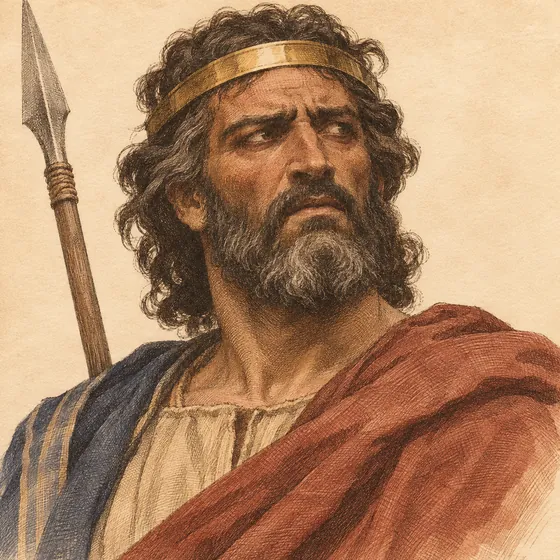
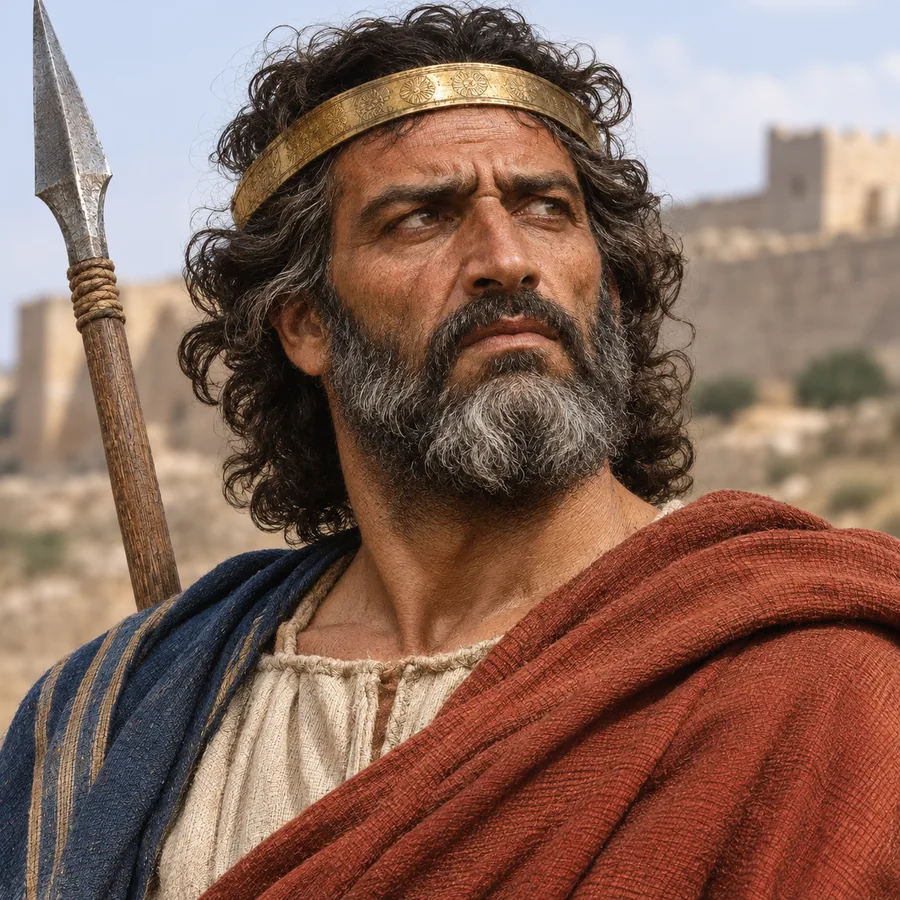

In 1 Samuel, Israel's first king, anointed by Samuel; he loses God's favour, hunts the young David, and dies in battle against the Philistines.
See 1 Samuel 10:1, 1 Samuel 15:26, 1 Samuel 23:14, 1 Samuel 31:4.
 A spear and a crown marks Saul in the reading view: the spear he hurled at David, and the crown taken from him after his death (1 Samuel 18:11, 2 Samuel 1:10).
Mentioned in 265 verses across 3 books, first in 1 Samuel 9:2. The verses below are the ones linked to this person (the Theographic dataset, with our sourced corrections).
How artists have pictured him
3 works from different centuries and traditions. Each shows how its time and place imagined Saul, not how he looked.


Questions about this
In the Bible
All 241 verses in 1 Samuel, in Bible order. Text from the Berean Standard Bible; verse numbers follow the KJV.
1 Samuel
- 1 Samuel 9:2
And he had a son named Saul, choice and handsome, without equal among the Israelites—a head taller than any of the people.
- 1 Samuel 9:3
One day the donkeys of Saul’s father Kish wandered off, and Kish said to his son Saul, “Take one of the servants and go look for the donkeys.”
- 1 Samuel 9:5
When they reached the land of Zuph, Saul said to his servant, “Come, let us go back, or my father will stop worrying about the donkeys and start worrying about us.”
- 1 Samuel 9:7
“If we do go,” Saul replied, “what can we give the man? For the bread in our packs is gone, and there is no gift to take to the man of God. What do we have?”
- 1 Samuel 9:8
The servant answered him again. “Look,” he said, “I have here in my hand a quarter shekel of silver. I will give it to the man of God, and he will tell us our way.”
- 1 Samuel 9:10
“Good,” said Saul to his servant. “Come, let us go.” So they set out for the city where the man of God was.
- 1 Samuel 9:15
Now on the day before Saul’s arrival, the LORD had revealed to Samuel,
- 1 Samuel 9:17
When Samuel saw Saul, the LORD told him, “Here is the man of whom I spoke; he shall rule over My people.”
- 1 Samuel 9:18
Saul approached Samuel in the gateway and asked, “Would you please tell me where the seer’s house is?”
- 1 Samuel 9:19
“I am the seer,” Samuel replied. “Go up before me to the high place, for you shall eat with me today. And when I send you off in the morning, I will tell you all that is in your heart.
- 1 Samuel 9:21
Saul replied, “Am I not a Benjamite from the smallest tribe of Israel, and is not my clan the least of all the clans of Benjamin? So why would you say such a thing to me?”
- 1 Samuel 9:22
Then Samuel took Saul and his servant, brought them into the hall, and seated them in the place of honor among those who were invited—about thirty in all.
- 1 Samuel 9:24
So the cook picked up the leg and what was attached to it and set it before Saul. Then Samuel said, “Here is what was kept back. It was set apart for you. Eat, for it has been kept for you for this occasion, from the time I said, ‘I have invited the people.’” So Saul dined with Samuel that day.
- 1 Samuel 9:25
And after they had come down from the high place into the city, Samuel spoke with Saul on the roof of his house.
- 1 Samuel 9:26
They got up early in the morning, and just before dawn Samuel called to Saul on the roof, “Get ready, and I will send you on your way!” So Saul arose, and both he and Samuel went outside together.
- 1 Samuel 9:27
As they were going down to the edge of the city, Samuel said to Saul, “Tell the servant to go on ahead of us, but you stay for a while, and I will reveal to you the word of God.” So the servant went on.
- 1 Samuel 10:11
All those who had formerly known Saul and saw him prophesying with the prophets asked one another, “What has happened to the son of Kish? Is Saul also among the prophets?”
- 1 Samuel 10:12
Then a man who lived there replied, “And who is their father?” So the saying became a proverb: “Is Saul also among the prophets?”
- 1 Samuel 10:14
Now Saul’s uncle asked him and his servant, “Where did you go?” “To look for the donkeys,” Saul replied. “When we saw they were not to be found, we went to Samuel.”
- 1 Samuel 10:15
“Tell me,” Saul’s uncle asked, “what did Samuel say to you?”
- 1 Samuel 10:16
And Saul replied, “He assured us that the donkeys had been found.” But Saul did not tell his uncle what Samuel had said about the kingship.
- 1 Samuel 10:21
Then he had the tribe of Benjamin come forward by its clans, and the clan of Matri was selected. Finally, Saul son of Kish was selected. But when they looked for him, they could not find him.
- 1 Samuel 10:26
Saul also went to his home in Gibeah, and the men of valor whose hearts God had touched went with him.
- 1 Samuel 11:4
When the messengers came to Gibeah of Saul and relayed these words in the hearing of the people, they all wept aloud.
- 1 Samuel 11:5
Just then Saul was returning from the field, behind his oxen. “What troubles the people?” asked Saul. “Why are they weeping?” And they relayed to him the words of the men from Jabesh.
- 1 Samuel 11:6
When Saul heard their words, the Spirit of God rushed upon him, and he burned with great anger.
- 1 Samuel 11:7
He took a pair of oxen, cut them into pieces, and sent them by messengers throughout the land of Israel, proclaiming, “This is what will be done to the oxen of anyone who does not march behind Saul and Samuel.” Then the terror of the LORD fell upon the people, and they turned out as one man.
- 1 Samuel 11:11
The next day Saul organized the troops into three divisions, and during the morning watch they invaded the camp of the Ammonites and slaughtered them, until the hottest part of the day. And the survivors were so scattered that no two of them were left together.
- 1 Samuel 11:12
Then the people said to Samuel, “Who said that Saul should not reign over us? Bring those men here so we can kill them!”
- 1 Samuel 11:13
But Saul ordered, “No one shall be put to death this day, for today the LORD has worked salvation in Israel.”
- 1 Samuel 11:15
So all the people went to Gilgal and confirmed Saul as king in the presence of the LORD. There they sacrificed peace offerings before the LORD, and Saul and all the Israelites rejoiced greatly.
- 1 Samuel 13:1
Saul was thirty years old when he became king, and he reigned over Israel forty-two years.
- 1 Samuel 13:2
He chose for himself three thousand men of Israel: Two thousand were with Saul at Michmash and in the hill country of Bethel, and a thousand were with Jonathan in Gibeah of Benjamin. And the rest of the troops he sent away, each to his own home.
- 1 Samuel 13:3
Then Jonathan attacked the Philistine outpost at Geba, and the Philistines heard about it. So Saul blew the ram’s horn throughout the land, saying, “Let the Hebrews hear!”
- 1 Samuel 13:4
And all Israel heard the news: “Saul has attacked an outpost of the Philistines, and now Israel has become a stench to the Philistines!” Then the people were summoned to join Saul at Gilgal.
- 1 Samuel 13:7
Some Hebrews even crossed the Jordan into the land of Gad and Gilead. Saul, however, remained at Gilgal, and all his troops were quaking in fear.
- 1 Samuel 13:9
So he said, “Bring me the burnt offering and the peace offerings.” And he offered up the burnt offering.
- 1 Samuel 13:10
Just as he finished offering the burnt offering, Samuel arrived, and Saul went out to greet him.
- 1 Samuel 13:11
“What have you done?” Samuel asked. And Saul replied, “When I saw that the troops were deserting me, and that you did not come at the appointed time and the Philistines were gathering at Michmash,
- 1 Samuel 13:13
“You have acted foolishly,” Samuel declared. “You have not kept the command that the LORD your God gave you; if you had, the LORD would have established your kingdom over Israel for all time.
- 1 Samuel 13:15
Then Samuel set out from Gilgal and went up to Gibeah in Benjamin. And Saul numbered the troops who were with him, about six hundred men.
- 1 Samuel 13:16
Now Saul and Jonathan his son and the troops with them were staying in Geba of Benjamin, while the Philistines camped at Michmash.
- 1 Samuel 13:22
So on the day of battle not a sword or spear could be found in the hands of the troops with Saul and Jonathan; only Saul and his son Jonathan had weapons.
- 1 Samuel 14:1
One day Jonathan son of Saul said to the young man bearing his armor, “Come, let us cross over to the Philistine outpost on the other side.” But Jonathan did not tell his father.
- 1 Samuel 14:2
Meanwhile, Saul was staying under the pomegranate tree in Migron on the outskirts of Gibeah. And the troops who were with him numbered about six hundred men,
- 1 Samuel 14:16
Now when Saul’s watchmen at Gibeah in Benjamin looked and saw the troops melting away and scattering in every direction,
- 1 Samuel 14:17
Saul said to the troops who were with him, “Call the roll and see who has left us.” And when they had called the roll, they saw that Jonathan and his armor-bearer were not there.
- 1 Samuel 14:18
Then Saul said to Ahijah, “Bring the ark of God.” (For at that time it was with the Israelites.)
- 1 Samuel 14:19
While Saul was talking to the priest, the commotion in the Philistine camp continued to increase. So Saul said to the priest, “Withdraw your hand.”
- 1 Samuel 14:20
Then Saul and all his troops assembled and marched to the battle, and they found the Philistines in total confusion, with each man wielding the sword against his neighbor.
- 1 Samuel 14:21
And the Hebrews who had previously gone up into the surrounding camps of the Philistines now went over to the Israelites who were with Saul and Jonathan.
- 1 Samuel 14:24
Now the men of Israel were in distress that day, for Saul had placed the troops under an oath, saying, “Cursed is the man who eats any food before evening, before I have taken vengeance on my enemies.” So none of the troops tasted any food.
- 1 Samuel 14:33
Then someone reported to Saul: “Look, the troops are sinning against the LORD by eating meat with the blood still in it.” “You have broken faith,” said Saul. “Roll a large stone over here at once.”
- 1 Samuel 14:34
Then he said, “Go among the troops and tell them, ‘Each man must bring me his ox or his sheep, slaughter them in this place, and then eat. Do not sin against the LORD by eating meat with the blood still in it.’” So that night everyone brought his ox and slaughtered it there.
- 1 Samuel 14:35
Then Saul built an altar to the LORD; it was the first time he had built an altar to the LORD.
- 1 Samuel 14:36
And Saul said, “Let us go down after the Philistines by night and plunder them until dawn, leaving no man alive!” “Do what seems good to you,” the troops replied. But the priest said, “We must consult God here.”
- 1 Samuel 14:37
So Saul inquired of God, “Shall I go down after the Philistines? Will You give them into the hand of Israel?” But God did not answer him that day.
- 1 Samuel 14:38
Therefore Saul said, “Come here, all you leaders of the troops, and let us investigate how this sin has occurred today.
- 1 Samuel 14:40
Then Saul said to all Israel, “You stand on one side, and I and my son Jonathan will stand on the other side.” “Do what seems good to you,” the troops replied.
- 1 Samuel 14:41
So Saul said to the LORD, the God of Israel, “Why have You not answered Your servant this day? If the fault is with me or my son Jonathan, respond with Urim; but if the fault is with the men of Israel, respond with Thummim.” And Jonathan and Saul were selected, but the people were cleared of the charge.
- 1 Samuel 14:42
Then Saul said, “Cast the lot between me and my son Jonathan.” And Jonathan was selected.
- 1 Samuel 14:43
“Tell me what you have done,” Saul commanded him. So Jonathan told him, “I only tasted a little honey with the end of the staff that was in my hand. And now I must die?”
- 1 Samuel 14:44
And Saul declared, “May God punish me, and ever so severely, if you, Jonathan, do not surely die!”
- 1 Samuel 14:45
But the people said to Saul, “Must Jonathan die—he who accomplished such a great deliverance for Israel? Never! As surely as the LORD lives, not a hair of his head will fall to the ground, for with God’s help he has accomplished this today.” So the people rescued Jonathan, and he did not die.
- 1 Samuel 14:46
Then Saul gave up his pursuit of the Philistines, and the Philistines returned to their own land.
- 1 Samuel 14:47
After Saul had assumed the kingship over Israel, he fought against all his enemies on every side—the Moabites, the Ammonites, the Edomites, the kings of Zobah, and the Philistines. Wherever he turned, he routed them.
- 1 Samuel 14:49
Now the sons of Saul were Jonathan, Ishvi, and Malchishua. His two daughters were named Merab (his firstborn) and Michal (his younger daughter).
- 1 Samuel 14:50
His wife’s name was Ahinoam daughter of Ahimaaz. The name of the commander of his army was Abner, the son of Saul’s uncle Ner.
- 1 Samuel 14:51
Saul’s father Kish and Abner’s father Ner were sons of Abiel.
- 1 Samuel 14:52
And the war with the Philistines was fierce for all the days of Saul. So whenever he noticed any strong or brave man, Saul would enlist him.
- 1 Samuel 15:1
Then Samuel said to Saul, “The LORD sent me to anoint you king over His people Israel. Now therefore, listen to the words of the LORD.
- 1 Samuel 15:4
So Saul summoned the troops and numbered them at Telaim—200,000 foot soldiers and 10,000 men of Judah.
- 1 Samuel 15:5
Saul came to the city of Amalek and lay in wait in the valley.
- 1 Samuel 15:6
And he warned the Kenites, “Since you showed kindness to all the Israelites when they came up out of Egypt, go on and get away from the Amalekites. Otherwise I will sweep you away with them.” So the Kenites moved away from the Amalekites.
- 1 Samuel 15:7
Then Saul struck down the Amalekites all the way from Havilah to Shur, which is east of Egypt.
- 1 Samuel 15:9
Saul and his troops spared Agag, along with the best of the sheep and cattle, the fat calves and lambs, and the best of everything else. They were unwilling to destroy them, but they devoted to destruction all that was despised and worthless.
- 1 Samuel 15:11
“I regret that I have made Saul king, for he has turned away from following Me and has not carried out My instructions.” And Samuel was distressed and cried out to the LORD all that night.
- 1 Samuel 15:12
Early in the morning Samuel got up to confront Saul, but he was told, “Saul has gone to Carmel, and behold, he has set up a monument for himself and has turned and gone down to Gilgal.”
- 1 Samuel 15:13
When Samuel reached him, Saul said to him, “May the LORD bless you. I have carried out the LORD’s instructions.”
- 1 Samuel 15:15
Saul answered, “The troops brought them from the Amalekites; they spared the best sheep and cattle to sacrifice to the LORD your God, but the rest we devoted to destruction.”
- 1 Samuel 15:16
“Stop!” exclaimed Samuel. “Let me tell you what the LORD said to me last night.” “Tell me,” Saul replied.
- 1 Samuel 15:20
“But I did obey the LORD,” Saul replied. “I went on the mission that the LORD gave me. I brought back Agag king of Amalek and devoted the Amalekites to destruction.
- 1 Samuel 15:24
Then Saul said to Samuel, “I have sinned; I have transgressed the LORD’s commandment and your instructions, because I feared the people and obeyed their voice.
- 1 Samuel 15:26
“I will not return with you,” Samuel replied. “For you have rejected the word of the LORD, and He has rejected you as king over Israel.”
- 1 Samuel 15:31
So Samuel went back with Saul, and Saul worshiped the LORD.
- 1 Samuel 15:34
Then Samuel went to Ramah, but Saul went up to his home in Gibeah of Saul.
- 1 Samuel 15:35
And to the day of his death, Samuel never again visited Saul. Samuel mourned for Saul, and the LORD regretted that He had made Saul king over Israel.
- 1 Samuel 16:1
Now the LORD said to Samuel, “How long are you going to mourn for Saul, since I have rejected him as king over Israel? Fill your horn with oil and go. I am sending you to Jesse of Bethlehem, for I have selected from his sons a king for Myself.”
- 1 Samuel 16:2
“How can I go?” Samuel asked. “Saul will hear of it and kill me!” The LORD answered, “Take a heifer with you and say, ‘I have come to sacrifice to the LORD.’
- 1 Samuel 16:14
After the Spirit of the LORD had departed from Saul, a spirit of distress from the LORD began to torment him.
- 1 Samuel 16:15
Saul’s servants said to him, “Surely a spirit of distress from God is tormenting you.
- 1 Samuel 16:17
And Saul commanded his servants, “Find me someone who plays well, and bring him to me.”
- 1 Samuel 16:19
So Saul sent messengers to Jesse and said, “Send me your son David, who is with the sheep.”
- 1 Samuel 16:20
And Jesse took a donkey loaded with bread, a skin of wine, and one young goat, and sent them to Saul with his son David.
- 1 Samuel 16:21
When David came to Saul and entered his service, Saul admired him greatly, and David became his armor-bearer.
- 1 Samuel 16:22
Then Saul sent word to Jesse, saying, “Let David remain in my service, for I am pleased with him.”
- 1 Samuel 16:23
And whenever the spirit from God came upon Saul, David would pick up his harp and play, and Saul would become well, and the spirit of distress would depart from him.
- 1 Samuel 17:2
Saul and the men of Israel assembled and camped in the Valley of Elah, arraying themselves for battle against the Philistines.
- 1 Samuel 17:8
And Goliath stood and shouted to the ranks of Israel, “Why do you come out and array yourselves for battle? Am I not a Philistine, and are you not servants of Saul? Choose one of your men and have him come down against me.
- 1 Samuel 17:11
On hearing the words of the Philistine, Saul and all the Israelites were dismayed and greatly afraid.
- 1 Samuel 17:12
Now David was the son of a man named Jesse, an Ephrathite from Bethlehem of Judah who had eight sons in the days of Saul. And Jesse was old and well along in years.
- 1 Samuel 17:13
The three older sons of Jesse had followed Saul into battle: The firstborn was Eliab, the second was Abinadab, and the third was Shammah.
- 1 Samuel 17:14
And David was the youngest. The three oldest had followed Saul,
- 1 Samuel 17:15
but David went back and forth from Saul to tend his father’s sheep in Bethlehem.
- 1 Samuel 17:19
They are with Saul and all the men of Israel in the Valley of Elah, fighting against the Philistines.”
- 1 Samuel 17:31
Now David’s words were overheard and reported to Saul, who called for him.
- 1 Samuel 17:32
And David said to Saul, “Let no man’s heart fail on account of this Philistine. Your servant will go and fight him!”
- 1 Samuel 17:33
But Saul replied, “You cannot go out against this Philistine to fight him. You are just a boy, and he has been a warrior from his youth.”
- 1 Samuel 17:34
David replied, “Your servant has been tending his father’s sheep, and whenever a lion or a bear came and carried off a lamb from the flock,
- 1 Samuel 17:37
David added, “The LORD, who delivered me from the claws of the lion and the bear, will deliver me from the hand of this Philistine.” “Go,” said Saul, “and may the LORD be with you.”
- 1 Samuel 17:38
Then Saul clothed David in his own tunic, put a bronze helmet on his head, and dressed him in armor.
- 1 Samuel 17:39
David strapped his sword over the tunic and tried to walk, but he was not accustomed to them. “I cannot walk in these,” David said to Saul. “I am not accustomed to them.” So David took them off.
- 1 Samuel 17:55
As Saul had watched David going out to confront the Philistine, he said to Abner the commander of the army, “Abner, whose son is this young man?” “As surely as you live, O king,” Abner replied, “I do not know.”
- 1 Samuel 17:57
So when David returned from killing the Philistine, still holding his head in his hand, Abner took him and brought him before Saul.
- 1 Samuel 17:58
“Whose son are you, young man?” asked Saul. “I am the son of your servant Jesse of Bethlehem,” David replied.
- 1 Samuel 18:1
After David had finished speaking with Saul, the souls of Jonathan and David were knit together, and Jonathan loved him as himself.
- 1 Samuel 18:2
And from that day Saul kept David with him and did not let him return to his father’s house.
- 1 Samuel 18:5
So David marched out and prospered in everything Saul sent him to do, and Saul set him over the men of war. And this was pleasing in the sight of all the people, and of Saul’s officers as well.
- 1 Samuel 18:6
As the troops were returning home after David had killed the Philistine, the women came out of all the cities of Israel to meet King Saul with singing and dancing, with joyful songs, and with tambourines and other instruments.
- 1 Samuel 18:7
And as the women danced, they sang out: “Saul has slain his thousands, and David his tens of thousands.”
- 1 Samuel 18:8
And Saul was furious and resented this song. “They have ascribed tens of thousands to David,” he said, “but only thousands to me. What more can he have but the kingdom?”
- 1 Samuel 18:9
And from that day forward Saul kept a jealous eye on David.
- 1 Samuel 18:10
The next day a spirit of distress sent from God came upon Saul, and he prophesied inside the house while David played the harp as usual. Now Saul was holding a spear,
- 1 Samuel 18:11
and he hurled it, thinking, “I will pin David to the wall.” But David eluded him twice.
- 1 Samuel 18:12
So Saul was afraid of David, because the LORD was with David but had departed from Saul.
- 1 Samuel 18:13
Therefore Saul sent David away and gave him command of a thousand men. David led the troops out to battle and back,
- 1 Samuel 18:15
When Saul saw that David was very successful, he was afraid of him.
- 1 Samuel 18:17
Then Saul said to David, “Here is my older daughter Merab. I will give her to you in marriage. Only be valiant for me and fight the LORD’s battles.” But Saul was thinking, “I need not raise my hand against him; let the hand of the Philistines be against him.”
- 1 Samuel 18:18
And David said to Saul, “Who am I, and what is my family or my father’s clan in Israel, that I should become the son-in-law of the king?”
- 1 Samuel 18:19
So when it was time to give Saul’s daughter Merab to David, she was given in marriage to Adriel of Meholah.
- 1 Samuel 18:20
Now Saul’s daughter Michal loved David, and when this was reported to Saul, it pleased him.
- 1 Samuel 18:21
“I will give her to David,” Saul thought, “so that she may be a snare to him, and the hand of the Philistines may be against him.” So Saul said to David, “For a second time now you can be my son-in-law.”
- 1 Samuel 18:22
Then Saul ordered his servants, “Speak to David privately and tell him, ‘Behold, the king is pleased with you, and all his servants love you. Now therefore, become his son-in-law.’”
- 1 Samuel 18:23
But when Saul’s servants relayed these words to David, he replied, “Does it seem trivial in your sight to be the son-in-law of the king? I am a poor man and lightly esteemed.”
- 1 Samuel 18:24
And the servants told Saul what David had said.
- 1 Samuel 18:25
Saul replied, “Say to David, ‘The king desires no other dowry but a hundred Philistine foreskins as revenge on his enemies.’” But Saul intended to cause David’s death at the hands of the Philistines.
- 1 Samuel 18:27
David and his men went out and killed two hundred Philistines. He brought their foreskins and presented them as payment in full to become the king’s son-in-law. Then Saul gave his daughter Michal to David in marriage.
- 1 Samuel 18:28
When Saul realized that the LORD was with David and that his daughter Michal loved David,
- 1 Samuel 18:29
he grew even more afraid of David. So from then on Saul was David’s enemy.
- 1 Samuel 18:30
Every time the Philistine commanders came out for battle, David was more successful than all of Saul’s officers, so that his name was highly esteemed.
- 1 Samuel 19:1
Then Saul ordered his son Jonathan and all his servants to kill David. But Jonathan delighted greatly in David,
- 1 Samuel 19:2
so he warned David, saying, “My father Saul intends to kill you. Be on your guard in the morning; find a secret place and hide there.
- 1 Samuel 19:4
Then Jonathan spoke well of David to his father Saul and said to him, “The king should not sin against his servant David; he has not sinned against you. In fact, his actions have been highly beneficial to you.
- 1 Samuel 19:6
Saul listened to the voice of Jonathan and swore an oath: “As surely as the LORD lives, David will not be put to death.”
- 1 Samuel 19:7
So Jonathan summoned David and told him all these things. Then Jonathan brought David to Saul to serve him as he had before.
- 1 Samuel 19:9
But as Saul was sitting in his house with his spear in his hand, a spirit of distress from the LORD came upon him. While David was playing the harp,
- 1 Samuel 19:10
Saul tried to pin him to the wall with his spear. But the spear struck the wall and David eluded him, ran away, and escaped that night.
- 1 Samuel 19:11
Then Saul sent messengers to David’s house to watch him and kill him in the morning. But David’s wife Michal warned him, “If you do not run for your life tonight, tomorrow you will be dead!”
- 1 Samuel 19:14
When Saul sent the messengers to seize David, Michal said, “He is ill.”
- 1 Samuel 19:15
But Saul sent the messengers back to see David and told them, “Bring him up to me in his bed so I can kill him.”
- 1 Samuel 19:17
And Saul said to Michal, “Why did you deceive me like this? You sent my enemy away and he has escaped!” Michal replied, “He said to me, ‘Help me get away, or I will kill you!’”
- 1 Samuel 19:18
So David ran away and escaped. And he went to Samuel at Ramah and told him all that Saul had done to him. Then he and Samuel went to Naioth and stayed there.
- 1 Samuel 19:19
When Saul was told that David was at Naioth in Ramah,
- 1 Samuel 19:20
he sent messengers to capture him. But when they saw the group of prophets prophesying, with Samuel leading them, the Spirit of God came upon them, and Saul’s messengers also began to prophesy.
- 1 Samuel 19:21
When this was reported to Saul, he sent more messengers, but they began to prophesy as well. So Saul tried again and sent messengers a third time, and even they began to prophesy.
- 1 Samuel 19:24
Then Saul stripped off his robes and also prophesied before Samuel. And he collapsed and lay naked all that day and night. That is why it is said, “Is Saul also among the prophets?”
- 1 Samuel 20:25
He sat in his usual place by the wall, opposite Jonathan and beside Abner, but David’s place was empty.
- 1 Samuel 20:26
Saul said nothing that day because he thought, “Something has happened to David to make him ceremonially unclean—surely he is unclean.”
- 1 Samuel 20:27
But on the day after the New Moon, the second day, David’s place was still empty, and Saul asked his son Jonathan, “Why hasn’t the son of Jesse come to the meal either yesterday or today?”
- 1 Samuel 20:28
Jonathan answered, “David urgently requested my permission to go to Bethlehem,
- 1 Samuel 20:30
Then Saul’s anger burned against Jonathan, and he said to him, “You son of a perverse and rebellious woman! Do I not know that you have chosen the son of Jesse to your own shame and to the disgrace of the mother who bore you?
- 1 Samuel 20:32
“Why must he be put to death?” Jonathan replied. “What has he done?”
- 1 Samuel 20:33
Then Saul hurled his spear at Jonathan to kill him; so Jonathan knew that his father was determined to kill David.
- 1 Samuel 21:7
Now one of Saul’s servants was there that day, detained before the LORD. And his name was Doeg the Edomite, the chief shepherd for Saul.
- 1 Samuel 21:10
That day David fled from Saul and went to Achish king of Gath.
- 1 Samuel 21:11
But the servants of Achish said to him, “Is this not David, the king of the land? Did they not sing about him in their dances, saying: ‘Saul has slain his thousands, and David his tens of thousands’?”
- 1 Samuel 22:6
Soon Saul learned that David and his men had been discovered. At that time Saul was in Gibeah, sitting under the tamarisk tree on the hill at Gibeah, with his spear in hand and all his servants standing around him.
- 1 Samuel 22:7
Then Saul said to his servants, “Listen, men of Benjamin! Is the son of Jesse giving all of you fields and vineyards and making you commanders of thousands or hundreds?
- 1 Samuel 22:9
But Doeg the Edomite, who had stationed himself with Saul’s servants, answered: “I saw the son of Jesse come to Ahimelech son of Ahitub at Nob.
- 1 Samuel 22:12
“Listen now, son of Ahitub,” said Saul. “Here I am, my lord,” he replied.
- 1 Samuel 22:13
And Saul asked him, “Why have you and the son of Jesse conspired against me? You gave him bread and a sword and inquired of God for him so that he could rise up against me to lie in wait, as he is doing today.”
- 1 Samuel 22:21
And Abiathar told David that Saul had killed the priests of the LORD.
- 1 Samuel 22:22
Then David said to Abiathar, “I knew that Doeg the Edomite was there that day, and that he was sure to tell Saul. I myself am responsible for the lives of everyone in your father’s house.
- 1 Samuel 23:7
When Saul was told that David had gone to Keilah, he said, “God has delivered him into my hand, for he has trapped himself by entering a town with gates and bars.”
- 1 Samuel 23:8
Then Saul summoned all his troops to go to war at Keilah and besiege David and his men.
- 1 Samuel 23:9
When David learned that Saul was plotting evil against him, he said to Abiathar the priest, “Bring the ephod.”
- 1 Samuel 23:10
And David said, “O LORD, God of Israel, Your servant has heard that Saul intends to come to Keilah and destroy the city on my account.
- 1 Samuel 23:11
Will the citizens of Keilah surrender me into his hand? Will Saul come down, as Your servant has heard? O LORD, God of Israel, please tell Your servant.” “He will,” said the LORD.
- 1 Samuel 23:12
So David asked, “Will the citizens of Keilah surrender me and my men into the hand of Saul?” “They will,” said the LORD.
- 1 Samuel 23:13
Then David and his men, about six hundred strong, set out and departed from Keilah, moving from place to place. When Saul was told that David had escaped from Keilah, he declined to go forth.
- 1 Samuel 23:14
And David stayed in the wilderness strongholds and in the hill country of the Wilderness of Ziph. Day after day Saul searched for him, but God would not deliver David into his hand.
- 1 Samuel 23:15
While David was in Horesh in the Wilderness of Ziph, he saw that Saul had come out to take his life.
- 1 Samuel 23:16
And Saul’s son Jonathan came to David in Horesh and strengthened his hand in God,
- 1 Samuel 23:17
saying, “Do not be afraid, for my father Saul will never lay a hand on you. And you will be king over Israel, and I will be your second-in-command. Even my father Saul knows this is true.”
- 1 Samuel 23:19
Then the Ziphites came up to Saul at Gibeah and said, “Is not David hiding among us in the strongholds at Horesh, on the hill of Hachilah south of Jeshimon?
- 1 Samuel 23:21
“May you be blessed by the LORD,” replied Saul, “for you have had compassion on me.
- 1 Samuel 23:24
So they set out and went to Ziph ahead of Saul. Now David and his men were in the Wilderness of Maon in the Arabah south of Jeshimon,
- 1 Samuel 23:25
and Saul and his men went to seek him. When David was told about it, he went down to the rock and stayed in the Wilderness of Maon. And when Saul heard of this, he pursued David there.
- 1 Samuel 23:26
Saul was proceeding along one side of the mountain, and David and his men along the other side. Even though David was hurrying to get away, Saul and his men were closing in on David and his men to capture them.
- 1 Samuel 23:27
Then a messenger came to Saul, saying, “Come quickly, for the Philistines have raided the land!”
- 1 Samuel 23:28
So Saul broke off his pursuit of David and went to meet the Philistines. That is why that place is called Sela-hammahlekoth.
- 1 Samuel 24:1
After Saul had returned from pursuing the Philistines, he was told, “David is in the wilderness of En-gedi.”
- 1 Samuel 24:2
So Saul took three thousand chosen men from all Israel and went to look for David and his men in the region of the Rocks of the Wild Goats.
- 1 Samuel 24:3
Soon Saul came to the sheepfolds along the road, where there was a cave, and he went in to relieve himself. And David and his men were hiding in the recesses of the cave.
- 1 Samuel 24:4
So David’s men said to him, “This is the day about which the LORD said to you, ‘Behold, I will deliver your enemy into your hand, that you may do with him as you wish.’” Then David crept up secretly and cut off a corner of Saul’s robe.
- 1 Samuel 24:5
Afterward, David’s conscience was stricken because he had cut off the corner of Saul’s robe.
- 1 Samuel 24:7
With these words David restrained his men, and he did not let them rise up against Saul. Then Saul left the cave and went on his way.
- 1 Samuel 24:8
After that, David got up, went out of the cave, and called out to Saul, “My lord the king!” When Saul looked behind him, David bowed facedown in reverence
- 1 Samuel 24:9
and said to Saul, “Why do you listen to the words of men who say, ‘Look, David intends to harm you’?
- 1 Samuel 24:16
When David had finished saying these things, Saul called back, “Is that your voice, David my son?” Then Saul wept aloud
- 1 Samuel 24:22
So David gave his oath to Saul. Then Saul returned home, but David and his men went up to the stronghold.
- 1 Samuel 25:44
But Saul had given his daughter Michal, David’s wife, to Palti son of Laish, who was from Gallim.
- 1 Samuel 26:1
Then the Ziphites came to Saul at Gibeah and said, “Is not David hiding on the hill of Hachilah, opposite Jeshimon?”
- 1 Samuel 26:2
So Saul, accompanied by three thousand chosen men of Israel, went down to the Wilderness of Ziph to search for David there.
- 1 Samuel 26:3
Saul camped beside the road at the hill of Hachilah opposite Jeshimon, but David was living in the wilderness. When he realized that Saul had followed him there,
- 1 Samuel 26:4
David sent out spies to verify that Saul had arrived.
- 1 Samuel 26:5
Then David set out and went to the place where Saul had camped. He saw the place where Saul and Abner son of Ner, the general of his army, had lain down. Saul was lying inside the inner circle of the camp, with the troops camped around him.
- 1 Samuel 26:6
And David asked Ahimelech the Hittite and Abishai son of Zeruiah, Joab’s brother, “Who will go down with me to Saul in the camp?” “I will go with you,” answered Abishai.
- 1 Samuel 26:7
That night David and Abishai came to the troops, and Saul was lying there asleep in the inner circle of the camp, with his spear stuck in the ground by his head. And Abner and the troops were lying around him.
- 1 Samuel 26:12
So David took the spear and water jug by Saul’s head, and they departed. No one saw them or knew about it, nor did anyone wake up; they all remained asleep, because a deep sleep from the LORD had fallen on them.
- 1 Samuel 26:17
Then Saul recognized David’s voice and asked, “Is that your voice, David my son?” “It is my voice, my lord and king,” David said.
- 1 Samuel 26:21
Then Saul replied, “I have sinned. Come back, David my son. I will never harm you again, because today you considered my life precious. I have played the fool and have committed a grave error!”
- 1 Samuel 26:25
Saul said to him, “May you be blessed, David my son. You will accomplish great things and will surely prevail.” So David went on his way, and Saul returned home.
- 1 Samuel 27:1
David, however, said to himself, “One of these days now I will be swept away by the hand of Saul. There is nothing better for me than to escape to the land of the Philistines. Then Saul will stop searching for me all over Israel, and I will slip out of his hand.”
- 1 Samuel 27:4
And when Saul learned that David had fled to Gath, he no longer searched for him.
- 1 Samuel 28:3
Now by this time Samuel had died, and all Israel had mourned for him and buried him in Ramah, his own city. And Saul had removed the mediums and spiritists from the land.
- 1 Samuel 28:4
The Philistines came together and camped at Shunem, while Saul gathered all Israel and camped at Gilboa.
- 1 Samuel 28:5
When Saul saw the Philistine army, he was afraid and trembled violently.
- 1 Samuel 28:6
He inquired of the LORD, but the LORD did not answer him by dreams or Urim or prophets.
- 1 Samuel 28:7
Then Saul said to his servants, “Find me a woman who is a medium, so I can go and consult her.” “There is a medium at Endor,” his servants replied.
- 1 Samuel 28:8
So Saul disguised himself by putting on different clothes, and he set out with two of his men. They came to the woman at night, and Saul said, “Consult a spirit for me. Bring up for me the one I name.”
- 1 Samuel 28:9
But the woman replied, “Surely you know what Saul has done, how he has killed the mediums and spiritists in the land. Why have you set a trap to get me killed?”
- 1 Samuel 28:10
Then Saul swore to her by the LORD: “As surely as the LORD lives, no punishment shall come upon you for this.”
- 1 Samuel 28:12
But when the woman saw Samuel, she cried out in a loud voice and said to Saul, “Why have you deceived me? You are Saul!”
- 1 Samuel 28:13
“Do not be afraid,” the king replied. “What do you see?” “I see a god coming up out of the earth,” the woman answered.
- 1 Samuel 28:14
“What does he look like?” asked Saul. “An old man is coming up,” she replied. “And he is wearing a robe.” So Saul knew that it was Samuel, and he bowed facedown in reverence.
- 1 Samuel 28:15
Then Samuel said to Saul, “Why have you disturbed me by bringing me up?” “I am deeply distressed,” replied Saul. “The Philistines are fighting against me, and God has turned away from me. He no longer answers me, either by prophets or by dreams. So I have called on you to tell me what to do.”
- 1 Samuel 28:20
Immediately Saul fell flat on the ground, terrified by the words of Samuel. And his strength was gone, because he had not eaten anything all that day and night.
- 1 Samuel 28:21
When the woman came to Saul and saw how distraught he was, she said to him, “Look, your maidservant has obeyed your voice. I took my life in my hands and did as you told me.
- 1 Samuel 28:25
She served it to Saul and his servants, and they ate. And that night they got up and left.
- 1 Samuel 29:3
Then the commanders of the Philistines asked, “What about these Hebrews?” Achish replied, “Is this not David, the servant of King Saul of Israel? He has been with me all these days, even years, and from the day he defected until today I have found no fault in him.”
- 1 Samuel 29:5
Is this not the David about whom they sing in their dances: ‘Saul has slain his thousands, and David his tens of thousands’?”
- 1 Samuel 31:2
The Philistines followed hard after Saul and his sons, and they killed Saul’s sons Jonathan, Abinadab, and Malchishua.
- 1 Samuel 31:3
When the battle intensified against Saul, the archers overtook him and wounded him critically.
- 1 Samuel 31:4
Then Saul said to his armor-bearer, “Draw your sword and run it through me, or these uncircumcised men will come and run me through and torture me!” But his armor-bearer was terrified and refused to do it. So Saul took his own sword and fell on it.
- 1 Samuel 31:5
When his armor-bearer saw that Saul was dead, he too fell on his own sword and died with him.
- 1 Samuel 31:6
So Saul, his three sons, his armor-bearer, and all his men died together that same day.
- 1 Samuel 31:7
When the Israelites along the valley and those on the other side of the Jordan saw that the army of Israel had fled and that Saul and his sons had died, they abandoned their cities and ran away. So the Philistines came and occupied their cities.
- 1 Samuel 31:8
The next day, when the Philistines came to strip the dead, they found Saul and his three sons fallen on Mount Gilboa.
- 1 Samuel 31:11
When the people of Jabesh-gilead heard what the Philistines had done to Saul,
- 1 Samuel 31:12
all their men of valor set out, journeyed all night, and retrieved the bodies of Saul and his sons from the wall of Beth-shan. When they arrived at Jabesh, they burned the bodies there.
Events
Events the dataset lists Saul as taking part in. Dates follow its Ussher–Jones reckoning (one of several traditional counts), not established history.
- c. 1135 BCBirth of Saul
- c. 1095 BCReign of Saul
- c. 1056 BCDeath of Saul
Dictionary
From Easton’s Bible Dictionary (1897), as attached to this record by Theographic. The entry is for the name and can describe more than one person who bore it. Easton wrote in 1897, and some of his views are now debated.
Read Easton’s entry
The son of Kish (probably his only son, and a child of prayer, “asked for”), of the tribe of Benjamin, the first king of the Jewish nation. The singular providential circumstances connected with his election as king are recorded in [1 Sam. 8](/1sam#1Sam.8)-10. His father’s she-asses had strayed, and Saul was sent with a servant to seek for them. Leaving his home at Gibeah (10:5, “the hill of God,” A.V.; lit., as in R.V. marg., “Gibeah of God”), Saul and his servant went toward the north-west over Mount Ephraim, and then turning north-east they came to “the land of Shalisha,” and thence eastward to the land of Shalim, and at length came to the district of Zuph, near Samuel’s home at Ramah (9:5-10). At this point Saul proposed to return from the three days’ fruitless search, but his servant suggested that they should first consult the “seer.” Hearing that he was about to offer sacrifice, the two hastened into Ramah, and “behold, Samuel came out against them,” on his way to the “bamah”, i.e., the “height”, where sacrifice was to be offered; and in answer to Saul’s question, “Tell me, I pray thee, where the seer’s house is,” Samuel made himself known to him. Samuel had been divinely prepared for his coming (9:15-17), and received Saul as his guest. He took him with him to the sacrifice, and then after the feast “communed with Saul upon the top of the house” of all that was in his heart. On the morrow Samuel “took a vial of oil and poured it on his head,” and anointed Saul as king over Israel (9:25-10:8), giving him three signs in confirmation of his call to be king. When Saul reached his home in Gibeah the last of these signs was fulfilled, and the Sprit of God came upon him, and “he was turned into another man.” The simple countryman was transformed into the king of Israel, a remarkable change suddenly took place in his whole demeanour, and the people said in their astonishment, as they looked on the stalwart son of Kish, “Is Saul also among the prophets?”, a saying which passed into a “proverb.” (Comp. 19:24.)
The intercourse between Saul and Samuel was as yet unknown to the people. The “anointing” had been in secret. But now the time had come when the transaction must be confirmed by the nation. Samuel accordingly summoned the people to a solemn assembly “before the Lord” at Mizpeh. Here the lot was drawn (10:17-27), and it fell upon Saul, and when he was presented before them, the stateliest man in all Israel, the air was rent for the first time in Israel by the loud cry, “God save the king!” He now returned to his home in Gibeah, attended by a kind of bodyguard, “a band of men whose hearts God had touched.” On reaching his home he dismissed them, and resumed the quiet toils of his former life.
Soon after this, on hearing of the conduct of Nahash the Ammonite at Jabeshgilead (q.v.), an army out of all the tribes of Israel rallied at his summons to the trysting-place at Bezek, and he led them forth a great army to battle, gaining a complete victory over the Ammonite invaders at Jabesh (11:1-11). Amid the universal joy occasioned by this victory he was now fully recognized as the king of Israel. At the invitation of Samuel “all the people went to Gilgal, and there they made Saul king before the Lord in Gilgal.” Samuel now officially anointed him as king (11:15). Although Samuel never ceased to be a judge in Israel, yet now his work in that capacity practically came to an end.
Saul now undertook the great and difficult enterprise of freeing the land from its hereditary enemies the Philistines, and for this end he gathered together an army of 3,000 men (1 Sam. 13:1, 2). The Philistines were encamped at Geba. Saul, with 2,000 men, occupied Michmash and Mount Bethel; while his son Jonathan, with 1,000 men, occupied Gibeah, to the south of Geba, and seemingly without any direction from his father “smote” the Philistines in Geba. Thus roused, the Philistines, who gathered an army of 30,000 chariots and 6,000 horsemen, and “people as the sand which is on the sea-shore in multitude,” encamped in Michmash, which Saul had evacuated for Gilgal. Saul now tarried for seven days in Gilgal before making any movement, as Samuel had appointed (10:8); but becoming impatient on the seventh day, as it was drawing to a close, when he had made an end of offering the burnt offering, Samuel appeared and warned him of the fatal consequences of his act of disobedience, for he had not waited long enough (13:13, 14).
When Saul, after Samuel’s departure, went out from Gilgal with his 600 men, his followers having decreased to that number (13:15), against the Philistines at Michmash (q.v.), he had his head-quarters under a pomegrante tree at Migron, over against Michmash, the Wady esSuweinit alone intervening. Here at Gibeah-Geba Saul and his army rested, uncertain what to do. Jonathan became impatient, and with his armour-bearer planned an assault against the Philistines, unknown to Saul and the army (14:1-15). Jonathan and his armour-bearer went down into the wady, and on their hands and knees climbed to the top of the narrow rocky ridge called Bozez, where was the outpost of the Philistine army. They surprised and then slew twenty of the Philistines, and immediately the whole host of the Philistines was thrown into disorder and fled in great terror. “It was a very great trembling;” a supernatural panic seized the host. Saul and his 600 men, a band which speedily increased to 10,000, perceiving the confusion, pursued the army of the Philistines, and the tide of battle rolled on as far as to Bethaven, halfway between Michmash and Bethel. The Philistines were totally routed. “So the Lord saved Israel that day.” While pursuing the Philistines, Saul rashly adjured the people, saying, “Cursed be the man that eateth any food until evening.” But though faint and weary, the Israelites “smote the Philistines that day from Michmash to Aijalon” (a distance of from 15 to 20 miles). Jonathan had, while passing through the wood in pursuit of the Philistines, tasted a little of the honeycomb which was abundant there (14:27). This was afterwards discovered by Saul (ver. 42), and he threatened to put his son to death. The people, however, interposed, saying, “There shall not one hair of his head fall to the ground.” He whom God had so signally owned, who had “wrought this great salvation in Israel,” must not die. “Then Saul went up from following the Philistines: and the Philistines went to their own place” (1 Sam. 14:24-46); and thus the campaign against the Philistines came to an end. This was Saul’s second great military success.
Saul’s reign, however, continued to be one of almost constant war against his enemies round about (14:47, 48), in all of which he proved victorious. The war against the Amalekites is the only one which is recorded at length ([1 Sam. 15](/1sam#1Sam.15)). These oldest and hereditary (Ex. 17:8; Num. 14:43-45) enemies of Israel occupied the territory to the south and south-west of Palestine. Samuel summoned Saul to execute the “ban” which God had pronounced (Deut. 25:17-19) on this cruel and relentless foe of Israel. The cup of their iniquity was now full. This command was “the test of his moral qualification for being king.” Saul proceeded to execute the divine command; and gathering the people together, marched from Telaim (1 Sam. 15:4) against the Amalekites, whom he smote “from Havilah until thou comest to Shur,” utterly destroying “all the people with the edge of the sword”, i.e., all that fell into his hands. He was, however, guilty of rebellion and disobedience in sparing Agag their king, and in conniving at his soldiers’ sparing the best of the sheep and cattle; and Samuel, following Saul to Gilgal, in the Jordan valley, said unto him, “Because thou hast rejected the word of the Lord, he also hath rejected thee from being king” (15:23). The kingdom was rent from Saul and was given to another, even to David, whom the Lord chose to be Saul’s successor, and whom Samuel anointed (16:1-13). From that day “the spirit of the Lord departed from Saul, and an evil spirit from the Lord troubled him.” He and Samuel parted only to meet once again at one of the schools of the prophets.
David was now sent for as a “cunning player on an harp” (1 Sam. 16:16, 18), to play before Saul when the evil spirit troubled him, and thus was introduced to the court of Saul. He became a great favourite with the king. At length David returned to his father’s house and to his wonted avocation as a shepherd for perhaps some three years. The Philistines once more invaded the land, and gathered their army between Shochoh and Azekah, in Ephes-dammim, on the southern slope of the valley of Elah. Saul and the men of Israel went forth to meet them, and encamped on the northern slope of the same valley which lay between the two armies. It was here that David slew Goliath of Gath, the champion of the Philistines (17:4-54), an exploit which led to the flight and utter defeat of the Philistine army. Saul now took David permanently into his service (18:2); but he became jealous of him (ver. 9), and on many occasions showed his enmity toward him (ver. 10, 11), his enmity ripening into a purpose of murder which at different times he tried in vain to carry out.
After some time the Philistines “gathered themselves together” in the plain of Esdraelon, and pitched their camp at Shunem, on the slope of Little Hermon; and Saul “gathered all Israel together,” and “pitched in Gilboa” (1 Sam. 28:3-14). Being unable to discover the mind of the Lord, Saul, accompanied by two of his retinue, betook himself to the “witch of Endor,” some 7 or 8 miles distant. Here he was overwhelmed by the startling communication that was mysteriously made to him by Samuel (ver. 16-19), who appeared to him. “He fell straightway all along on the earth, and was sore afraid, because of the words of Samuel” (ver. 20). The Philistine host “fought against Israel: and the men of Israel fled before the Philistines, and fell down slain in Mount Gilboa” (31:1). In his despair at the disaster that had befallen his army, Saul “took a sword and fell upon it.” And the Philistines on the morrow “found Saul and his three sons fallen in Mount Gilboa.” Having cut off his head, they sent it with his weapons to Philistia, and hung up the skull in the temple of Dagon at Ashdod. They suspended his headless body, with that of Jonathan, from the walls of Bethshan. The men of Jabesh-gilead afterwards removed the bodies from this position; and having burnt the flesh, they buried the bodies under a tree at Jabesh. The remains were, however, afterwards removed to the family sepulchre at Zelah (2 Sam. 21:13, 14).