Person
Joseph (son of Jacob)
Also called Zaphnath-paaneah
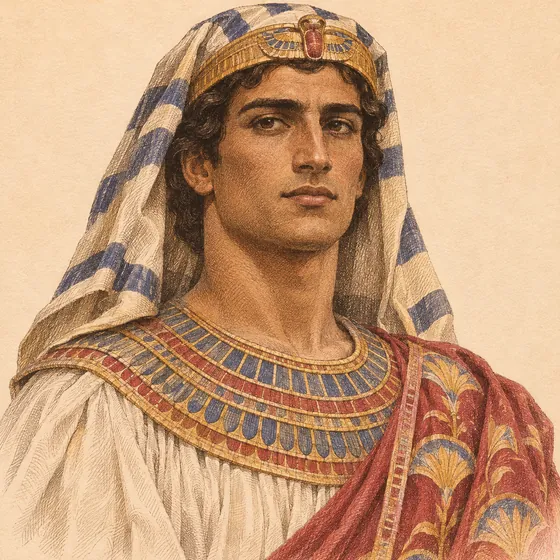
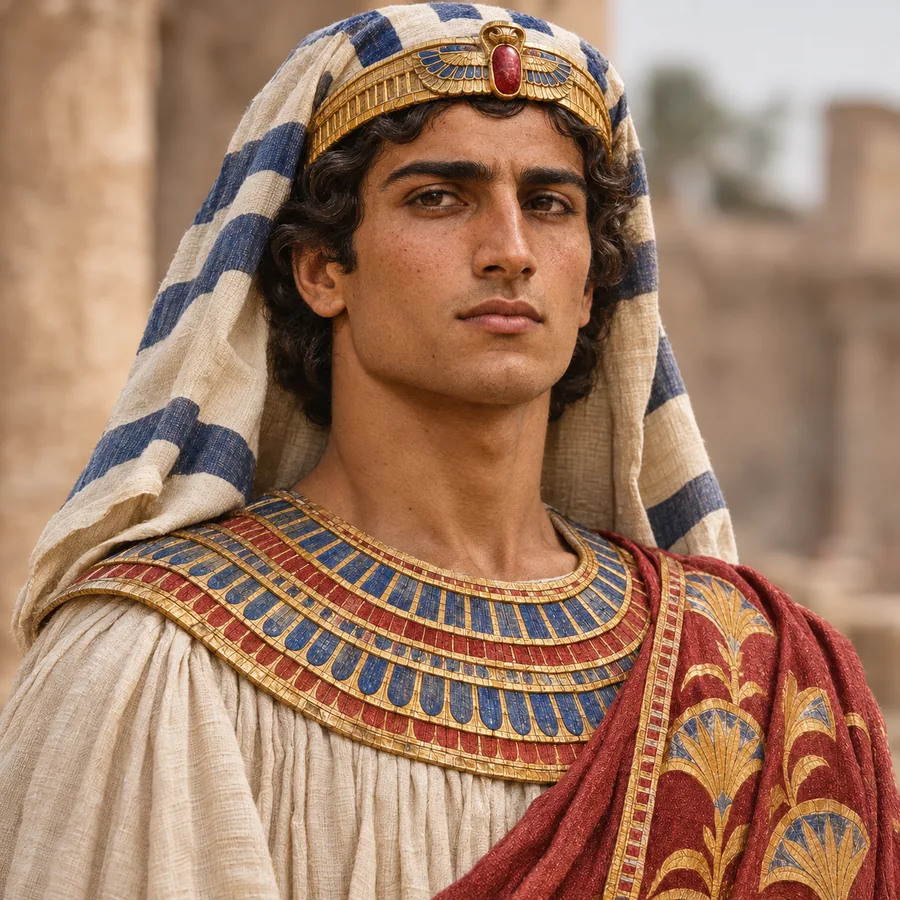

In Genesis 37–50, Jacob's favoured son, sold by his brothers; in Egypt he interprets Pharaoh's dreams, rises to power and saves his family from famine.
See Genesis 37:3, Genesis 37:28, Genesis 41:41, Genesis 45:5.
 An ornate robe marks Joseph in the reading view: the special robe his father made him (the Hebrew word is uncertain; “of many colours” is the King James rendering) (Genesis 37:3).
Mentioned in 199 verses across 19 books, first in Genesis 30:24. The verses below are the ones linked to this person (the Theographic dataset, with our sourced corrections).
How artists have pictured him
3 works from different centuries and traditions. Each shows how its time and place imagined Joseph, not how he looked.


In these stories
Questions about this
In the Bible
All 138 verses in Genesis, in Bible order. Text from the Berean Standard Bible; verse numbers follow the KJV.
Genesis
- Genesis 30:24
She named him Joseph, and said, “May the LORD add to me another son.”
- Genesis 30:25
Now after Rachel had given birth to Joseph, Jacob said to Laban, “Send me on my way so I can return to my homeland.
- Genesis 33:2
He put the maidservants and their children in front, Leah and her children next, and Rachel and Joseph at the rear.
- Genesis 33:7
Leah and her children also approached and bowed down, and then Joseph and Rachel approached and bowed down.
- Genesis 35:24
The sons of Rachel were Joseph and Benjamin.
- Genesis 37:2
This is the account of Jacob. When Joseph was seventeen years old, he was tending the flock with his brothers, the sons of his father’s wives Bilhah and Zilpah, and he brought their father a bad report about them.
- Genesis 37:3
Now Israel loved Joseph more than his other sons, because Joseph had been born to him in his old age; so he made him a robe of many colors.
- Genesis 37:5
Then Joseph had a dream, and when he told it to his brothers, they hated him even more.
- Genesis 37:13
Israel said to him, “Are not your brothers pasturing the flocks at Shechem? Get ready; I am sending you to them.” “I am ready,” Joseph replied.
- Genesis 37:17
“They have moved on from here,” the man answered. “I heard them say, ‘Let us go to Dothan.’” So Joseph set out after his brothers and found them at Dothan.
- Genesis 37:23
So when Joseph came to his brothers, they stripped him of his robe—the robe of many colors he was wearing—
- Genesis 37:28
So when the Midianite traders passed by, his brothers pulled Joseph out of the pit and sold him for twenty shekels of silver to the Ishmaelites, who took him to Egypt.
- Genesis 37:29
When Reuben returned to the pit and saw that Joseph was not there, he tore his clothes,
- Genesis 37:31
Then they took Joseph’s robe, slaughtered a young goat, and dipped the robe in its blood.
- Genesis 37:33
His father recognized it and said, “It is my son’s robe! A vicious animal has devoured him. Joseph has surely been torn to pieces!”
- Genesis 39:1
Meanwhile, Joseph had been taken down to Egypt, where an Egyptian named Potiphar, an officer of Pharaoh and captain of the guard, bought him from the Ishmaelites who had taken him there.
- Genesis 39:2
And the LORD was with Joseph, and he became a successful man, serving in the household of his Egyptian master.
- Genesis 39:4
Joseph found favor in his sight and became his personal attendant. Potiphar put him in charge of his household and entrusted him with everything he owned.
- Genesis 39:5
From the time that he put Joseph in charge of his household and all he owned, the LORD blessed the Egyptian’s household on account of him. The LORD’s blessing was on everything he owned, both in his house and in his field.
- Genesis 39:6
So Potiphar left all that he owned in Joseph’s care; he did not concern himself with anything except the food he ate. Now Joseph was well-built and handsome,
- Genesis 39:7
and after some time his master’s wife cast her eyes upon Joseph and said, “Sleep with me.”
- Genesis 39:10
Although Potiphar’s wife spoke to Joseph day after day, he refused to go to bed with her or even be near her.
- Genesis 39:11
One day, however, Joseph went into the house to attend to his work, and not a single household servant was inside.
- Genesis 39:20
So Joseph’s master took him and had him thrown into the prison where the king’s prisoners were confined. While Joseph was there in the prison,
- Genesis 39:21
the LORD was with him and extended kindness to him, granting him favor in the eyes of the prison warden.
- Genesis 39:22
And the warden put all the prisoners under Joseph’s care, so that he was responsible for all that was done in the prison.
- Genesis 40:3
and imprisoned them in the house of the captain of the guard, the same prison where Joseph was confined.
- Genesis 40:4
The captain of the guard assigned them to Joseph, and he became their personal attendant. After they had been in custody for some time,
- Genesis 40:6
When Joseph came to them in the morning, he saw that they were distraught.
- Genesis 40:8
“We both had dreams,” they replied, “but there is no one to interpret them.” Then Joseph said to them, “Don’t interpretations belong to God? Tell me your dreams.”
- Genesis 40:9
So the chief cupbearer told Joseph his dream: “In my dream there was a vine before me,
- Genesis 40:12
Joseph replied, “This is the interpretation: The three branches are three days.
- Genesis 40:16
When the chief baker saw that the interpretation was favorable, he said to Joseph, “I too had a dream: There were three baskets of white bread on my head.
- Genesis 40:18
Joseph replied, “This is the interpretation: The three baskets are three days.
- Genesis 40:22
But Pharaoh hanged the chief baker, just as Joseph had described to them in his interpretation.
- Genesis 40:23
The chief cupbearer, however, did not remember Joseph; he forgot all about him.
- Genesis 41:14
So Pharaoh sent for Joseph, who was quickly brought out of the dungeon. After he had shaved and changed his clothes, he went in before Pharaoh.
- Genesis 41:15
Pharaoh said to Joseph, “I had a dream, and no one can interpret it. But I have heard it said of you that when you hear a dream you can interpret it.”
- Genesis 41:16
“I myself cannot do it,” Joseph replied, “but God will give Pharaoh a sound answer.”
- Genesis 41:17
Then Pharaoh said to Joseph: “In my dream I was standing on the bank of the Nile,
- Genesis 41:25
At this, Joseph said to Pharaoh, “The dreams of Pharaoh are one and the same. God has revealed to Pharaoh what He is about to do.
- Genesis 41:39
Then Pharaoh said to Joseph, “Since God has made all this known to you, there is no one as discerning and wise as you.
- Genesis 41:41
Pharaoh also told Joseph, “I hereby place you over all the land of Egypt.”
- Genesis 41:42
Then Pharaoh removed the signet ring from his finger, put it on Joseph’s finger, clothed him in garments of fine linen, and placed a gold chain around his neck.
- Genesis 41:44
And Pharaoh declared to Joseph, “I am Pharaoh, but without your permission, no one in all the land of Egypt shall lift his hand or foot.”
- Genesis 41:45
Pharaoh gave Joseph the name Zaphenath-paneah, and he gave him Asenath daughter of Potiphera, priest of On, to be his wife. And Joseph took charge of all the land of Egypt.
- Genesis 41:46
Now Joseph was thirty years old when he entered the service of Pharaoh king of Egypt. And Joseph left Pharaoh’s presence and traveled throughout the land of Egypt.
- Genesis 41:49
So Joseph stored up grain in such abundance, like the sand of the sea, that he stopped keeping track of it; for it was beyond measure.
- Genesis 41:50
Before the years of famine arrived, two sons were born to Joseph by Asenath daughter of Potiphera, priest of On.
- Genesis 41:51
Joseph named the firstborn Manasseh, saying, “God has made me forget all my hardship and all my father’s household.”
- Genesis 41:54
the seven years of famine began, just as Joseph had said. And although there was famine in every country, there was food throughout the land of Egypt.
- Genesis 41:55
When extreme hunger came to all the land of Egypt and the people cried out to Pharaoh for food, he told all the Egyptians, “Go to Joseph and do whatever he tells you.”
- Genesis 41:56
When the famine had spread over all the land, Joseph opened up all the storehouses and sold grain to the Egyptians; for the famine was severe in the land of Egypt.
- Genesis 41:57
And every nation came to Joseph in Egypt to buy grain, because the famine was severe over all the earth.
- Genesis 42:3
So ten of Joseph’s brothers went down to buy grain from Egypt.
- Genesis 42:4
But Jacob did not send Joseph’s brother Benjamin with his brothers, for he said, “I am afraid that harm might befall him.”
- Genesis 42:6
Now Joseph was the ruler of the land; he was the one who sold grain to all its people. So when his brothers arrived, they bowed down before him with their faces to the ground.
- Genesis 42:7
And when Joseph saw his brothers, he recognized them, but he treated them as strangers and spoke harshly to them. “Where have you come from?” he asked. “From the land of Canaan,” they replied. “We are here to buy food.”
- Genesis 42:8
Although Joseph recognized his brothers, they did not recognize him.
- Genesis 42:9
Joseph remembered his dreams about them and said, “You are spies! You have come to see if our land is vulnerable.”
- Genesis 42:14
Then Joseph declared, “Just as I said, you are spies!
- Genesis 42:18
and on the third day he said to them, “I fear God. So do this and you will live:
- Genesis 42:23
They did not realize that Joseph understood them, since there was an interpreter between them.
- Genesis 42:25
Then Joseph gave orders to fill their bags with grain, to return each man’s silver to his sack, and to give them provisions for their journey. This order was carried out,
- Genesis 42:36
Their father Jacob said to them, “You have deprived me of my sons. Joseph is gone and Simeon is no more. Now you want to take Benjamin. Everything is going against me!”
- Genesis 43:15
So the men took these gifts, along with double the amount of silver, and Benjamin as well. Then they hurried down to Egypt and stood before Joseph.
- Genesis 43:16
When Joseph saw Benjamin with his brothers, he said to the steward of his house, “Take these men to my house. Slaughter an animal and prepare it, for they shall dine with me at noon.”
- Genesis 43:17
The man did as Joseph had commanded and took the brothers to Joseph’s house.
- Genesis 43:18
But the brothers were frightened that they had been taken to Joseph’s house. “We have been brought here because of the silver that was returned in our bags the first time,” they said. “They intend to overpower us and take us as slaves, along with our donkeys.”
- Genesis 43:19
So they approached Joseph’s steward and spoke to him at the entrance to the house.
- Genesis 43:24
And the steward took the men into Joseph’s house, gave them water to wash their feet, and provided food for their donkeys.
- Genesis 43:25
Since the brothers had been told that they were going to eat a meal there, they prepared their gift for Joseph’s arrival at noon.
- Genesis 43:26
When Joseph came home, they presented him with the gifts they had brought, and they bowed to the ground before him.
- Genesis 43:30
Joseph hurried out because he was moved to tears for his brother, and he went to a private room to weep.
- Genesis 44:2
Put my cup, the silver one, in the mouth of the youngest one’s sack, along with the silver for his grain.” So the steward did as Joseph had instructed.
- Genesis 44:4
They had not gone far from the city when Joseph told his steward, “Pursue the men at once, and when you overtake them, ask, ‘Why have you repaid good with evil?
- Genesis 44:14
When Judah and his brothers arrived at Joseph’s house, he was still there, and they fell to the ground before him.
- Genesis 44:15
“What is this deed you have done?” Joseph declared. “Do you not know that a man like me can surely divine the truth?”
- Genesis 45:1
Then Joseph could no longer control himself before all his attendants, and he cried out, “Send everyone away from me!” So none of them were with Joseph when he made himself known to his brothers.
- Genesis 45:3
Joseph said to his brothers, “I am Joseph! Is my father still alive?” But they were unable to answer him, because they were terrified in his presence.
- Genesis 45:4
Then Joseph said to his brothers, “Please come near me.” And they did so. “I am Joseph, your brother,” he said, “the one you sold into Egypt!
- Genesis 45:9
Now return quickly to my father and tell him, ‘This is what your son Joseph says: God has made me lord of all Egypt. Come down to me without delay.
- Genesis 45:16
When the news reached Pharaoh’s house that Joseph’s brothers had come, Pharaoh and his servants were pleased.
- Genesis 45:17
Pharaoh said to Joseph, “Tell your brothers, ‘Do as follows: Load your animals and return to the land of Canaan.
- Genesis 45:21
So the sons of Israel did as they were told. Joseph gave them wagons as Pharaoh had instructed, and he also gave them provisions for their journey.
- Genesis 45:26
“Joseph is still alive,” they said, “and he is ruler over all the land of Egypt!” But Jacob was stunned, for he did not believe them.
- Genesis 45:27
However, when they relayed all that Joseph had told them, and when he saw the wagons that Joseph had sent to carry him back, the spirit of their father Jacob was revived.
- Genesis 45:28
“Enough!” declared Israel. “My son Joseph is still alive! I will go to see him before I die.”
- Genesis 46:4
I will go down with you to Egypt, and I will surely bring you back. And Joseph’s own hands will close your eyes.”
- Genesis 46:19
The sons of Jacob’s wife Rachel: Joseph and Benjamin.
- Genesis 46:20
Manasseh and Ephraim were born to Joseph in the land of Egypt by Asenath daughter of Potiphera, priest of On.
- Genesis 46:27
And with the two sons who had been born to Joseph in Egypt, the members of Jacob’s family who went to Egypt were seventy in all.
- Genesis 46:28
Now Jacob had sent Judah ahead of him to Joseph to get directions to Goshen. When Jacob’s family arrived in the land of Goshen,
- Genesis 46:29
Joseph prepared his chariot and went there to meet his father Israel. Joseph presented himself to him, embraced him, and wept profusely.
- Genesis 46:30
Then Israel said to Joseph, “Finally I can die, now that I have seen your face and know that you are still alive!”
- Genesis 46:31
Joseph said to his brothers and to his father’s household, “I will go up and inform Pharaoh: ‘My brothers and my father’s household from the land of Canaan have come to me.
- Genesis 47:1
So Joseph went and told Pharaoh: “My father and my brothers, with their flocks and herds and all they own, have come from the land of Canaan and are now in Goshen.”
- Genesis 47:5
Pharaoh said to Joseph, “Now that your father and brothers have come to you,
- Genesis 47:7
Then Joseph brought in his father Jacob and presented him before Pharaoh, and Jacob blessed Pharaoh.
- Genesis 47:11
So Joseph settled his father and brothers in the land of Egypt and gave them property in the best part of the land, the district of Rameses, as Pharaoh had commanded.
- Genesis 47:12
Joseph also provided his father and brothers and all his father’s household with food for their families.
- Genesis 47:14
Joseph collected all the money to be found in the land of Egypt and the land of Canaan in exchange for the grain they were buying, and he brought it into Pharaoh’s palace.
- Genesis 47:15
When the money from the lands of Egypt and Canaan was gone, all the Egyptians came to Joseph and said, “Give us food. Why should we die before your eyes? For our funds have run out!”
- Genesis 47:16
“Then bring me your livestock,” said Joseph. “Since the money is gone, I will sell you food in exchange for your livestock.”
- Genesis 47:17
So they brought their livestock to Joseph, and he gave them food in exchange for their horses, their flocks and herds, and their donkeys. Throughout that year he provided them with food in exchange for all their livestock.
- Genesis 47:20
So Joseph acquired for Pharaoh all the land in Egypt; the Egyptians, one and all, sold their fields because the famine was so severe upon them. The land became Pharaoh’s,
- Genesis 47:23
Then Joseph said to the people, “Now that I have acquired you and your land for Pharaoh this day, here is seed for you to sow in the land.
- Genesis 47:26
So Joseph established a law that a fifth of the produce belongs to Pharaoh, and it is in effect in the land of Egypt to this day. Only the priests’ land does not belong to Pharaoh.
- Genesis 47:29
When the time drew near for Israel to die, he called his son Joseph and said to him, “If I have found favor in your eyes, put your hand under my thigh and promise to show me kindness and faithfulness. Do not bury me in Egypt,
- Genesis 48:1
Some time later Joseph was told, “Your father is ill.” So he set out with his two sons, Manasseh and Ephraim.
- Genesis 48:2
When Jacob was told, “Your son Joseph has come to you,” Israel rallied his strength and sat up in bed.
- Genesis 48:3
Jacob said to Joseph, “God Almighty appeared to me at Luz in the land of Canaan, and there He blessed me
- Genesis 48:8
When Israel saw the sons of Joseph, he asked, “Who are these?”
- Genesis 48:9
Joseph said to his father, “They are the sons God has given me in this place.” So Jacob said, “Please bring them to me, that I may bless them.”
- Genesis 48:11
“I never expected to see your face again,” Israel said to Joseph, “but now God has let me see your children as well.”
- Genesis 48:12
Then Joseph removed his sons from his father’s knees and bowed facedown.
- Genesis 48:13
And Joseph took both of them—with Ephraim in his right hand toward Israel’s left hand, and Manasseh in his left hand toward Israel’s right hand—and brought them close to him.
- Genesis 48:15
Then he blessed Joseph and said: “May the God before whom my fathers Abraham and Isaac walked, the God who has been my shepherd all my life to this day,
- Genesis 48:17
When Joseph saw that his father had placed his right hand on Ephraim’s head, he was displeased and took his father’s hand to move it from Ephraim’s head to Manasseh’s.
- Genesis 48:18
“Not so, my father!” Joseph said. “This one is the firstborn; put your right hand on his head.”
- Genesis 48:21
Then Israel said to Joseph, “Look, I am about to die, but God will be with you and bring you back to the land of your fathers.
- Genesis 49:22
Joseph is a fruitful vine— a fruitful vine by a spring, whose branches scale the wall.
- Genesis 49:26
The blessings of your father have surpassed the blessings of the ancient mountains and the bounty of the everlasting hills. May they rest on the head of Joseph, on the brow of the prince of his brothers.
- Genesis 50:1
Then Joseph fell upon his father’s face, wept over him, and kissed him.
- Genesis 50:2
And Joseph directed the physicians in his service to embalm his father Israel. So they embalmed him,
- Genesis 50:4
When the days of mourning had passed, Joseph said to Pharaoh’s court, “If I have found favor in your eyes, please tell Pharaoh that
- Genesis 50:7
Then Joseph went to bury his father, and all the servants of Pharaoh accompanied him—the elders of Pharaoh’s household and all the elders of the land of Egypt—
- Genesis 50:8
along with all of Joseph’s household, and his brothers, and his father’s household. Only their children and flocks and herds were left in Goshen.
- Genesis 50:14
After Joseph had buried his father, he returned to Egypt with his brothers and all who had gone with him to bury his father.
- Genesis 50:15
When Joseph’s brothers saw that their father was dead, they said, “What if Joseph bears a grudge? Then he will surely repay us for all the evil that we did to him.”
- Genesis 50:16
So they sent word to Joseph, saying, “Before he died, your father commanded,
- Genesis 50:17
‘This is what you are to say to Joseph: I beg you, please forgive the transgression and sin of your brothers, for they did you wrong.’ So now, Joseph, please forgive the transgression of the servants of the God of your father.” When their message came to him, Joseph wept.
- Genesis 50:19
But Joseph replied, “Do not be afraid. Am I in the place of God?
- Genesis 50:22
Now Joseph and his father’s household remained in Egypt, and Joseph lived to the age of 110.
- Genesis 50:23
He saw Ephraim’s sons to the third generation, and indeed the sons of Machir son of Manasseh were brought up on Joseph’s knees.
- Genesis 50:24
Then Joseph said to his brothers, “I am about to die, but God will surely visit you and bring you up from this land to the land He promised on oath to Abraham, Isaac, and Jacob.”
- Genesis 50:25
And Joseph made the sons of Israel take an oath and said, “God will surely attend to you, and then you must carry my bones up from this place.”
- Genesis 50:26
So Joseph died at the age of 110. And they embalmed his body and placed it in a coffin in Egypt.
Events
Events the dataset lists Joseph (son of Jacob) as taking part in. Dates follow its Ussher–Jones reckoning (one of several traditional counts), not established history.
- c. 1745 BCBirth of Joseph
- c. 1745 BCLifetime of Joseph
- c. 1728 BCJoseph sold to Egypt
- c. 1718 BCJoseph imprisoned
- c. 1715 BCJoseph Promoted in Egypt
- c. 1715 BC7 years of plenty
- c. 1708 BC7 years of famine
- c. 1706 BCJoseph's brothers return to Egypt
- c. 1635 BCDeath of Joseph
Dictionary
From Easton’s Bible Dictionary (1897), as attached to this record by Theographic. The entry is for the name and can describe more than one person who bore it. Easton wrote in 1897, and some of his views are now debated.
Read Easton’s entry
The elder of the two sons of Jacob by Rachel (Gen. 30:23, 24), who, on the occasion of his birth, said, “God hath taken away [Heb. ‘asaph] my reproach.” “The Lord shall add [Heb. yoseph] to me another son” (Gen. 30:24). He was a child of probably six years of age when his father returned from Haran to Canaan and took up his residence in the old patriarchal town of Hebron. “Now Israel loved Joseph more than all his children, because he was the son of his old age,” and he “made him a long garment with sleeves” (Gen. 37:3, R.V. marg.), i.e., a garment long and full, such as was worn by the children of nobles. This seems to be the correct rendering of the words. The phrase, however, may also be rendered, “a coat of many pieces”, i.e., a patchwork of many small pieces of divers colours.
When he was about seventeen years old Joseph incurred the jealous hatred of his brothers (Gen. 37:4). They “hated him, and could not speak peaceably unto him.” Their anger was increased when he told them his dreams (37:11).
Jacob desiring to hear tidings of his sons, who had gone to Shechem with their flocks, some 60 miles from Hebron, sent Joseph as his messenger to make inquiry regarding them. Joseph found that they had left Shechem for Dothan, whither he followed them. As soon as they saw him coming they began to plot against him, and would have killed him had not Reuben interposed. They ultimately sold him to a company of Ishmaelite merchants for twenty pieces (shekels) of silver (about $2, 10s.), ten pieces less than the current value of a slave, for “they cared little what they had for him, if so be they were rid of him.” These merchants were going down with a varied assortment of merchandise to the Egyptian market, and thither they conveyed him, and ultimately sold him as a slave to Potiphar, an “officer of Pharaoh’s, and captain of the guard” (Gen. 37:36). “The Lord blessed the Egyptian’s house for Joseph’s sake,” and Potiphar made him overseer over his house. At length a false charge having been brought against him by Potiphar’s wife, he was at once cast into the state prison (39; 40), where he remained for at least two years. After a while the “chief of the cupbearers” and the “chief of the bakers” of Pharaoh’s household were cast into the same prison (40:2). Each of these new prisoners dreamed a dream in the same night, which Joseph interpreted, the event occurring as he had said.
This led to Joseph’s being remembered subsequently by the chief butler when Pharaoh also dreamed. At his suggestion Joseph was brought from prison to interpret the king’s dreams. Pharaoh was well pleased with Joseph’s wisdom in interpreting his dreams, and with his counsel with reference to the events then predicted; and he set him over all the land of Egypt (Gen. 41:46), and gave him the name of Zaphnath-paaneah. He was married to Asenath, the daughter of the priest of On, and thus became a member of the priestly class. Joseph was now about thirty years of age.
As Joseph had interpreted, seven years of plenty came, during which he stored up great abundance of corn in granaries built for the purpose. These years were followed by seven years of famine “over all the face of the earth,” when “all countries came into Egypt to Joseph to buy corn” (Gen. 41:56, 57; 47:13, 14). Thus “Joseph gathered up all the money that was in the land of Egypt, and in the land of Canaan, for the corn which they bought.” Afterwards all the cattle and all the land, and at last the Egyptians themselves, became the property of Pharaoh.
During this period of famine Joseph’s brethren also came down to Egypt to buy corn. The history of his dealings with them, and of the manner in which he at length made himself known to them, is one of the most interesting narratives that can be read ([Gen. 42](/gen#Gen.42)-45). Joseph directed his brethren to return and bring Jacob and his family to the land of Egypt, saying, “I will give you the good of the land of Egypt, and ye shall eat the fat of the land. Regard not your stuff; for the good of all the land is yours.” Accordingly Jacob and his family, to the number of threescore and ten souls, together with “all that they had,” went down to Egypt. They were settled in the land of Goshen, where Joseph met his father, and “fell on his neck, and wept on his neck a good while” (Gen. 46:29).
The excavations of Dr. Naville have shown the land of Goshen to be the Wady Tumilat, between Ismailia and Zagazig. In Goshen (Egyptian Qosem) they had pasture for their flocks, were near the Asiatic frontier of Egypt, and were out of the way of the Egyptian people. An inscription speaks of it as a district given up to the wandering shepherds of Asia.
Jacob at length died, and in fulfilment of a promise which he had exacted, Joseph went up to Canaan to bury his father in “the field of Ephron the Hittite” (Gen. 47:29-31; 50:1-14). This was the last recorded act of Joseph, who again returned to Egypt.
“The ‘Story of the Two Brothers,’ an Egyptian romance written for the son of the Pharaoh of the Oppression, contains an episode very similar to the Biblical account of Joseph’s treatment by Potiphar’s wife. Potiphar and Potipherah are the Egyptian Pa-tu-pa-Ra, ‘the gift of the sun-god.’ The name given to Joseph, Zaphnath-paaneah, is probably the Egyptian Zaf-nti-pa-ankh, ‘nourisher of the living one,’ i.e., of the Pharaoh. There are many instances in the inscriptions of foreigners in Egypt receiving Egyptian names, and rising to the highest offices of state.”
By his wife Asenath, Joseph had two sons, Manasseh and Ephraim (Gen. 41:50). Joseph having obtained a promise from his brethren that when the time should come that God would “bring them unto the land which he sware to Abraham, to Isaac, and to Jacob,” they would carry up his bones out of Egypt, at length died, at the age of one hundred and ten years; and “they embalmed him, and he was put in a coffin” (Gen. 50:26). This promise was faithfully observed. Their descendants, long after, when the Exodus came, carried the body about with them during their forty years’ wanderings, and at length buried it in Shechem, in the parcel of ground which Jacob bought from the sons of Hamor (Josh. 24:32; comp. Gen. 33:19). With the death of Joseph the patriarchal age of the history of Israel came to a close.
The Pharaoh of Joseph’s elevation was probably Apepi, or Apopis, the last of the Hyksos kings. Some, however, think that Joseph came to Egypt in the reign of Thothmes III. (see PHARAOH), long after the expulsion of the Hyksos.
The name Joseph denotes the two tribes of Ephraim and Manasseh in Deut. 33:13-17; the kingdom of Israel in Ezek. 37:16, 19, Amos 5:6; and the whole covenant people of Israel in Ps. 81:4.