Person
John the Apostle
Also called Boanerges
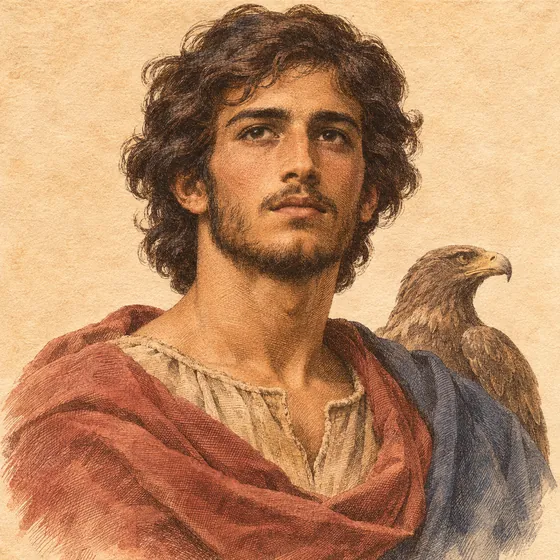
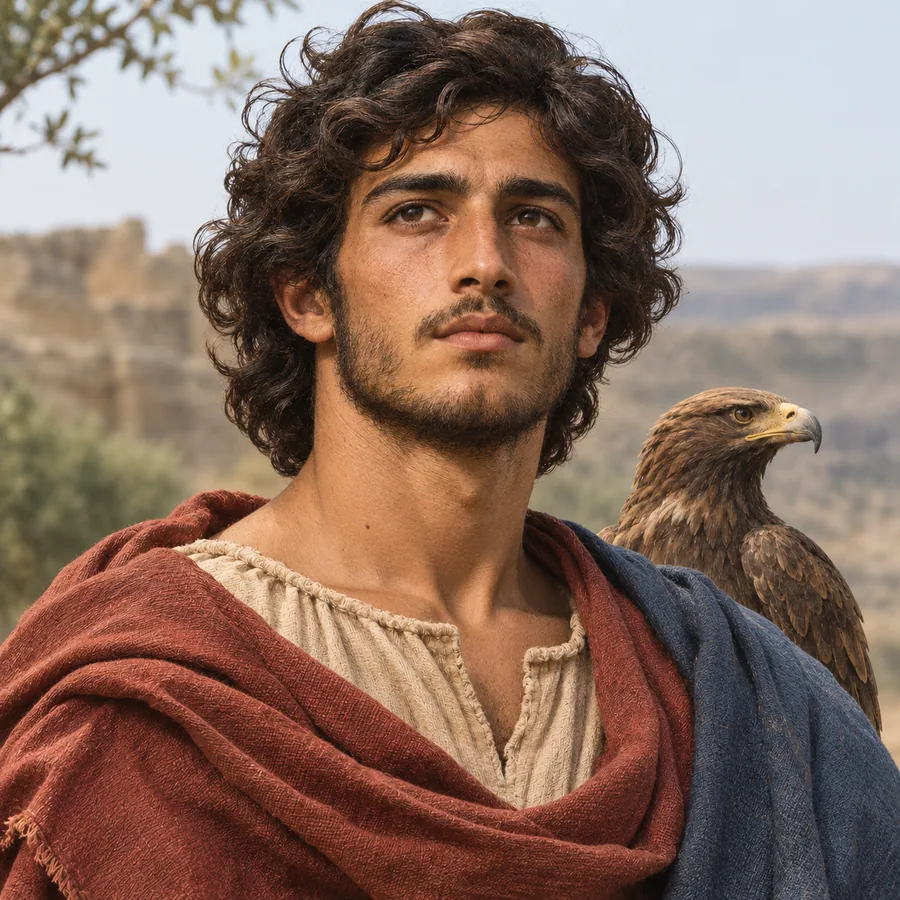

One of Jesus's twelve disciples, a Galilean fisherman and the brother of James; in Acts he works beside Peter. Tradition names him the author of the Gospel of John.
See Matthew 4:21, Mark 3:17, Acts 3:1.
 An eagle marks John the Apostle in the reading view: in Christian art, the symbol of the Gospel of John, which tradition attributes to him (Revelation 4:7).
Mentioned in 35 verses across 6 books, first in Matthew 4:21. The verses below are the ones linked to this person (the Theographic dataset, with our sourced corrections).
How artists have pictured him
3 works from different centuries and traditions. Each shows how its time and place imagined John the Apostle, not how he looked.


In the Bible
The first 10 of 35 verses, in Bible order. Text from the Berean Standard Bible; verse numbers follow the KJV.
Matthew
- Matthew 4:21
Going on from there, He saw two other brothers, James son of Zebedee and his brother John. They were in a boat with their father Zebedee, mending their nets. Jesus called them,
- Matthew 10:2
These are the names of the twelve apostles: first Simon, called Peter, and his brother Andrew; James son of Zebedee, and his brother John;
- Matthew 17:1
After six days Jesus took with Him Peter, James, and John the brother of James, and led them up a high mountain by themselves.
Mark
- Mark 1:19
Going on a little farther, He saw James son of Zebedee and his brother John. They were in a boat, mending their nets.
- Mark 1:29
As soon as Jesus and His companions had left the synagogue, they went with James and John to the home of Simon and Andrew.
- Mark 3:17
James son of Zebedee and his brother John (whom He named Boanerges, meaning “Sons of Thunder”),
- Mark 5:37
And He did not allow anyone to accompany Him except Peter, James, and John the brother of James.
- Mark 9:2
After six days Jesus took with Him Peter, James, and John, and led them up a high mountain by themselves. There He was transfigured before them.
- Mark 9:38
John said to Him, “Teacher, we saw someone else driving out demons in Your name, and we tried to stop him, because he does not accompany us.”
- Mark 10:35
Then James and John, the sons of Zebedee, came to Jesus and declared, “Teacher, we want You to do for us whatever we ask.”
Events
Events the dataset lists John the Apostle as taking part in. Dates follow its Ussher–Jones reckoning (one of several traditional counts), not established history.
- c. AD 27First Disciples Gathered
- c. AD 28Apostles Chosen
- c. AD 29The Transfiguation
- no dateOlivet Discourse
- no dateMatthias replaces Judas
- c. AD 30Lame man healed
- c. AD 30Peter and John's Trial
- c. AD 31Philip preaches in Samaria
Dictionary
From Easton’s Bible Dictionary (1897), as attached to this record by Theographic. The entry is for the name and can describe more than one person who bore it. Easton wrote in 1897, and some of his views are now debated.
Read Easton’s entry
THE APOSTLE, brother of James the “Greater” (Matt. 4:21; 10:2; Mark 1:19; 3:17; 10:35). He was one, probably the younger, of the sons of Zebedee (Matt. 4:21) and Salome (Matt. 27:56; comp. Mark 15:40), and was born at Bethsaida. His father was apparently a man of some wealth (comp. Mark 1:20; Luke 5:3; John 19:27). He was doubtless trained in all that constituted the ordinary education of Jewish youth. When he grew up he followed the occupation of a fisherman on the Lake of Galilee. When John the Baptist began his ministry in the wilderness of Judea, John, with many others, gathered round him, and was deeply influenced by his teaching. There he heard the announcement, “Behold the Lamb of God,” and forthwith, on the invitation of Jesus, became a disciple and ranked among his followers (John 1:36, 37) for a time. He and his brother then returned to their former avocation, for how long is uncertain. Jesus again called them ([Matt. 4](/matt#Matt.4): 21; Luke 5:1-11), and now they left all and permanently attached themselves to the company of his disciples. He became one of the innermost circle (Mark 5:37; Matt. 17:1; 26:37; Mark 13:3). He was the disciple whom Jesus loved. In zeal and intensity of character he was a “Boanerges” (Mark 3:17). This spirit once and again broke out (Matt. 20:20-24; Mark 10:35-41; Luke 9:49, 54). At the betrayal he and Peter follow Christ afar off, while the others betake themselves to hasty flight (John 18:15). At the trial he follows Christ into the council chamber, and thence to the praetorium (18:16, 19, 28) and to the place of crucifixion (19:26, 27). To him and Peter, Mary first conveys tidings of the resurrection (20:2), and they are the first to go and see what her strange words mean. After the resurrection he and Peter again return to the Sea of Galilee, where the Lord reveals himself to them (21:1, 7). We find Peter and John frequently after this together (Acts 3:1; 4:13). John remained apparently in Jerusalem as the leader of the church there (Acts 15:6; Gal. 2:9). His subsequent history is unrecorded. He was not there, however, at the time of Paul’s last visit (Acts 21:15-40). He appears to have retired to Ephesus, but at what time is unknown. The seven churches of Asia were the objects of his special care (Rev. 1:11). He suffered under persecution, and was banished to Patmos (1:9); whence he again returned to Ephesus, where he died, probably about A.D. 98, having outlived all or nearly all the friends and companions even of his maturer years. There are many interesting traditions regarding John during his residence at Ephesus, but these cannot claim the character of historical truth.