Person
Solomon
Also called Jedidiah
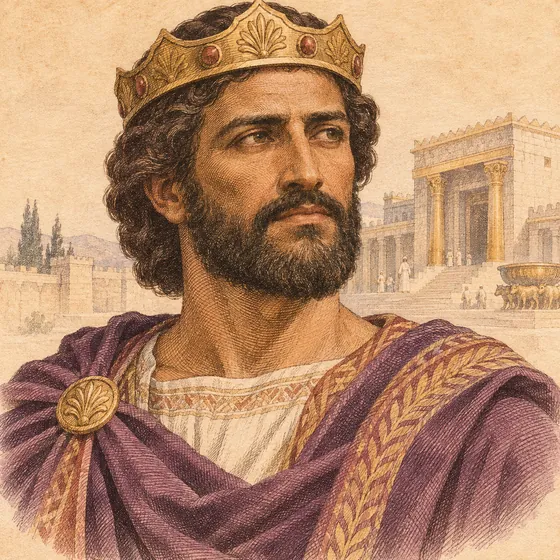
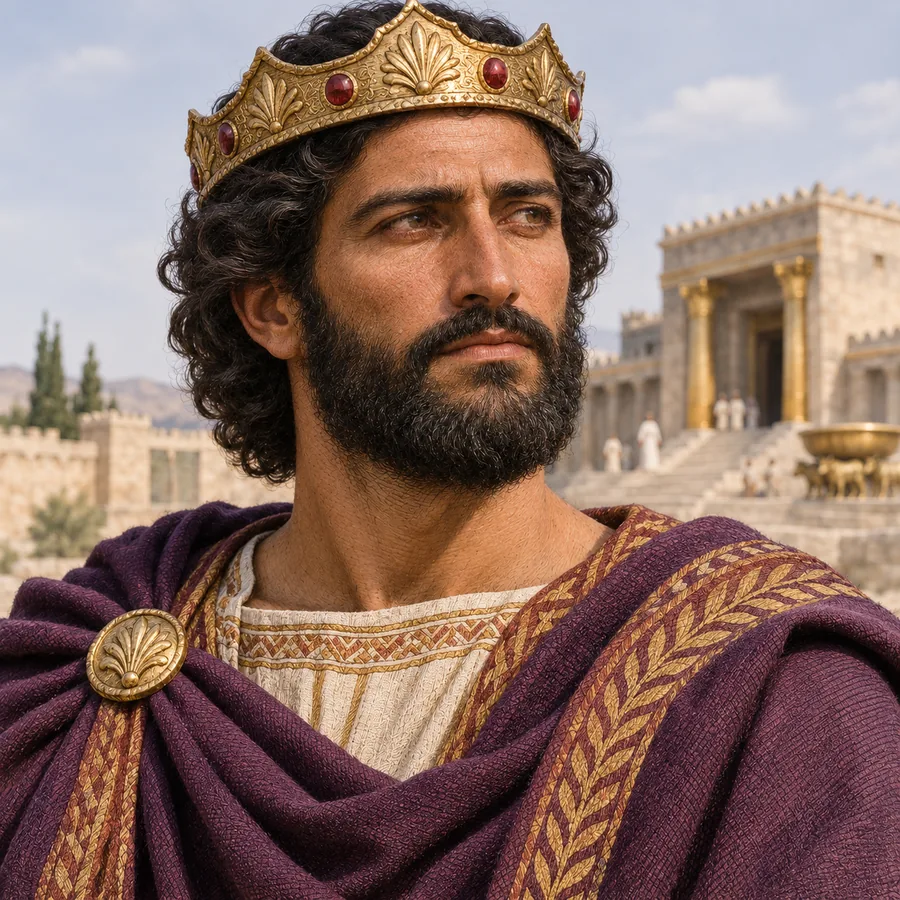
In 1 Kings 1–11, David's son and successor, famed for wisdom and wealth, who builds the temple in Jerusalem; in old age his wives turn his heart to other gods.
See 1 Kings 1:39, 1 Kings 3:12, 1 Kings 6:14, 1 Kings 11:4.
 The temple marks Solomon in the reading view: “So Solomon built the house, and finished it” (1 Kings 6:14).
Mentioned in 273 verses across 14 books, first in 1 Kings 1:10. The verses below are the ones linked to this person (the Theographic dataset, with our sourced corrections).
How artists have pictured him
3 works from different centuries and traditions. Each shows how its time and place imagined Solomon, not how he looked.


Questions about this
In the Bible
All 140 verses in 1 Kings, in Bible order. Text from the Berean Standard Bible; verse numbers follow the KJV.
1 Kings
- 1 Kings 1:10
But he did not invite Nathan the prophet, Benaiah, the mighty men, or his brother Solomon.
- 1 Kings 1:11
Then Nathan said to Bathsheba the mother of Solomon, “Have you not heard that Adonijah son of Haggith has become king, and our lord David does not know it?
- 1 Kings 1:12
Now please, come and let me advise you. Save your own life and the life of your son Solomon.
- 1 Kings 1:13
Go at once to King David and say, ‘My lord the king, did you not swear to your maidservant, “Surely your son Solomon will reign after me, and he will sit on my throne”? Why then has Adonijah become king?’
- 1 Kings 1:17
“My lord,” she replied, “you yourself swore to your maidservant by the LORD your God: ‘Surely your son Solomon will reign after me, and he will sit on my throne.’
- 1 Kings 1:19
And he has sacrificed an abundance of oxen, fattened calves, and sheep, and has invited all the other sons of the king, as well as Abiathar the priest and Joab the commander of the army. But he did not invite your servant Solomon.
- 1 Kings 1:21
Otherwise, when my lord the king rests with his fathers, I and my son Solomon will be counted as criminals.”
- 1 Kings 1:26
But me your servant he did not invite, nor Zadok the priest, nor Benaiah son of Jehoiada, nor your servant Solomon.
- 1 Kings 1:30
I will carry out this very day exactly what I swore to you by the LORD, the God of Israel: Surely your son Solomon will reign after me, and he will sit on my throne in my place.”
- 1 Kings 1:33
“Take my servants with you,” said the king. “Set my son Solomon on my own mule and take him down to Gihon.
- 1 Kings 1:34
There Zadok the priest and Nathan the prophet are to anoint him king over Israel. You are to blow the ram’s horn and declare, ‘Long live King Solomon!’
- 1 Kings 1:37
Just as the LORD was with my lord the king, so may He be with Solomon and make his throne even greater than that of my lord King David.”
- 1 Kings 1:38
Then Zadok the priest, Nathan the prophet, and Benaiah son of Jehoiada, along with the Cherethites and Pelethites, went down and set Solomon on King David’s mule, and they escorted him to Gihon.
- 1 Kings 1:39
Zadok the priest took the horn of oil from the tabernacle and anointed Solomon. Then they blew the ram’s horn, and all the people proclaimed, “Long live King Solomon!”
- 1 Kings 1:43
“Not at all,” Jonathan replied. “Our lord King David has made Solomon king.
- 1 Kings 1:46
Moreover, Solomon has taken his seat on the royal throne.
- 1 Kings 1:47
The king’s servants have also gone to congratulate our lord King David, saying, ‘May your God make the name of Solomon more famous than your own name, and may He make his throne greater than your throne.’ And the king has bowed in worship on his bed,
- 1 Kings 1:50
But Adonijah, in fear of Solomon, got up and went to take hold of the horns of the altar.
- 1 Kings 1:51
It was reported to Solomon: “Behold, Adonijah fears King Solomon, and he has taken hold of the horns of the altar, saying, ‘Let King Solomon first swear to me not to put his servant to the sword.’”
- 1 Kings 1:52
And Solomon replied, “If he is a man of character, not a single hair of his will fall to the ground. But if evil is found in him, he will die.”
- 1 Kings 1:53
So King Solomon summoned Adonijah down from the altar, and he came and bowed down before King Solomon, who said to him, “Go to your home.”
- 1 Kings 2:1
As the time drew near for David to die, he charged his son Solomon,
- 1 Kings 2:12
So Solomon sat on the throne of his father David, and his kingdom was firmly established.
- 1 Kings 2:13
Now Adonijah son of Haggith went to Bathsheba the mother of Solomon, and she asked, “Do you come in peace?” “Yes, in peace,” he replied.
- 1 Kings 2:17
Adonijah replied, “Please speak to King Solomon, since he will not turn you down. Let him give me Abishag the Shunammite as my wife.”
- 1 Kings 2:19
So Bathsheba went to King Solomon to speak to him for Adonijah. The king stood up to greet her, bowed to her, and sat down on his throne. Then the king had a throne brought for his mother, who sat down at his right hand.
- 1 Kings 2:22
King Solomon answered his mother, “Why do you request Abishag the Shunammite for Adonijah? Since he is my older brother, you might as well request the kingdom for him and for Abiathar the priest and for Joab son of Zeruiah!”
- 1 Kings 2:23
Then King Solomon swore by the LORD: “May God punish me, and ever so severely, if Adonijah has not made this request at the expense of his life.
- 1 Kings 2:25
So King Solomon sent the order to Benaiah son of Jehoiada, who struck down Adonijah, and he died.
- 1 Kings 2:27
So Solomon banished Abiathar from the priesthood of the LORD and thus fulfilled the word that the LORD had spoken at Shiloh against the house of Eli.
- 1 Kings 2:29
It was reported to King Solomon: “Joab has fled to the tent of the LORD and is now beside the altar.” So Solomon sent Benaiah son of Jehoiada, saying, “Go, strike him down!”
- 1 Kings 2:41
When Solomon was told that Shimei had gone from Jerusalem to Gath and had returned,
- 1 Kings 2:45
But King Solomon will be blessed and David’s throne will remain secure before the LORD forever.”
- 1 Kings 2:46
Then the king commanded Benaiah son of Jehoiada, and he went out and struck Shimei down, and he died. Thus the kingdom was firmly established in the hand of Solomon.
- 1 Kings 3:1
Later, Solomon formed an alliance with Pharaoh king of Egypt by marrying his daughter. Solomon brought her to the City of David until he had finished building his palace and the house of the LORD, as well as the wall around Jerusalem.
- 1 Kings 3:3
And Solomon loved the LORD and walked in the statutes of his father David, except that he sacrificed and burned incense on the high places.
- 1 Kings 3:4
Now the king went to Gibeon to sacrifice there, for it was the great high place. Solomon offered a thousand burnt offerings on the altar there.
- 1 Kings 3:5
One night at Gibeon the LORD appeared to Solomon in a dream, and God said, “Ask, and I will give it to you!”
- 1 Kings 3:6
Solomon replied, “You have shown much loving devotion to Your servant, my father David, because he walked before You in faithfulness, righteousness, and uprightness of heart. And You have maintained this loving devotion by giving him a son to sit on his throne this very day.
- 1 Kings 3:10
Now it pleased the Lord that Solomon had made this request.
- 1 Kings 3:15
Then Solomon awoke, and indeed it had been a dream. So he returned to Jerusalem, stood before the ark of the covenant of the Lord, and offered burnt offerings and peace offerings. Then he held a feast for all his servants.
- 1 Kings 4:1
So King Solomon ruled over Israel,
- 1 Kings 4:7
Solomon had twelve governors over all Israel to provide food for the king and his household. Each one would arrange provisions for one month of the year,
- 1 Kings 4:11
Ben-abinadab in Naphath-dor (Taphath, a daughter of Solomon, was his wife);
- 1 Kings 4:15
Ahimaaz in Naphtali (he had married Basemath, a daughter of Solomon);
- 1 Kings 4:21
And Solomon reigned over all the kingdoms from the Euphrates to the land of the Philistines, as far as the border of Egypt. These kingdoms offered tribute and served Solomon all the days of his life.
- 1 Kings 4:22
Solomon’s provisions for a single day were thirty cors of fine flour, sixty cors of meal,
- 1 Kings 4:25
Throughout the days of Solomon, Judah and Israel dwelt securely from Dan to Beersheba, each man under his own vine and his own fig tree.
- 1 Kings 4:26
Solomon had 4,000 stalls for his chariot horses and 12,000 horses.
- 1 Kings 4:27
Each month the governors in turn provided food for King Solomon and all who came to his table. They saw to it that nothing was lacking.
- 1 Kings 4:29
And God gave Solomon wisdom, exceedingly deep insight, and understanding beyond measure, like the sand on the seashore.
- 1 Kings 4:30
Solomon’s wisdom was greater than that of all the men of the East, greater than all the wisdom of Egypt.
- 1 Kings 4:34
So men of all nations came to listen to Solomon’s wisdom, sent by all the kings of the earth, who had heard of his wisdom.
- 1 Kings 5:1
Now when Hiram king of Tyre heard that Solomon had been anointed king in his father’s place, he sent envoys to Solomon; for Hiram had always been a friend of David.
- 1 Kings 5:2
And Solomon relayed this message to Hiram:
- 1 Kings 5:7
When Hiram received Solomon’s message, he rejoiced greatly and said, “Blessed be the LORD this day! He has given David a wise son over this great people!”
- 1 Kings 5:8
Then Hiram sent a reply to Solomon, saying: “I have received your message; I will do all you desire regarding the cedar and cypress timber.
- 1 Kings 5:10
So Hiram provided Solomon with all the cedar and cypress timber he wanted,
- 1 Kings 5:11
and year after year Solomon would provide Hiram with 20,000 cors of wheat as food for his household, as well as 20,000 baths of pure olive oil.
- 1 Kings 5:12
And the LORD gave Solomon wisdom, as He had promised him. There was peace between Hiram and Solomon, and the two of them made a treaty.
- 1 Kings 5:13
Then King Solomon conscripted a labor force of 30,000 men from all Israel.
- 1 Kings 5:15
Solomon had 70,000 porters and 80,000 stonecutters in the mountains,
- 1 Kings 5:16
not including his 3,300 foremen who supervised the workers.
- 1 Kings 5:18
So Solomon’s and Hiram’s builders, along with the Gebalites, quarried the stone and prepared the timber and stone for the construction of the temple.
- 1 Kings 6:1
In the four hundred and eightieth year after the Israelites had come out of the land of Egypt, in the month of Ziv, the second month of the fourth year of Solomon’s reign over Israel, he began to build the house of the LORD.
- 1 Kings 6:2
The house that King Solomon built for the LORD was sixty cubits long, twenty cubits wide, and thirty cubits high.
- 1 Kings 6:11
Then the word of the LORD came to Solomon, saying:
- 1 Kings 6:14
So Solomon built the temple and finished it.
- 1 Kings 6:21
So Solomon overlaid the inside of the temple with pure gold, and he extended gold chains across the front of the inner sanctuary, which was overlaid with gold.
- 1 Kings 7:1
Solomon, however, took thirteen years to complete the construction of his entire palace.
- 1 Kings 7:8
And the palace where Solomon would live, set further back, was of similar construction. He also made a palace like this hall for Pharaoh’s daughter, whom he had married.
- 1 Kings 7:13
Now King Solomon sent to bring Huram from Tyre.
- 1 Kings 7:14
He was the son of a widow from the tribe of Naphtali, and his father was a man of Tyre, a craftsman in bronze. Huram had great skill, understanding, and knowledge for every kind of bronze work. So he came to King Solomon and carried out all his work.
- 1 Kings 7:40
Additionally, Huram made the pots, shovels, and sprinkling bowls. So Huram finished all the work that he had undertaken for King Solomon in the house of the LORD:
- 1 Kings 7:45
and the pots, shovels, and sprinkling bowls. All the articles that Huram made for King Solomon in the house of the LORD were made of burnished bronze.
- 1 Kings 7:47
Solomon left all these articles unweighed, because there were so many. The weight of the bronze could not be determined.
- 1 Kings 7:48
Solomon also made all the furnishings for the house of the LORD: the golden altar; the golden table on which was placed the Bread of the Presence;
- 1 Kings 7:51
So all the work that King Solomon had performed for the house of the LORD was completed. Then Solomon brought in the items his father David had dedicated—the silver, the gold, and the furnishings—and he placed them in the treasuries of the house of the LORD.
- 1 Kings 8:1
At that time Solomon assembled before him in Jerusalem the elders of Israel—all the tribal heads and family leaders of the Israelites—to bring up the ark of the covenant of the LORD from Zion, the City of David.
- 1 Kings 8:2
And all the men of Israel came together to King Solomon at the feast in the seventh month, the month of Ethanim.
- 1 Kings 8:5
There, before the ark, King Solomon and the whole congregation of Israel who had assembled with him sacrificed so many sheep and oxen that they could not be counted or numbered.
- 1 Kings 8:12
Then Solomon declared: “The LORD has said that He would dwell in the thick cloud.
- 1 Kings 8:22
Then Solomon stood before the altar of the LORD in front of the whole assembly of Israel, spread out his hands toward heaven,
- 1 Kings 8:54
Now when Solomon had finished praying this entire prayer and petition to the LORD, he got up before the altar of the LORD, where he had been kneeling with his hands spread out toward heaven.
- 1 Kings 8:63
And Solomon offered as peace offerings to the LORD 22,000 oxen and 120,000 sheep. So the king and all the Israelites dedicated the house of the LORD.
- 1 Kings 8:65
So at that time Solomon and all Israel with him—a great assembly of people from Lebo-hamath to the Brook of Egypt—kept the feast before the LORD our God for seven days and seven more days—fourteen days in all.
- 1 Kings 9:1
Now when Solomon had finished building the house of the LORD and the royal palace, and had achieved all that he had desired to do,
- 1 Kings 9:2
the LORD appeared to him a second time, as He had appeared to him at Gibeon.
- 1 Kings 9:10
Now at the end of the twenty years during which Solomon built these two houses, the house of the LORD and the royal palace,
- 1 Kings 9:11
King Solomon gave twenty towns in the land of Galilee to Hiram king of Tyre, who had supplied him with cedar and cypress logs and gold for his every desire.
- 1 Kings 9:12
So Hiram went out from Tyre to inspect the towns that Solomon had given him, but he was not pleased with them.
- 1 Kings 9:15
This is the account of the forced labor that King Solomon imposed to build the house of the LORD, his own palace, the supporting terraces, and the wall of Jerusalem, as well as Hazor, Megiddo, and Gezer.
- 1 Kings 9:16
Pharaoh king of Egypt had attacked and captured Gezer. He had set it on fire, killed the Canaanites who lived in the city, and given it as a dowry to his daughter, Solomon’s wife.
- 1 Kings 9:17
So Solomon rebuilt Gezer, Lower Beth-horon,
- 1 Kings 9:19
as well as all the store cities that Solomon had for his chariots and horses —whatever he desired to build in Jerusalem, Lebanon, and throughout the land of his dominion.
- 1 Kings 9:21
their descendants who remained in the land, those whom the Israelites were unable to devote to destruction —Solomon conscripted these people to be forced laborers, as they are to this day.
- 1 Kings 9:22
But Solomon did not consign any of the Israelites to slavery, because they were his men of war, his servants, his officers, his captains, and the commanders of his chariots and cavalry.
- 1 Kings 9:23
They were also the chief officers over Solomon’s projects: 550 supervisors over the people who did the work.
- 1 Kings 9:24
As soon as Pharaoh’s daughter had come up from the City of David to the palace that Solomon had built for her, he built the supporting terraces.
- 1 Kings 9:25
Three times a year Solomon offered burnt offerings and peace offerings on the altar he had built for the LORD, burning incense with them before the LORD. So he completed the temple.
- 1 Kings 9:26
King Solomon also assembled a fleet of ships at Ezion-geber, which is near Eloth in Edom, on the shore of the Red Sea.
- 1 Kings 9:27
And Hiram sent his servants, men who knew the sea, to serve in the fleet with Solomon’s servants.
- 1 Kings 9:28
They sailed to Ophir and imported gold from there—420 talents —and delivered it to Solomon.
- 1 Kings 10:1
Now when the queen of Sheba heard about the fame of Solomon concerning the name of the LORD, she came to test him with difficult questions.
- 1 Kings 10:2
She arrived in Jerusalem with a very large caravan—with camels bearing spices, gold in great abundance, and precious stones. So she came to Solomon and spoke to him all that was on her mind.
- 1 Kings 10:3
And Solomon answered all her questions; nothing was too difficult for the king to explain.
- 1 Kings 10:4
When the queen of Sheba saw all the wisdom of Solomon, the palace he had built,
- 1 Kings 10:10
Then she gave the king 120 talents of gold, a great quantity of spices, and precious stones. Never again was such an abundance of spices brought in as those the queen of Sheba gave to King Solomon.
- 1 Kings 10:13
King Solomon gave the queen of Sheba all she desired—whatever she asked—besides what he had given her out of his royal bounty. Then she left and returned to her own country, along with her servants.
- 1 Kings 10:14
The weight of gold that came to Solomon each year was 666 talents,
- 1 Kings 10:16
King Solomon made two hundred large shields of hammered gold; six hundred shekels of gold went into each shield.
- 1 Kings 10:21
All King Solomon’s drinking cups were gold, and all the utensils of the House of the Forest of Lebanon were pure gold. There was no silver, because it was accounted as nothing in the days of Solomon.
- 1 Kings 10:23
So King Solomon surpassed all the kings of the earth in riches and wisdom.
- 1 Kings 10:24
The whole world sought an audience with Solomon to hear the wisdom that God had put in his heart.
- 1 Kings 10:26
Solomon accumulated 1,400 chariots and 12,000 horses, which he stationed in the chariot cities and also with him in Jerusalem.
- 1 Kings 10:28
Solomon’s horses were imported from Egypt and Kue; the royal merchants purchased them from Kue.
- 1 Kings 11:1
King Solomon, however, loved many foreign women along with the daughter of Pharaoh—women of Moab, Ammon, Edom, and Sidon, as well as Hittite women.
- 1 Kings 11:2
These women were from the nations about which the LORD had told the Israelites, “You must not intermarry with them, for surely they will turn your hearts after their gods.” Yet Solomon clung to these women in love.
- 1 Kings 11:4
For when Solomon grew old, his wives turned his heart after other gods, and he was not wholeheartedly devoted to the LORD his God, as his father David had been.
- 1 Kings 11:5
Solomon followed Ashtoreth the goddess of the Sidonians and Milcom the abomination of the Ammonites.
- 1 Kings 11:6
So Solomon did evil in the sight of the LORD; unlike his father David, he did not follow the LORD completely.
- 1 Kings 11:7
At that time on a hill east of Jerusalem, Solomon built a high place for Chemosh the abomination of Moab and for Molech the abomination of the Ammonites.
- 1 Kings 11:9
Now the LORD grew angry with Solomon, because his heart had turned away from the LORD, the God of Israel, who had appeared to him twice.
- 1 Kings 11:11
Then the LORD said to Solomon, “Because you have done this and have not kept My covenant and My statutes, which I have commanded you, I will tear the kingdom away from you and give it to your servant.
- 1 Kings 11:14
Then the LORD raised up against Solomon an adversary, Hadad the Edomite, from the royal line of Edom.
- 1 Kings 11:25
Rezon was Israel’s enemy throughout the days of Solomon, adding to the trouble caused by Hadad. So Rezon ruled over Aram with hostility toward Israel.
- 1 Kings 11:26
Now Jeroboam son of Nebat was an Ephraimite from Zeredah whose mother was a widow named Zeruah. Jeroboam was a servant of Solomon, but he rebelled against the king,
- 1 Kings 11:27
and this is the account of his rebellion against the king. Solomon had built the supporting terraces and repaired the gap in the wall of the city of his father David.
- 1 Kings 11:28
Now Jeroboam was a mighty man of valor. So when Solomon noticed that the young man was industrious, he put him in charge of the whole labor force of the house of Joseph.
- 1 Kings 11:31
and said to Jeroboam, “Take ten pieces for yourself, for this is what the LORD, the God of Israel, says: ‘Behold, I will tear the kingdom out of the hand of Solomon, and I will give you ten tribes.
- 1 Kings 11:40
Solomon therefore sought to kill Jeroboam. But Jeroboam arose and fled to Egypt, to Shishak king of Egypt, where he remained until the death of Solomon.
- 1 Kings 11:41
As for the rest of the acts of Solomon—all that he did, as well as his wisdom—are they not written in the Book of the Acts of Solomon?
- 1 Kings 11:42
Thus the time that Solomon reigned in Jerusalem over all Israel was forty years.
- 1 Kings 11:43
And Solomon rested with his fathers and was buried in the city of his father David. And his son Rehoboam reigned in his place.
- 1 Kings 12:2
When Jeroboam son of Nebat heard about this, he was still in Egypt where he had fled from King Solomon and had been living ever since.
- 1 Kings 12:6
Then King Rehoboam consulted with the elders who had served his father Solomon during his lifetime. “How do you advise me to respond to these people?” he asked.
- 1 Kings 12:21
And when Rehoboam arrived in Jerusalem, he mobilized the whole house of Judah and the tribe of Benjamin—180,000 chosen warriors—to fight against the house of Israel and restore the kingdom to Rehoboam son of Solomon.
- 1 Kings 12:23
“Tell Rehoboam son of Solomon king of Judah, all the house of Judah and Benjamin, and the rest of the people
- 1 Kings 14:21
Meanwhile, Rehoboam son of Solomon reigned in Judah. He was forty-one years old when he became king, and he reigned seventeen years in Jerusalem, the city the LORD had chosen from all the tribes of Israel in which to put His Name. His mother’s name was Naamah the Ammonite.
- 1 Kings 14:26
He seized the treasures of the house of the LORD and of the royal palace. He took everything, including all the gold shields that Solomon had made.
Events
Events the dataset lists Solomon as taking part in. Dates follow its Ussher–Jones reckoning (one of several traditional counts), not established history.
- c. 1015 BCReign of Solomon
- c. 975 BCDeath of Solomon
Dictionary
From Easton’s Bible Dictionary (1897), as attached to this record by Theographic. The entry is for the name and can describe more than one person who bore it. Easton wrote in 1897, and some of his views are now debated.
Read Easton’s entry
Peaceful, (Heb. Shelomoh), David’s second son by Bathsheba, i.e., the first after their legal marriage ([2 Sam. 12](/2sam#2Sam.12)). He was probably born about B.C. 1035 (1 Chr. 22:5; 29:1). He succeeded his father on the throne in early manhood, probably about sixteen or eighteen years of age. Nathan, to whom his education was intrusted, called him Jedidiah, i.e., “beloved of the Lord” (2 Sam. 12:24, 25). He was the first king of Israel “born in the purple.” His father chose him as his successor, passing over the claims of his elder sons: “Assuredly Solomon my son shall reign after me.” His history is recorded in [1 Kings 1](/1kgs#1Kgs.1)-11 and [2 Chr. 1](/2chr#2Chr.1)-9. His elevation to the throne took place before his father’s death, and was hastened on mainly by Nathan and Bathsheba, in consequence of the rebellion of Adonijah (1 Kings 1:5-40). During his long reign of forty years the Hebrew monarchy gained its highest splendour. This period has well been called the “Augustan age” of the Jewish annals. The first half of his reign was, however, by far the brighter and more prosperous; the latter half was clouded by the idolatries into which he fell, mainly from his heathen intermarriages (1 Kings 11:1-8; 14:21, 31).
Before his death David gave parting instructions to his son (1 Kings 2:1-9; 1 Chr. 22:7-16; [28](/1chr#1Chr.28)). As soon as he had settled himself in his kingdom, and arranged the affairs of his extensive empire, he entered into an alliance with Egypt by the marriage of the daughter of Pharaoh (1 Kings 3:1), of whom, however, nothing further is recorded. He surrounded himself with all the luxuries and the external grandeur of an Eastern monarch, and his government prospered. He entered into an alliance with Hiram, king of Tyre, who in many ways greatly assisted him in his numerous undertakings.
For some years before his death David was engaged in the active work of collecting materials (1 Chr. 29:6-9; 2 Chr. 2:3-7) for building a temple in Jerusalem as a permanent abode for the ark of the covenant. He was not permitted to build the house of God (1 Chr. 22:8); that honour was reserved to his son Solomon.
After the completion of the temple, Solomon engaged in the erection of many other buildings of importance in Jerusalem and in other parts of his kingdom. For the long space of thirteen years he was engaged in the erection of a royal palace on Ophel (1 Kings 7:1-12). It was 100 cubits long, 50 broad, and 30 high. Its lofty roof was supported by forty-five cedar pillars, so that the hall was like a forest of cedar wood, and hence probably it received the name of “The House of the Forest of Lebanon.” In front of this “house” was another building, which was called the Porch of Pillars, and in front of this again was the “Hall of Judgment,” or Throne-room (1 Kings 7:7; 10:18-20; 2 Chr. 9:17-19), “the King’s Gate,” where he administered justice and gave audience to his people. This palace was a building of great magnificence and beauty. A portion of it was set apart as the residence of the queen consort, the daughter of Pharaoh. From the palace there was a private staircase of red and scented sandal wood which led up to the temple.
Solomon also constructed great works for the purpose of securing a plentiful supply of water for the city (Eccl. 2:4-6). He then built Millo (LXX., “Acra”) for the defence of the city, completing a line of ramparts around it (1 Kings 9:15, 24; 11:27). He erected also many other fortifications for the defence of his kingdom at various points where it was exposed to the assault of enemies (1 Kings 9:15-19; 2 Chr. 8:2-6). Among his great undertakings must also be mentioned the building of Tadmor (q.v.) in the wilderness as a commercial depot, as well as a military outpost.
During his reign Palestine enjoyed great commercial prosperity. Extensive traffic was carried on by land with Tyre and Egypt and Arabia, and by sea with Spain and India and the coasts of Africa, by which Solomon accumulated vast stores of wealth and of the produce of all nations (1 Kings 9:26-28; 10:11, 12; 2 Chr. 8:17, 18; 9:21). This was the “golden age” of Israel. The royal magnificence and splendour of Solomon’s court were unrivalled. He had seven hundred wives and three hundred concubines, an evidence at once of his pride, his wealth, and his sensuality. The maintenance of his household involved immense expenditure. The provision required for one day was “thirty measures of fine flour, and threescore measures of meal, ten fat oxen, and twenty oxen out of the pastures, and an hundred sheep, beside harts, and roebucks, and fallow-deer, and fatted fowl” (1 Kings 4:22, 23).
Solomon’s reign was not only a period of great material prosperity, but was equally remarkable for its intellectual activity. He was the leader of his people also in this uprising amongst them of new intellectual life. “He spake three thousand proverbs: and his songs were a thousand and five. And he spake of trees, from the cedar tree that is in Lebanon even unto the hyssop that springeth out of the wall: he spake also of beasts, and of fowl, and of creeping things, and of fishes” (1 Kings 4:32, 33).
His fame was spread abroad through all lands, and men came from far and near “to hear the wisdom of Solomon.” Among others thus attracted to Jerusalem was “the queen of the south” (Matt. 12:42), the queen of Sheba, a country in Arabia Felix. “Deep, indeed, must have been her yearning, and great his fame, which induced a secluded Arabian queen to break through the immemorial custom of her dreamy land, and to put forth the energy required for braving the burdens and perils of so long a journey across a wilderness. Yet this she undertook, and carried it out with safety.” (1 Kings 10:1-13; 2 Chr. 9:1-12.) She was filled with amazement by all she saw and heard: “there was no more spirit in her.” After an interchange of presents she returned to her native land.
But that golden age of Jewish history passed away. The bright day of Solomon’s glory ended in clouds and darkness. His decline and fall from his high estate is a sad record. Chief among the causes of his decline were his polygamy and his great wealth. “As he grew older he spent more of his time among his favourites. The idle king living among these idle women, for 1,000 women, with all their idle and mischievous attendants, filled the palaces and pleasure-houses which he had built (1 Kings 11:3), learned first to tolerate and then to imitate their heathenish ways. He did not, indeed, cease to believe in the God of Israel with his mind. He did not cease to offer the usual sacrifices in the temple at the great feasts. But his heart was not right with God; his worship became merely formal; his soul, left empty by the dying out of true religious fervour, sought to be filled with any religious excitement which offered itself. Now for the first time a worship was publicly set up amongst the people of the Lord which was not simply irregular or forbidden, like that of Gideon (Judg. 8:27), or the Danites (Judg. 18:30, 31), but was downright idolatrous.” (1 Kings 11:7; 2 Kings 23:13.)
This brought upon him the divine displeasure. His enemies prevailed against him (1 Kings 11:14-22, 23-25, 26-40), and one judgment after another fell upon the land. And now the end of all came, and he died, after a reign of forty years, and was buried in the city of David, and “with him was buried the short-lived glory and unity of Israel.” “He leaves behind him but one weak and worthless son, to dismember his kingdom and disgrace his name.”
“The kingdom of Solomon,” says Rawlinson, “is one of the most striking facts in the Biblical history. A petty nation, which for hundreds of years has with difficulty maintained a separate existence in the midst of warlike tribes, each of which has in turn exercised dominion over it and oppressed it, is suddenly raised by the genius of a soldier-monarch to glory and greatness. An empire is established which extends from the Euphrates to the borders of Egypt, a distance of 450 miles; and this empire, rapidly constructed, enters almost immediately on a period of peace which lasts for half a century. Wealth, grandeur, architectural magnificence, artistic excellence, commercial enterprise, a position of dignity among the great nations of the earth, are enjoyed during this space, at the end of which there is a sudden collapse. The ruling nation is split in twain, the subject-races fall off, the pre-eminence lately gained being wholly lost, the scene of struggle, strife, oppression, recovery, inglorious submission, and desperate effort, re-commences.”, Historical Illustrations.