Person
John the Baptist
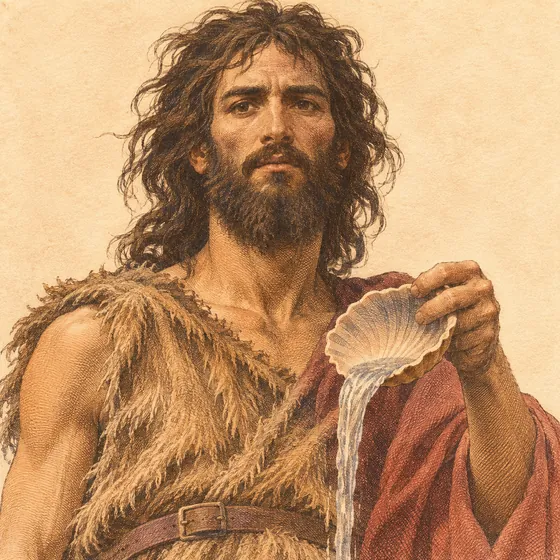
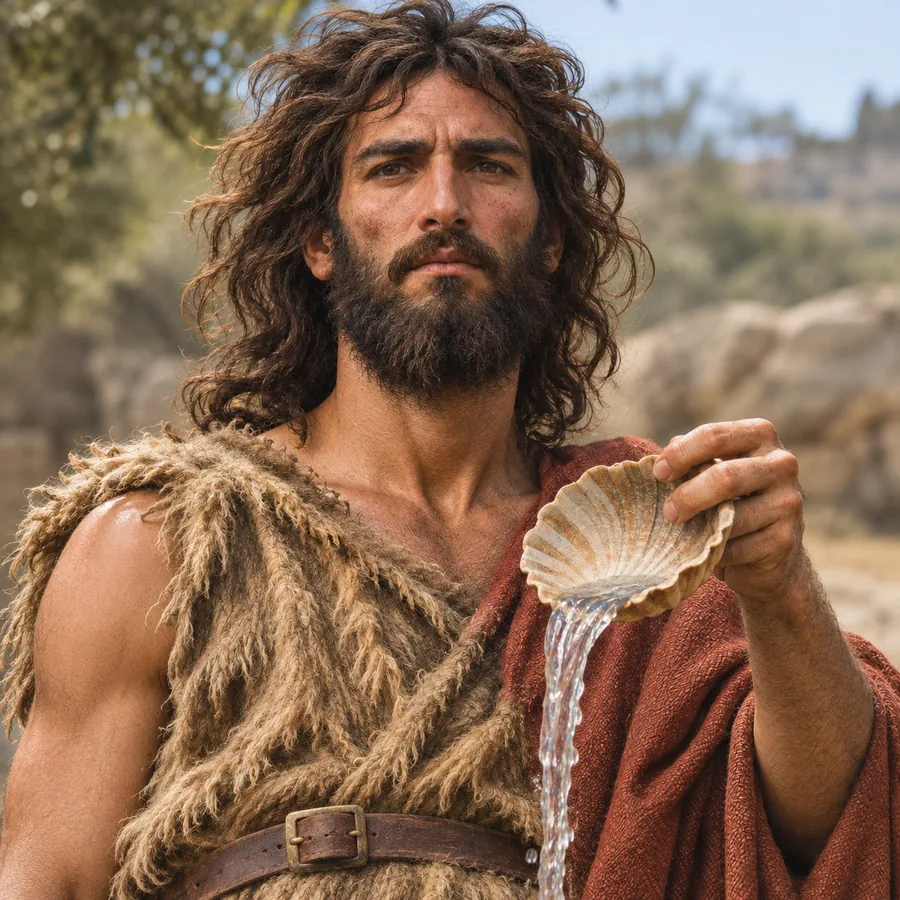

A prophet in the wilderness who calls people to repent and baptises them in the Jordan, including Jesus; Herod has him beheaded.
See Matthew 3:1, Matthew 3:6, Matthew 3:13, Matthew 14:10.
 A shell pouring water marks John the Baptist in the reading view: baptising in the Jordan; the shell is a traditional sign of baptism (Matthew 3:6).
Mentioned in 89 verses across 5 books, first in Luke 1:13. The verses below are the ones linked to this person (the Theographic dataset, with our sourced corrections).
How artists have pictured him
3 works from different centuries and traditions. Each shows how its time and place imagined John the Baptist, not how he looked.


In the Bible
All 23 verses in Luke, in Bible order. Text from the Berean Standard Bible; verse numbers follow the KJV.
Luke
- Luke 1:13
But the angel said to him, “Do not be afraid, Zechariah, because your prayer has been heard. Your wife Elizabeth will bear you a son, and you are to give him the name John.
- Luke 1:60
But his mother replied, “No! He shall be called John.”
- Luke 1:63
Zechariah asked for a tablet and wrote, “His name is John.” And they were all amazed.
- Luke 3:2
during the high priesthood of Annas and Caiaphas, the word of God came to John son of Zechariah in the wilderness.
- Luke 3:15
The people were waiting expectantly and were all wondering in their hearts if John could be the Christ.
- Luke 3:16
John answered all of them: “I baptize you with water, but One more powerful than I will come, the straps of whose sandals I am not worthy to untie. He will baptize you with the Holy Spirit and with fire.
- Luke 3:20
Herod added this to them all: He locked John up in prison.
- Luke 5:33
Then they said to Him, “John’s disciples and those of the Pharisees frequently fast and pray, but Yours keep on eating and drinking.”
- Luke 7:18
Then John’s disciples informed him about all these things.
- Luke 7:19
So John called two of his disciples and sent them to ask the Lord, “Are You the One who was to come, or should we look for someone else?”
- Luke 7:20
When the men came to Jesus, they said, “John the Baptist sent us to ask, ‘Are You the One who was to come, or should we look for someone else?’”
- Luke 7:22
So He replied, “Go back and report to John what you have seen and heard: The blind receive sight, the lame walk, the lepers are cleansed, the deaf hear, the dead are raised, and the good news is preached to the poor.
- Luke 7:24
After John’s messengers had left, Jesus began to speak to the crowds about John: “What did you go out into the wilderness to see? A reed swaying in the wind?
- Luke 7:28
I tell you, among those born of women there is no one greater than John, yet even the least in the kingdom of God is greater than he.”
- Luke 7:29
All the people who heard this, even the tax collectors, acknowledged God’s justice. For they had received the baptism of John.
- Luke 7:33
For John the Baptist came neither eating bread nor drinking wine, and you say, ‘He has a demon!’
- Luke 9:7
When Herod the tetrarch heard about all that was happening, he was perplexed. For some were saying that John had risen from the dead,
- Luke 9:9
“I beheaded John,” Herod said, “but who is this man I hear such things about?” And he kept trying to see Jesus.
- Luke 9:19
They replied, “Some say John the Baptist; others say Elijah; and still others, that a prophet of old has arisen.”
- Luke 11:1
One day in a place where Jesus had just finished praying, one of His disciples requested, “Lord, teach us to pray, just as John taught his disciples.”
- Luke 16:16
The Law and the Prophets were proclaimed until John. Since that time, the gospel of the kingdom of God is being preached, and everyone is forcing his way into it.
- Luke 20:4
John’s baptism—was it from heaven, or from men?”
- Luke 20:6
But if we say, ‘From men,’ all the people will stone us, for they are convinced that John was a prophet.”
Events
Events the dataset lists John the Baptist as taking part in. Dates follow its Ussher–Jones reckoning (one of several traditional counts), not established history.
- c. 5 BCBirth of John the Baptist
- c. AD 26John the Baptist Begins Ministry
- c. AD 26John Baptizes Jesus
- c. AD 27John the Baptist Imprisoned
- c. AD 27John the Baptist Witnesses
- c. AD 28Jesus' Message on John the Baptist
- c. AD 29John Beheaded
Dictionary
From Easton’s Bible Dictionary (1897), as attached to this record by Theographic. The entry is for the name and can describe more than one person who bore it. Easton wrote in 1897, and some of his views are now debated.
Read Easton’s entry
The “forerunner of our Lord.” We have but fragmentary and imperfect accounts of him in the Gospels. He was of priestly descent. His father, Zacharias, was a priest of the course of Abia (1 Chr. 24:10), and his mother, Elisabeth, was of the daughters of Aaron (Luke 1:5). The mission of John was the subject of prophecy (Matt. 3:3; Isa. 40:3; Mal. 3:1). His birth, which took place six months before that of Jesus, was foretold by an angel. Zacharias, deprived of the power of speech as a token of God’s truth and a reproof of his own incredulity with reference to the birth of his son, had the power of speech restored to him on the occasion of his circumcision (Luke 1:64). After this no more is recorded of him for thirty years than what is mentioned in Luke 1:80. John was a Nazarite from his birth (Luke 1:15; Num. 6:1-12). He spent his early years in the mountainous tract of Judah lying between Jerusalem and the Dead Sea (Matt. 3:1-12).
At length he came forth into public life, and great multitudes from “every quarter” were attracted to him. The sum of his preaching was the necessity of repentance. He denounced the Sadducees and Pharisees as a “generation of vipers,” and warned them of the folly of trusting to external privileges (Luke 3:8). “As a preacher, John was eminently practical and discriminating. Self-love and covetousness were the prevalent sins of the people at large. On them, therefore, he enjoined charity and consideration for others. The publicans he cautioned against extortion, the soldiers against crime and plunder.” His doctrine and manner of life roused the entire south of Palestine, and the people from all parts flocked to the place where he was, on the banks of the Jordan. There he baptized thousands unto repentance.
The fame of John reached the ears of Jesus in Nazareth (Matt. 3:5), and he came from Galilee to Jordan to be baptized of John, on the special ground that it became him to “fulfil all righteousness” (3:15). John’s special office ceased with the baptism of Jesus, who must now “increase” as the King come to his kingdom. He continued, however, for a while to bear testimony to the Messiahship of Jesus. He pointed him out to his disciples, saying, “Behold the Lamb of God.” His public ministry was suddenly (after about six months probably) brought to a close by his being cast into prison by Herod, whom he had reproved for the sin of having taken to himself the wife of his brother Philip (Luke 3:19). He was shut up in the castle of Machaerus (q.v.), a fortress on the southern extremity of Peraea, 9 miles east of the Dead Sea, and here he was beheaded. His disciples, having consigned the headless body to the grave, went and told Jesus all that had occurred (Matt. 14:3-12). John’s death occurred apparently just before the third Passover of our Lord’s ministry. Our Lord himself testified regarding him that he was a “burning and a shining light” (John 5:35).