Person
Mary (Mother of Jesus)
The mother of Jesus. In Luke, the angel Gabriel tells her she will conceive a son; the Gospels place her at his birth and, in John, at the cross.
See Luke 1:31, Luke 2:7, John 19:25.
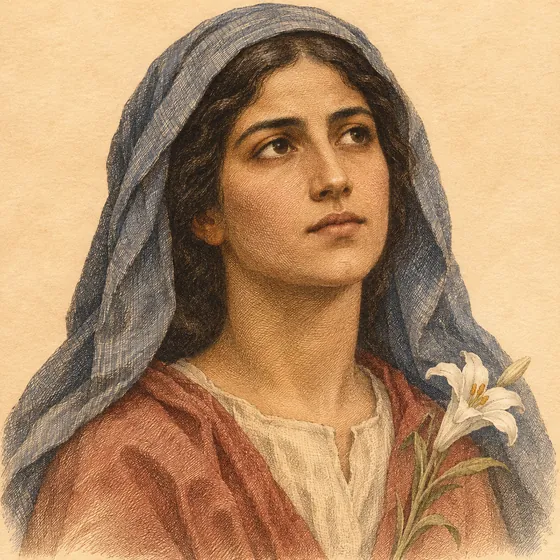
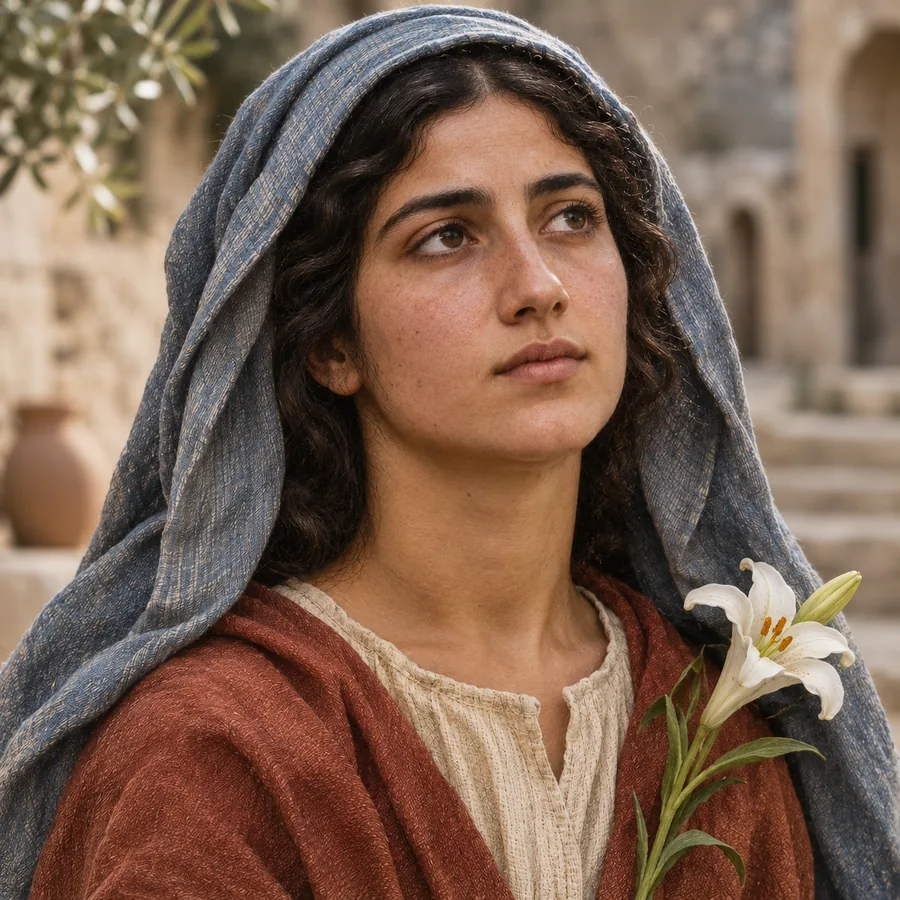
 A lily marks Mary in the reading view: in Christian art, the flower of the Annunciation (the angel's message to her) (Luke 1:26, Luke 1:38).
Mentioned in 21 verses across 5 books, first in Matthew 1:16. The verses below are the ones linked to this person (the Theographic dataset, with our sourced corrections).
How artists have pictured her
3 works from different centuries and traditions. Each shows how its time and place imagined Mary, not how she looked.


In these stories
In the Bible
The first 10 of 21 verses, in Bible order. Text from the Berean Standard Bible; verse numbers follow the KJV.
Matthew
- Matthew 1:16
and Jacob the father of Joseph, the husband of Mary, of whom was born Jesus, who is called Christ.
- Matthew 1:18
This is how the birth of Jesus Christ came about: His mother Mary was pledged in marriage to Joseph, but before they came together, she was found to be with child through the Holy Spirit.
- Matthew 1:20
But after he had pondered these things, an angel of the Lord appeared to him in a dream and said, “Joseph, son of David, do not be afraid to embrace Mary as your wife, for the One conceived in her is from the Holy Spirit.
- Matthew 2:11
On coming to the house, they saw the Child with His mother Mary, and they fell down and worshiped Him. Then they opened their treasures and presented Him with gifts of gold and frankincense and myrrh.
- Matthew 13:55
“Isn’t this the carpenter’s son? Isn’t His mother’s name Mary, and aren’t His brothers James, Joseph, Simon, and Judas?
Mark
- Mark 3:31
Then Jesus’ mother and brothers came and stood outside. They sent someone in to summon Him,
- Mark 6:3
Isn’t this the carpenter, the son of Mary and the brother of James, Joses, Judas, and Simon? Aren’t His sisters here with us as well?” And they took offense at Him.
Luke
Events
Events the dataset lists Mary (Mother of Jesus) as taking part in. Dates follow its Ussher–Jones reckoning (one of several traditional counts), not established history.
- c. 6 BCEspousal of Mary
- c. 5 BCThe Annuciation
- c. 5 BCMary Visits Elizabeth
- c. 4 BCJoseph and Mary Flee to Egypt
- c. 4 BCJoseph and Mary return from Egypt
- c. 4 BCJoseph and Mary return to Nazareth
- c. 4 BCTemple Presentation of Jesus
- no dateMatthias replaces Judas
Dictionary
From Easton’s Bible Dictionary (1897), as attached to this record by Theographic. The entry is for the name and can describe more than one person who bore it. Easton wrote in 1897, and some of his views are now debated.
Read Easton’s entry
The wife of Joseph, the mother of Jesus, called the “Virgin Mary,” though never so designated in Scripture (Matt. 2:11; Acts 1:14). Little is known of her personal history. Her genealogy is given in [Luke 3](/luke#Luke.3). She was of the tribe of Judah and the lineage of David (Ps. 132:11; Luke 1:32). She was connected by marriage with Elisabeth, who was of the lineage of Aaron (Luke 1:36).
While she resided at Nazareth with her parents, before she became the wife of Joseph, the angel Gabriel announced to her that she was to be the mother of the promised Messiah (Luke 1:35). After this she went to visit her cousin Elisabeth, who was living with her husband Zacharias (probably at Juttah, Josh. 15:55; 21:16, in the neighbourhood of Maon), at a considerable distance, about 100 miles, from Nazareth. Immediately on entering the house she was saluted by Elisabeth as the mother of her Lord, and then forthwith gave utterance to her hymn of thanksgiving (Luke 1:46-56; comp. 1 Sam. 2:1-10). After three months Mary returned to Nazareth to her own home. Joseph was supernaturally made aware (Matt. 1:18-25) of her condition, and took her to his own home. Soon after this the decree of Augustus (Luke 2:1) required that they should proceed to Bethlehem (Micah 5:2), some 80 or 90 miles from Nazareth; and while they were there they found shelter in the inn or khan provided for strangers (Luke 2:6, 7). But as the inn was crowded, Mary had to retire to a place among the cattle, and there she brought forth her son, who was called Jesus (Matt. 1:21), because he was to save his people from their sins. This was followed by the presentation in the temple, the flight into Egypt, and their return in the following year and residence at Nazareth ([Matt. 2](/matt#Matt.2)). There for thirty years Mary, the wife of Joseph the carpenter, resides, filling her own humble sphere, and pondering over the strange things that had happened to her. During these years only one event in the history of Jesus is recorded, viz., his going up to Jerusalem when twelve years of age, and his being found among the doctors in the temple (Luke 2:41-52). Probably also during this period Joseph died, for he is not again mentioned.
After the commencement of our Lord’s public ministry little notice is taken of Mary. She was present at the marriage in Cana. A year and a half after this we find her at Capernaum (Matt. 12:46, 48, 49), where Christ uttered the memorable words, “Who is my mother? and who are my brethren? And he stretched forth his hand toward his disciples, and said, Behold my mother and my brethren!” The next time we find her is at the cross along with her sister Mary, and Mary Magdalene, and Salome, and other women (John 19:26). From that hour John took her to his own abode. She was with the little company in the upper room after the Ascension (Acts 1:14). From this time she wholly disappears from public notice. The time and manner of her death are unknown.