Person
Judas Iscariot
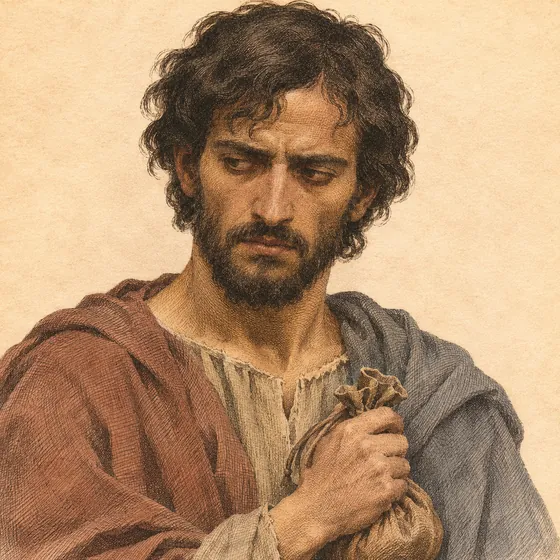
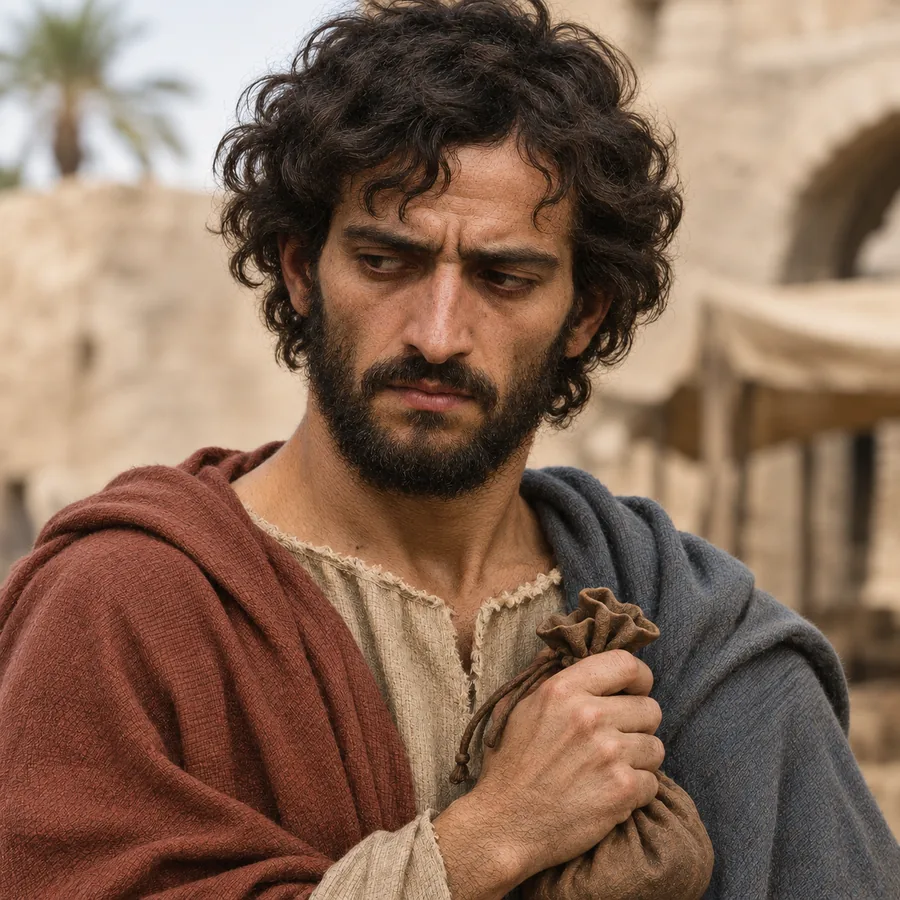

One of Jesus's twelve disciples, who kept the group's money and handed Jesus over to the chief priests for thirty pieces of silver; Matthew and Acts give different accounts of his death.
See Luke 6:16, John 12:6, Matthew 26:15, Matthew 27:5, Acts 1:18.
 A money bag marks Judas Iscariot in the reading view: he kept the common purse, and was paid thirty pieces of silver (John 12:6, Matthew 26:15).
Mentioned in 23 verses across 5 books, first in Luke 6:16. The verses below are the ones linked to this person (the Theographic dataset, with our sourced corrections).
How artists have pictured him
3 works from different centuries and traditions. Each shows how its time and place imagined Judas Iscariot, not how he looked. Many medieval and later images gave Judas red hair, a hooked nose or a yellow robe, stereotypes long used against Jews; the works here were chosen without them.


In the Bible
All 4 verses in Luke, in Bible order. Text from the Berean Standard Bible; verse numbers follow the KJV.
Luke
- Luke 6:16
Judas son of James, and Judas Iscariot, who became a traitor.
- Luke 22:3
Then Satan entered Judas Iscariot, who was one of the Twelve.
- Luke 22:47
While He was still speaking, a crowd arrived, led by the man called Judas, one of the Twelve. He approached Jesus to kiss Him.
- Luke 22:48
But Jesus asked him, “Judas, are you betraying the Son of Man with a kiss?”
Events
Events the dataset lists Judas Iscariot as taking part in. Dates follow its Ussher–Jones reckoning (one of several traditional counts), not established history.
- c. AD 28Apostles Chosen
- no dateJudas Plans Betrayal
- no datePrayer and Betrayal in Gethsemane
- no dateJudas' Suicide
Dictionary
From Easton’s Bible Dictionary (1897), as attached to this record by Theographic. The entry is for the name and can describe more than one person who bore it. Easton wrote in 1897, and some of his views are now debated.
Read Easton’s entry
Son of Simon (John 6:71; 13:2, 26), surnamed Iscariot, i.e., a man of Kerioth (Josh. 15:25). His name is uniformly the last in the list of the apostles, as given in the synoptic (i.e., the first three) Gospels. The evil of his nature probably gradually unfolded itself till “Satan entered into him” (John 13:27), and he betrayed our Lord (18:3). Afterwards he owned his sin with “an exceeding bitter cry,” and cast the money he had received as the wages of his iniquity down on the floor of the sanctuary, and “departed and went and hanged himself” (Matt. 27:5). He perished in his guilt, and “went unto his own place” (Acts 1:25). The statement in Acts 1:18 that he “fell headlong and burst asunder in the midst, and all his bowels gushed out,” is in no way contrary to that in Matt. 27:5. The sucide first hanged himself, perhaps over the valley of Hinnom, “and the rope giving way, or the branch to which he hung breaking, he fell down headlong on his face, and was crushed and mangled on the rocky pavement below.”
Why such a man was chosen to be an apostle we know not, but it is written that “Jesus knew from the beginning who should betray him” (John 6:64). Nor can any answer be satisfactorily given to the question as to the motives that led Judas to betray his Master. “Of the motives that have been assigned we need not care to fix on any one as that which simply led him on. Crime is, for the most part, the result of a hundred motives rushing with bewildering fury through the mind of the criminal.”