Person · one of several with this name
Elijah
Also called Elias
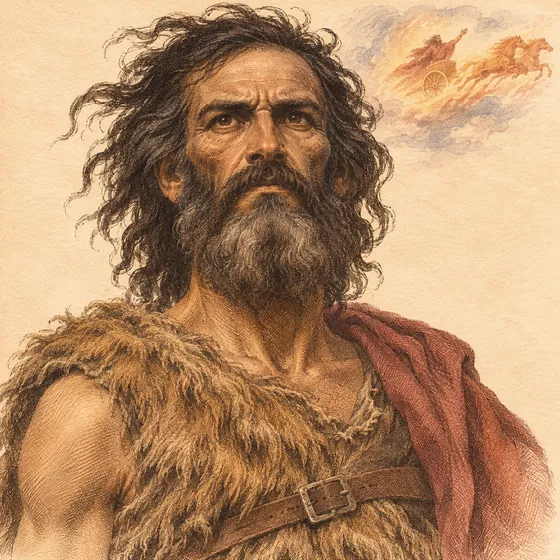
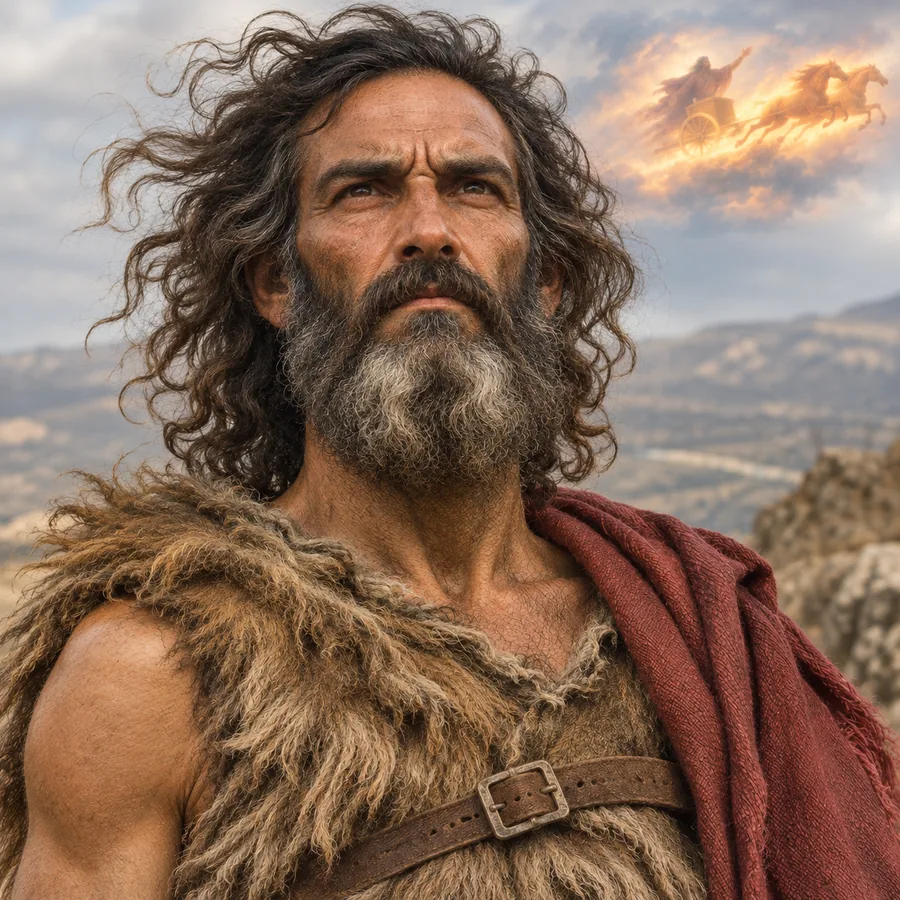

In 1 Kings 17 – 2 Kings 2, a prophet who confronts King Ahab, defeats the prophets of Baal on Mount Carmel, and is taken up to heaven in a whirlwind.
See 1 Kings 18:18, 1 Kings 18:38, 2 Kings 2:11.
 A chariot of fire marks Elijah in the reading view: a chariot of fire and horses of fire parted Elijah and Elisha (2 Kings 2:11).
Mentioned in 92 verses across 10 books, first in 1 Kings 17:1. The verses below are the ones linked to this person (the Theographic dataset, with our sourced corrections).
How artists have pictured him
3 works from different centuries and traditions. Each shows how its time and place imagined Elijah, not how he looked.


In these stories
In the Bible
All 38 verses in 1 Kings, in Bible order. Text from the Berean Standard Bible; verse numbers follow the KJV.
1 Kings
- 1 Kings 17:1
Now Elijah the Tishbite, who was among the settlers of Gilead, said to Ahab, “As surely as the LORD lives—the God of Israel before whom I stand—there will be neither dew nor rain in these years except at my word!”
- 1 Kings 17:13
“Do not be afraid,” Elijah said to her. “Go and do as you have said. But first make me a small cake of bread from what you have, and bring it out to me. Afterward, make some for yourself and your son,
- 1 Kings 17:15
So she went and did according to the word of Elijah, and there was food every day for Elijah and the woman and her household.
- 1 Kings 17:16
The jar of flour was not exhausted and the jug of oil did not run dry, according to the word that the LORD had spoken through Elijah.
- 1 Kings 17:18
“O man of God,” said the woman to Elijah, “what have you done to me? Have you come to remind me of my iniquity and cause the death of my son?”
- 1 Kings 17:22
And the LORD listened to the voice of Elijah, and the child’s life returned to him, and he lived.
- 1 Kings 17:23
Then Elijah took the child, brought him down from the upper room into the house, and gave him to his mother. “Look, your son is alive,” Elijah declared.
- 1 Kings 17:24
Then the woman said to Elijah, “Now I know that you are a man of God and that the word of the LORD from your mouth is truth.”
- 1 Kings 18:1
After a long time, in the third year of the drought, the word of the LORD came to Elijah: “Go and present yourself to Ahab, and I will send rain upon the face of the earth.”
- 1 Kings 18:2
So Elijah went to present himself to Ahab. The famine was severe in Samaria,
- 1 Kings 18:7
Now as Obadiah went on his way, Elijah suddenly met him. When Obadiah recognized him, he fell facedown and said, “Is it you, my lord Elijah?”
- 1 Kings 18:8
“It is I,” he answered. “Go tell your master, ‘Elijah is here!’”
- 1 Kings 18:11
And now you say, ‘Go tell your master that Elijah is here!’
- 1 Kings 18:14
And now you say, ‘Go tell your lord that Elijah is here!’ He will kill me!”
- 1 Kings 18:15
Then Elijah said, “As surely as the LORD of Hosts lives, before whom I stand, I will present myself to Ahab today.”
- 1 Kings 18:16
So Obadiah went to inform Ahab, who went to meet Elijah.
- 1 Kings 18:17
When Ahab saw Elijah, he said to him, “Is that you, O troubler of Israel?”
- 1 Kings 18:21
Then Elijah approached all the people and said, “How long will you waver between two opinions? If the LORD is God, follow Him. But if Baal is God, follow him.” But the people did not answer a word.
- 1 Kings 18:22
Then Elijah said to the people, “I am the only remaining prophet of the LORD, but Baal has four hundred and fifty prophets.
- 1 Kings 18:25
Then Elijah said to the prophets of Baal, “Since you are so numerous, choose for yourselves one bull and prepare it first. Then call on the name of your god, but do not light the fire.”
- 1 Kings 18:27
At noon Elijah began to taunt them, saying, “Shout louder, for he is a god! Perhaps he is deep in thought, or occupied, or on a journey. Perhaps he is sleeping and must be awakened!”
- 1 Kings 18:30
Then Elijah said to all the people, “Come near to me.” So all the people approached him, and he repaired the altar of the LORD that had been torn down.
- 1 Kings 18:31
And Elijah took twelve stones, one for each tribe of the sons of Jacob, to whom the word of the LORD had come and said, “Israel shall be your name.”
- 1 Kings 18:36
At the time of the evening sacrifice, Elijah the prophet approached the altar and said, “O LORD, God of Abraham, Isaac, and Israel, let it be known this day that You are God in Israel and that I am Your servant and have done all these things at Your command.
- 1 Kings 18:40
Then Elijah ordered them, “Seize the prophets of Baal! Do not let a single one escape.” So they seized them, and Elijah brought them down to the Kishon Valley and slaughtered them there.
- 1 Kings 18:41
And Elijah said to Ahab, “Go up, eat and drink, for there is the sound of a heavy rain.”
- 1 Kings 18:42
So Ahab went up to eat and drink. But Elijah climbed to the summit of Carmel, bent down on the ground, and put his face between his knees.
- 1 Kings 18:46
And the hand of the LORD came upon Elijah, and he tucked his cloak into his belt and ran ahead of Ahab all the way to Jezreel.
- 1 Kings 19:1
Now Ahab told Jezebel everything that Elijah had done and how he had killed all the prophets with the sword.
- 1 Kings 19:2
So Jezebel sent a messenger to Elijah, saying, “May the gods deal with me, and ever so severely, if by this time tomorrow I do not make your life like the lives of those you killed!”
- 1 Kings 19:9
There Elijah entered a cave and spent the night. And the word of the LORD came to him, saying, “What are you doing here, Elijah?”
- 1 Kings 19:13
When Elijah heard it, he wrapped his face in his cloak and went out and stood at the mouth of the cave. Suddenly a voice came to him and said, “What are you doing here, Elijah?”
- 1 Kings 19:19
So Elijah departed and found Elisha son of Shaphat. He was plowing with twelve teams of oxen, and he was with the twelfth team. Elijah passed by him and threw his cloak around him.
- 1 Kings 19:20
So Elisha left the oxen, ran after Elijah, and said, “Please let me kiss my father and mother goodbye, and then I will follow you.” “Go on back,” Elijah replied, “for what have I done to you?”
- 1 Kings 19:21
So Elisha turned back from him, took his pair of oxen, and slaughtered them. With the oxen’s equipment, he cooked the meat and gave it to the people, and they ate. Then he set out to follow and serve Elijah.
- 1 Kings 21:17
Then the word of the LORD came to Elijah the Tishbite, saying,
- 1 Kings 21:20
When Elijah arrived, Ahab said to him, “So you have found me out, my enemy.” He replied, “I have found you out because you have sold yourself to do evil in the sight of the LORD.
- 1 Kings 21:28
Then the word of the LORD came to Elijah the Tishbite, saying:
Events
Events the dataset lists Elijah as taking part in. Dates follow its Ussher–Jones reckoning (one of several traditional counts), not established history.
- c. 910 BCProphecies of Elijah
- c. AD 29The Transfiguation
Dictionary
From Easton’s Bible Dictionary (1897), as attached to this record by Theographic. The entry is for the name and can describe more than one person who bore it. Easton wrote in 1897, and some of his views are now debated.
Read Easton’s entry
“The Tishbite,” the “Elias” of the New Testament, is suddenly introduced to our notice in 1 Kings 17:1 as delivering a message from the Lord to Ahab. There is mention made of a town called Thisbe, south of Kadesh, but it is impossible to say whether this was the place referred to in the name given to the prophet.
Having delivered his message to Ahab, he retired at the command of God to a hiding-place by the brook Cherith, beyond Jordan, where he was fed by ravens. When the brook dried up God sent him to the widow of Zarephath, a city of Zidon, from whose scanty store he was supported for the space of two years. During this period the widow’s son died, and was restored to life by Elijah ([1 Kings 17](/1kgs#1Kgs.17): 2-24).
During all these two years a famine prevailed in the land. At the close of this period of retirement and of preparation for his work (comp. Gal. 1:17, 18) Elijah met Obadiah, one of Ahab’s officers, whom he had sent out to seek for pasturage for the cattle, and bade him go and tell his master that Elijah was there. The king came and met Elijah, and reproached him as the troubler of Israel. It was then proposed that sacrifices should be publicly offered, for the purpose of determining whether Baal or Jehovah were the true God. This was done on Carmel, with the result that the people fell on their faces, crying, “The Lord, he is the God.” Thus was accomplished the great work of Elijah’s ministry. The prophets of Baal were then put to death by the order of Elijah. Not one of them escaped. Then immediately followed rain, according to the word of Elijah, and in answer to his prayer (James 5:18).
Jezebel, enraged at the fate that had befallen her priests of Baal, threatened to put Elijah to death (1 Kings 19:1-13). He therefore fled in alarm to Beersheba, and thence went alone a day’s journey into the wilderness, and sat down in despondency under a juniper tree. As he slept an angel touched him, and said unto him, “Arise and eat; because the journey is too great for thee.” He arose and found a cake and a cruse of water. Having partaken of the provision thus miraculously supplied, he went forward on his solitary way for forty days and forty nights to Horeb, the mount of God, where he took up his abode in a cave. Here the Lord appeared unto him and said, “What dost thou here, Elijah?” In answer to his despondent words God manifests to him his glory, and then directs him to return to Damascus and anoint Hazael king over Syria, and Jehu king over Israel, and Elisha to be prophet in his room (1 Kings 19:13-21; comp. 2 Kings 8:7-15; 9:1-10).
Some six years after this he warned Ahab and Jezebel of the violent deaths they would die (1 Kings 21:19-24; 22:38). He also, four years afterwards, warned Ahaziah (q.v.), who had succeeded his father Ahab, of his approaching death (2 Kings 1:1-16). During these intervals he probably withdrew to some quiet retirement, no one knew where. His interview with Ahaziah’s messengers on the way to Ekron, and the account of the destruction of his captains with their fifties, suggest the idea that he may have been in retirement at this time on Mount Carmel.
The time now drew near when he was to be taken up into heaven (2 Kings 2:1-12). He had a presentiment of what was awaiting him. He went down to Gilgal, where was a school of the prophets, and where his successor Elisha, whom he had anointed some years before, resided. Elisha was solemnized by the thought of his master’s leaving him, and refused to be parted from him. “They two went on,” and came to Bethel and Jericho, and crossed the Jordan, the waters of which were “divided hither and thither” when smitten with Elijah’s mantle. Arrived at the borders of Gilead, which Elijah had left many years before, it “came to pass as they still went on and talked” they were suddenly separated by a chariot and horses of fire; and “Elijah went up by a whirlwind into heaven, “Elisha receiving his mantle, which fell from him as he ascended.
No one of the old prophets is so frequently referred to in the New Testament. The priests and Levites said to the Baptist (John 1:25), “Why baptizest thou, if thou be not that Christ, nor Elias?” Paul (Rom. 11:2) refers to an incident in his history to illustrate his argument that God had not cast away his people. James (5:17) finds in him an illustration of the power of prayer. (See also Luke 4:25; 9:54.) He was a type of John the Baptist in the sternness and power of his reproofs (Luke 9:8). He was the Elijah that “must first come” (Matt. 11:11, 14), the forerunner of our Lord announced by Malachi. Even outwardly the Baptist corresponded so closely to the earlier prophet that he might be styled a second Elijah. In him we see “the same connection with a wild and wilderness country; the same long retirement in the desert; the same sudden, startling entrance on his work (1 Kings 17:1; Luke 3:2); even the same dress, a hairy garment, and a leathern girdle about the loins (2 Kings 1:8; Matt. 3:4).”
How deep the impression was which Elijah made “on the mind of the nation may be judged from the fixed belief, which rested on the words of Malachi (4:5, 6), which many centuries after prevailed that he would again appear for the relief and restoration of the country. Each remarkable person as he arrives on the scene, be his habits and characteristics what they may, the stern John equally with his gentle Successor, is proclaimed to be Elijah (Matt. 11:13, 14; 16:14; 17:10; Mark 9:11; 15:35; Luke 9:7, 8; John 1:21). His appearance in glory on the mount of transfiguration does not seem to have startled the disciples. They were ‘sore afraid,’ but not apparently surprised.”