Person
Rahab
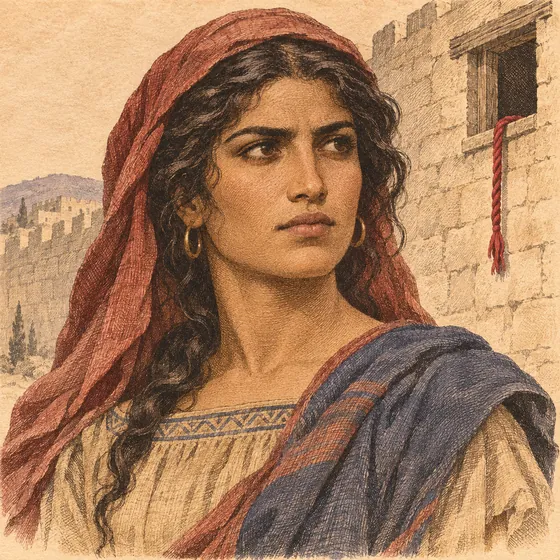
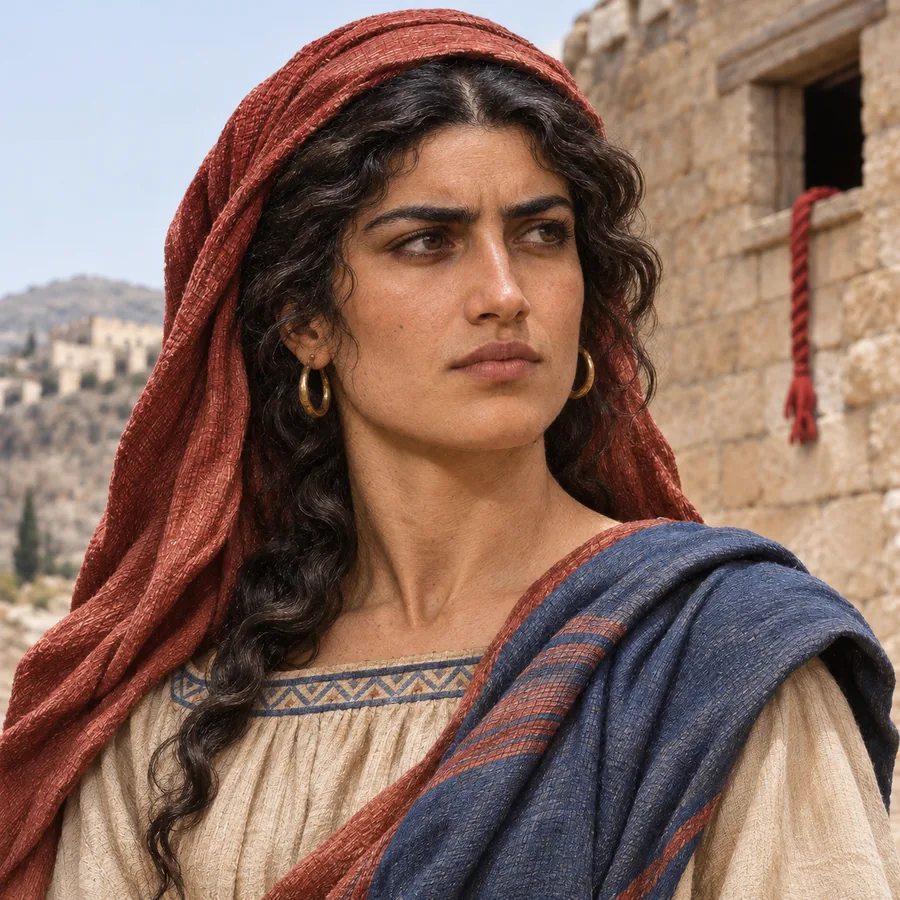
In Joshua 2 and 6, a woman of Jericho who hides two Israelite spies; she and her family are spared when the city falls.
See Joshua 2:4, Joshua 6:25.
 A scarlet cord from a window marks Rahab in the reading view: the sign she hung so her house would be spared (Joshua 2:18).
Mentioned in 7 verses across 3 books, first in Joshua 2:1. The verses below are the ones linked to this person (the Theographic dataset, with our sourced corrections).
How artists have pictured her
3 works from different centuries and traditions. Each shows how its time and place imagined Rahab, not how she looked.


In these stories
Questions about this
In the Bible
All 7 verses, in Bible order. Text from the Berean Standard Bible; verse numbers follow the KJV.
Joshua
- Joshua 2:1
Then Joshua son of Nun secretly sent two spies from Shittim, saying, “Go, inspect the land, especially Jericho.” So they went and entered the house of a prostitute named Rahab and stayed there.
- Joshua 2:3
So the king of Jericho sent to Rahab and said, “Bring out the men who came to you and entered your house, for they have come to spy out the whole land.”
- Joshua 6:17
Now the city and everything in it must be devoted to the LORD for destruction. Only Rahab the prostitute and all those with her in her house will live, because she hid the spies we sent.
- Joshua 6:23
So the young spies went in and brought out Rahab, her father and mother and brothers, and all who belonged to her. They brought out her whole family and settled them outside the camp of Israel.
- Joshua 6:25
And Joshua spared Rahab the prostitute, with her father’s household and all who belonged to her, because she hid the men Joshua had sent to spy out Jericho. So she has lived among the Israelites to this day.
Hebrews
- Hebrews 11:31
By faith the prostitute Rahab, because she welcomed the spies in peace, did not perish with those who were disobedient.
James
- James 2:25
In the same way, was not even Rahab the prostitute justified by her actions when she welcomed the spies and sent them off on another route?
Dictionary
From Easton’s Bible Dictionary (1897), as attached to this record by Theographic. The entry is for the name and can describe more than one person who bore it. Easton wrote in 1897, and some of his views are now debated.
Read Easton’s entry
Insolence; pride, a poetical name applied to Egypt in Ps. 87:4; 89:10; Isa. 51:9, as “the proud one.”
Rahab, (Heb. Rahab; i.e., “broad,” “large”). When the Hebrews were encamped at Shittim, in the “Arabah” or Jordan valley opposite Jericho, ready to cross the river, Joshua, as a final preparation, sent out two spies to “spy the land.” After five days they returned, having swum across the river, which at this season, the month Abib, overflowed its banks from the melting of the snow on Lebanon. The spies reported how it had fared with them (Josh. 2:1-7). They had been exposed to danger in Jericho, and had been saved by the fidelity of Rahab the harlot, to whose house they had gone for protection. When the city of Jericho fell (6:17-25), Rahab and her whole family were preserved according to the promise of the spies, and were incorporated among the Jewish people. She afterwards became the wife of Salmon, a prince of the tribe of Judah (Ruth 4:21; 1 Chr. 2:11; Matt. 1:5). “Rahab’s being asked to bring out the spies to the soldiers (Josh. 2:3) sent for them, is in strict keeping with Eastern manners, which would not permit any man to enter a woman’s house without her permission. The fact of her covering the spies with bundles of flax which lay on her house-roof (2:6) is an ‘undesigned coincidence’ which strictly corroborates the narrative. It was the time of the barley harvest, and flax and barley are ripe at the same time in the Jordan valley, so that the bundles of flax stalks might have been expected to be drying just then” (Geikie’s Hours, etc., ii., 390).