Person
Noah
Also called Noe
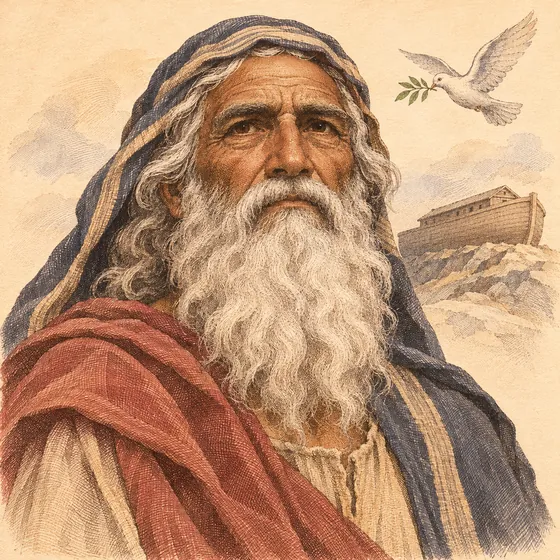
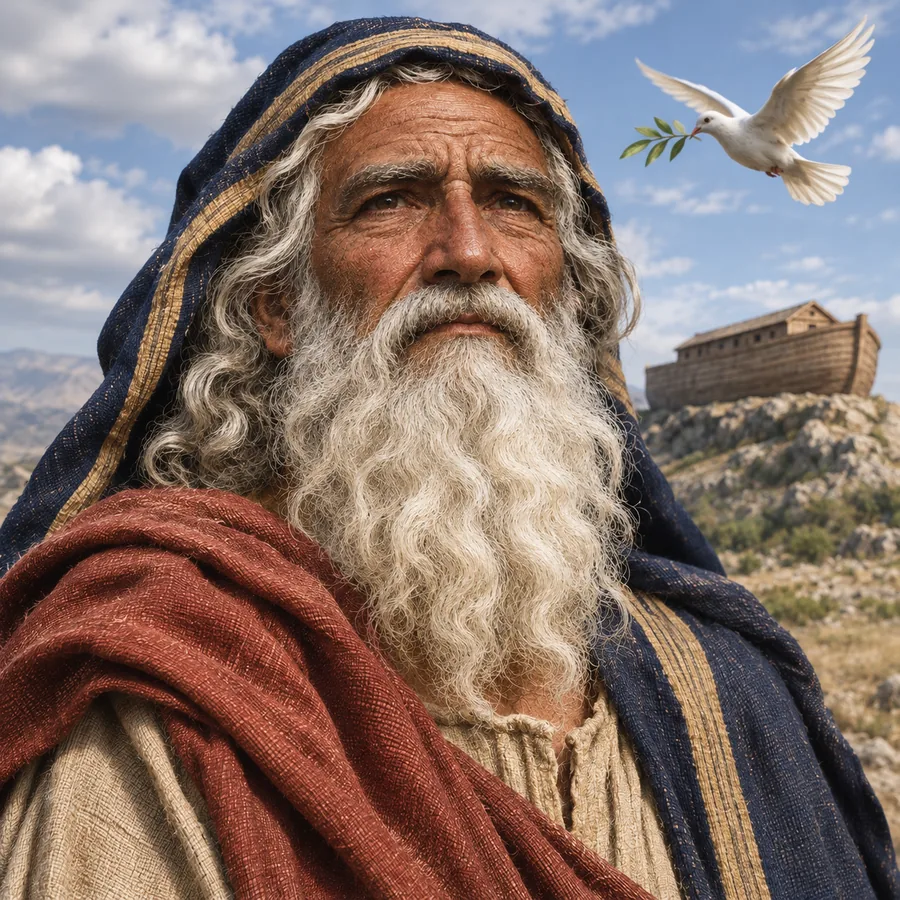

In Genesis 6–9, the man told to build an ark, who survives the flood with his family and the animals.
See Genesis 6:14, Genesis 7:23.
 An ark and a dove with an olive leaf marks Noah in the reading view: the dove that returned with an olive leaf (Genesis 8:11).
Mentioned in 47 verses across 9 books, first in Genesis 5:29. The verses below are the ones linked to this person (the Theographic dataset, with our sourced corrections).
How artists have pictured him
3 works from different centuries and traditions. Each shows how its time and place imagined Noah, not how he looked.


In these stories
In the Bible
The first 10 of 47 verses, in Bible order. Text from the Berean Standard Bible; verse numbers follow the KJV.
Genesis
- Genesis 5:29
And he named him Noah, saying, “May this one comfort us in the labor and toil of our hands caused by the ground that the LORD has cursed.”
- Genesis 5:30
And after he had become the father of Noah, Lamech lived 595 years and had other sons and daughters.
- Genesis 5:32
After Noah was 500 years old, he became the father of Shem, Ham, and Japheth.
- Genesis 6:8
Noah, however, found favor in the eyes of the LORD.
- Genesis 6:9
This is the account of Noah. Noah was a righteous man, blameless in his generation; Noah walked with God.
- Genesis 6:10
And Noah had three sons: Shem, Ham, and Japheth.
- Genesis 6:13
Then God said to Noah, “The end of all living creatures has come before Me, because through them the earth is full of violence. Now behold, I will destroy both them and the earth.
- Genesis 6:22
So Noah did everything precisely as God had commanded him.
- Genesis 7:1
Then the LORD said to Noah, “Go into the ark, you and all your family, because I have found you righteous in this generation.
- Genesis 7:5
And Noah did all that the LORD had commanded him.
Events
Events the dataset lists Noah as taking part in. Dates follow its Ussher–Jones reckoning (one of several traditional counts), not established history.
- c. 2948 BCBirth of Noah
- c. 2948 BCLifetime of Noah
- c. 2446 BCBirth of Shem
- c. 2400 BCGod instructs Noah to build the ark
- c. 2348 BCThe Great Flood begins
- c. 2348 BCThe Great Flood
- c. 2348 BCWater covers the earth
- c. 2347 BCThe flood subsides
- c. 2347 BCLeaving the Ark
- c. 2347 BCGod makes a covenant with Noah
- c. 2346 BCNoah gets drunk and Canaan is cursed
- c. 1998 BCDeath of Noah
Dictionary
From Easton’s Bible Dictionary (1897), as attached to this record by Theographic. The entry is for the name and can describe more than one person who bore it. Easton wrote in 1897, and some of his views are now debated.
Read Easton’s entry
Rest, (Heb. Noah) the grandson of Methuselah (Gen. 5:25-29), who was for two hundred and fifty years contemporary with Adam, and the son of Lamech, who was about fifty years old at the time of Adam’s death. This patriarch is rightly regarded as the connecting link between the old and the new world. He is the second great progenitor of the human family.
The words of his father Lamech at his birth (Gen. 5:29) have been regarded as in a sense prophetical, designating Noah as a type of Him who is the true “rest and comfort” of men under the burden of life (Matt. 11:28).
He lived five hundred years, and then there were born unto him three sons, Shem, Ham, and Japheth (Gen. 5:32). He was a “just man and perfect in his generation,” and “walked with God” (comp. Ezek. 14:14, 20). But now the descendants of Cain and of Seth began to intermarry, and then there sprang up a race distinguished for their ungodliness. Men became more and more corrupt, and God determined to sweep the earth of its wicked population (Gen. 6:7). But with Noah God entered into a covenant, with a promise of deliverance from the threatened deluge (18). He was accordingly commanded to build an ark (6:14-16) for the saving of himself and his house. An interval of one hundred and twenty years elapsed while the ark was being built (6:3), during which Noah bore constant testimony against the unbelief and wickedness of that generation (1 Pet. 3:18-20; 2 Pet. 2:5).
When the ark of “gopher-wood” (mentioned only here) was at length completed according to the command of the Lord, the living creatures that were to be preserved entered into it; and then Noah and his wife and sons and daughters-in-law entered it, and the “Lord shut him in” (Gen. 7:16). The judgment-threatened now fell on the guilty world, “the world that then was, being overflowed with water, perished” (2 Pet. 3:6). The ark floated on the waters for one hundred and fifty days, and then rested on the mountains of Ararat (Gen. 8:3, 4); but not for a considerable time after this was divine permission given him to leave the ark, so that he and his family were a whole year shut up within it ([Gen. 6](/gen#Gen.6)-14).
On leaving the ark Noah’s first act was to erect an altar, the first of which there is any mention, and offer the sacrifices of adoring thanks and praise to God, who entered into a covenant with him, the first covenant between God and man, granting him possession of the earth by a new and special charter, which remains in force to the present time (Gen. 8:21-9:17). As a sign and witness of this covenant, the rainbow was adopted and set apart by God, as a sure pledge that never again would the earth be destroyed by a flood.
But, alas! Noah after this fell into grievous sin (Gen. 9:21); and the conduct of Ham on this sad occasion led to the memorable prediction regarding his three sons and their descendants. Noah “lived after the flood three hundred and fifty years, and he died” (28:29)..
Noah, motion, (Heb. No’ah) one of the five daughters of Zelophehad (Num. 26:33; 27:1; 36:11; Josh. 17:3).