Person
Job
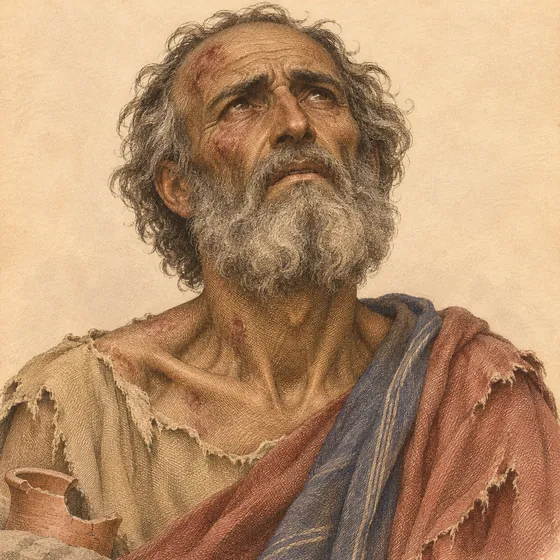
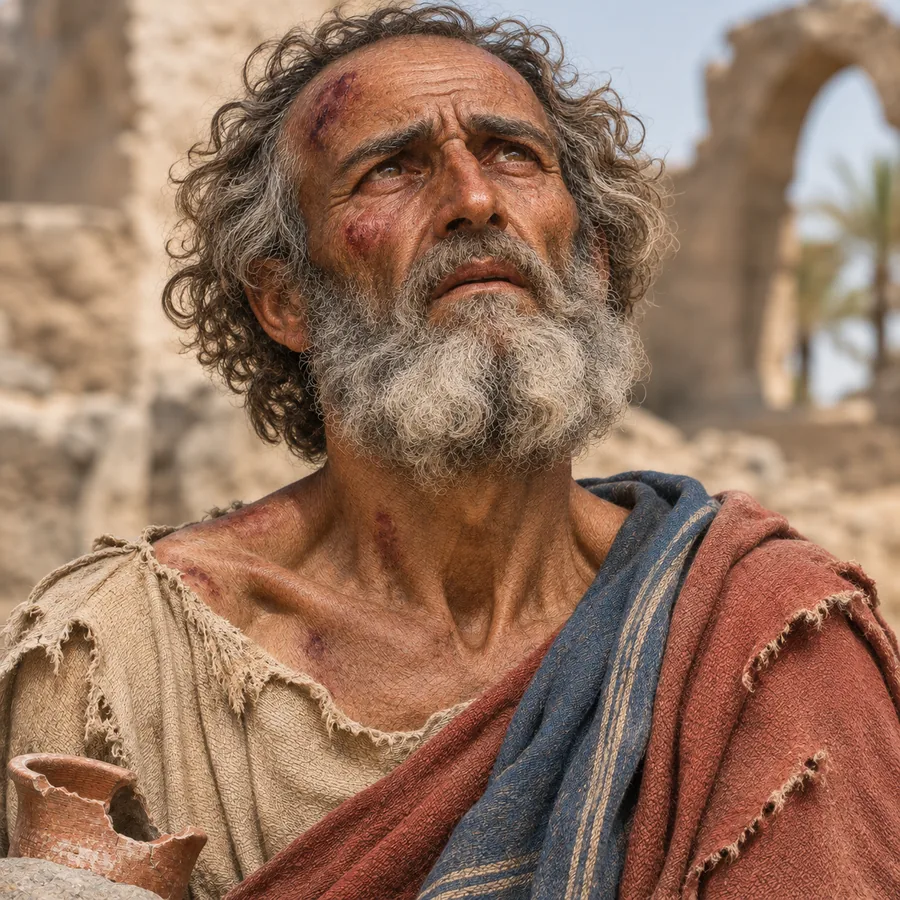

In the book of Job, a blameless man who loses his children, wealth and health, argues with his friends over why, and is answered by God from a whirlwind.
See Job 1:1, Job 1:19, Job 2:7, Job 38:1.
 A broken piece of pottery marks Job in the reading view: he took a potsherd to scrape himself and sat among the ashes (Job 2:8).
Mentioned in 53 verses across 3 books, first in Job 1:1. The verses below are the ones linked to this person (the Theographic dataset, with our sourced corrections).
How artists have pictured him
3 works from different centuries and traditions. Each shows how its time and place imagined Job, not how he looked.


Questions about this
In the Bible
The first 10 of 53 verses, in Bible order. Text from the Berean Standard Bible; verse numbers follow the KJV.
Job
- Job 1:1
There was a man in the land of Uz whose name was Job. And this man was blameless and upright, fearing God and shunning evil.
- Job 1:5
And when the days of feasting were over, Job would send for his children to purify them, rising early in the morning to offer burnt offerings for all of them. For Job thought, “Perhaps my children have sinned and cursed God in their hearts.” This was Job’s regular practice.
- Job 1:8
Then the LORD said to Satan, “Have you considered My servant Job? For there is no one on earth like him, a man who is blameless and upright, who fears God and shuns evil.”
- Job 1:9
Satan answered the LORD, “Does Job fear God for nothing?
- Job 1:14
a messenger came and reported to Job: “While the oxen were plowing and the donkeys were grazing nearby,
- Job 1:20
Then Job stood up, tore his robe, and shaved his head. He fell to the ground and worshiped,
- Job 1:22
In all this, Job did not sin or charge God with wrongdoing.
- Job 2:3
Then the LORD said to Satan, “Have you considered My servant Job? For there is no one on earth like him, a man who is blameless and upright, who fears God and shuns evil. He still retains his integrity, even though you incited Me against him to ruin him without cause.”
- Job 2:7
So Satan went out from the presence of the LORD and infected Job with terrible boils from the soles of his feet to the crown of his head.
- Job 2:10
“You speak as a foolish woman speaks,” he told her. “Should we accept from God only good and not adversity?” In all this, Job did not sin in what he said.
Events
Events the dataset lists Job as taking part in. Dates follow its Ussher–Jones reckoning (one of several traditional counts), not established history.
- c. 1720 BCBirth of Job
- c. 1720 BCLifetime of Job
- c. 1650 BCJob's Trial
- c. 1580 BCDeath of Job
Dictionary
From Easton’s Bible Dictionary (1897), as attached to this record by Theographic. The entry is for the name and can describe more than one person who bore it. Easton wrote in 1897, and some of his views are now debated.
Read Easton’s entry
Persecuted, an Arabian patriarch who resided in the land of Uz (q.v.). While living in the midst of great prosperity, he was suddenly overwhelmed by a series of sore trials that fell upon him. Amid all his sufferings he maintained his integrity. Once more God visited him with the rich tokens of his goodness and even greater prosperity than he had enjoyed before. He survived the period of trial for one hundred and forty years, and died in a good old age, an example to succeeding generations of integrity (Ezek. 14:14, 20) and of submissive patience under the sorest calamities (James 5:11). His history, so far as it is known, is recorded in his book.