Person
Ruth
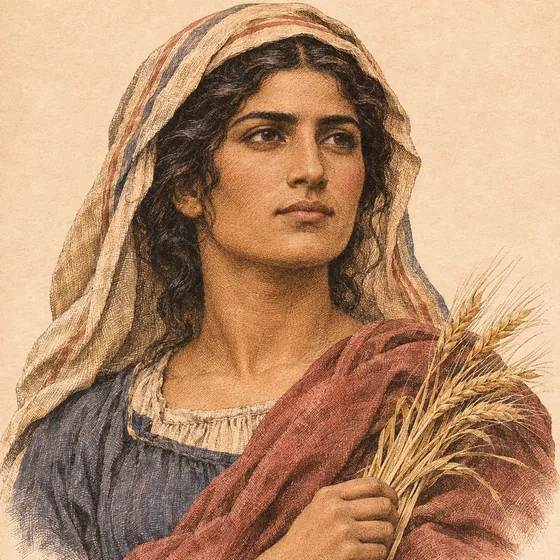
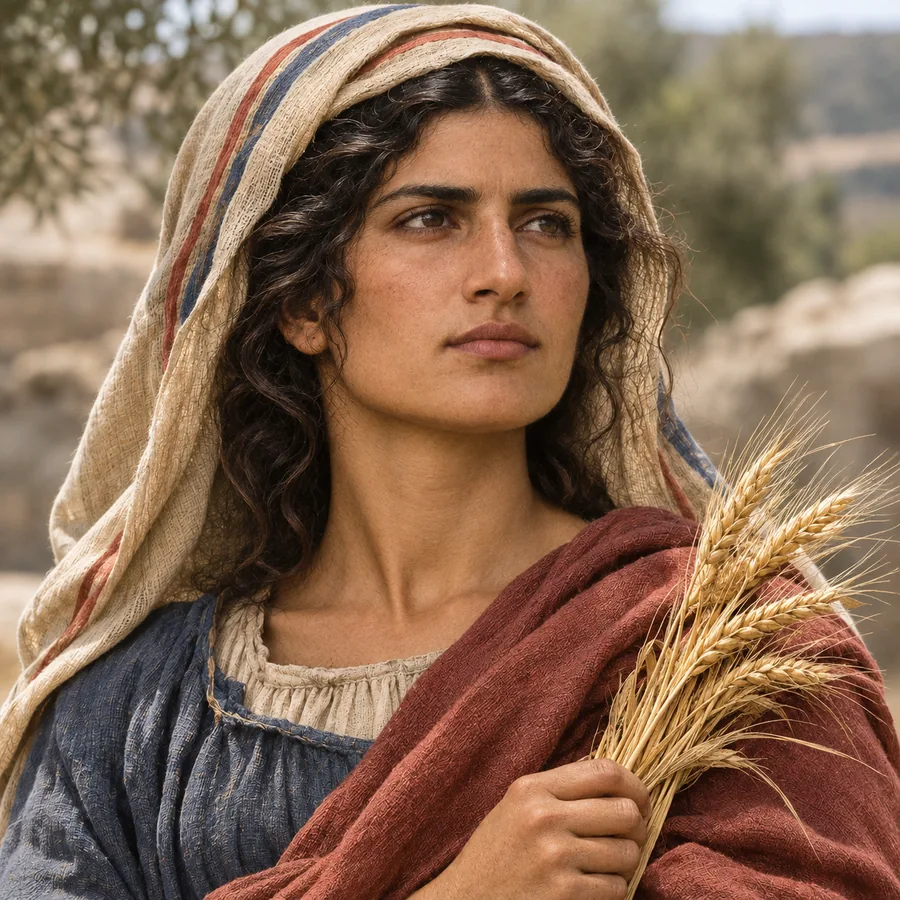

In the book of Ruth, a Moabite widow who stays with her mother-in-law Naomi, gleans in Boaz's field and marries him; she is King David's great-grandmother.
See Ruth 1:16, Ruth 2:3, Ruth 4:13, Ruth 4:17.
 A sheaf of barley marks Ruth in the reading view: she gleaned in the field and beat out about an ephah of barley (Ruth 2:17).
Mentioned in 13 verses across 2 books, first in Ruth 1:4. The verses below are the ones linked to this person (the Theographic dataset, with our sourced corrections).
How artists have pictured her
3 works from different centuries and traditions. Each shows how its time and place imagined Ruth, not how she looked.


In the Bible
The first 10 of 13 verses, in Bible order. Text from the Berean Standard Bible; verse numbers follow the KJV.
Ruth
- Ruth 1:4
who took Moabite women as their wives, one named Orpah and the other named Ruth. And after they had lived in Moab about ten years,
- Ruth 1:14
Again they wept aloud, and Orpah kissed her mother-in-law goodbye, but Ruth clung to her.
- Ruth 1:16
But Ruth replied: “Do not urge me to leave you or to turn from following you. For wherever you go, I will go, and wherever you live, I will live; your people will be my people, and your God will be my God.
- Ruth 1:22
So Naomi returned from the land of Moab with her daughter-in-law Ruth the Moabitess. And they arrived in Bethlehem at the beginning of the barley harvest.
- Ruth 2:2
And Ruth the Moabitess said to Naomi, “Please let me go into the fields and glean heads of grain after someone in whose sight I may find favor.” “Go ahead, my daughter,” Naomi replied.
- Ruth 2:8
Then Boaz said to Ruth, “Listen, my daughter. Do not go and glean in another field, and do not go away from this place, but stay here close to my servant girls.
- Ruth 2:21
Then Ruth the Moabitess said, “He also told me, ‘Stay with my young men until they have finished gathering all my harvest.’”
- Ruth 2:22
And Naomi said to her daughter-in-law Ruth, “My daughter, it is good for you to work with his young women, so that nothing will happen to you in another field.”
- Ruth 3:9
“Who are you?” he asked. “I am your servant Ruth,” she replied. “Spread the corner of your garment over me, for you are a kinsman-redeemer.”
- Ruth 4:5
Then Boaz said, “On the day you buy the land from Naomi and also from Ruth the Moabitess, you must also acquire the widow of the deceased in order to raise up the name of the deceased on his inheritance.”
Dictionary
From Easton’s Bible Dictionary (1897), as attached to this record by Theographic. The entry is for the name and can describe more than one person who bore it. Easton wrote in 1897, and some of his views are now debated.
Read Easton’s entry
A friend, a Moabitess, the wife of Mahlon, whose father, Elimelech, had settled in the land of Moab. On the death of Elimelech and Mahlon, Naomi came with Ruth, her daughter-in-law, who refused to leave her, to Bethlehem, the old home from which Elimelech had migrated. There she had a rich relative, Boaz, to whom Ruth was eventually married. She became the mother of Obed, the grandfather of David. Thus Ruth, a Gentile, is among the maternal progenitors of our Lord (Matt. 1:5). The story of “the gleaner Ruth illustrates the friendly relations between the good Boaz and his reapers, the Jewish land system, the method of transferring property from one person to another, the working of the Mosaic law for the relief of distressed and ruined families; but, above all, handing down the unselfishness, the brave love, the unshaken trustfulness of her who, though not of the chosen race, was, like the Canaanitess Tamar (Gen. 38:29; Matt. 1:3) and the Canaanitess Rahab (Matt. 1:5), privileged to become the ancestress of David, and so of ‘great David’s greater Son’” (Ruth 4:18-22).