Person
Isaiah
Also called Esaias
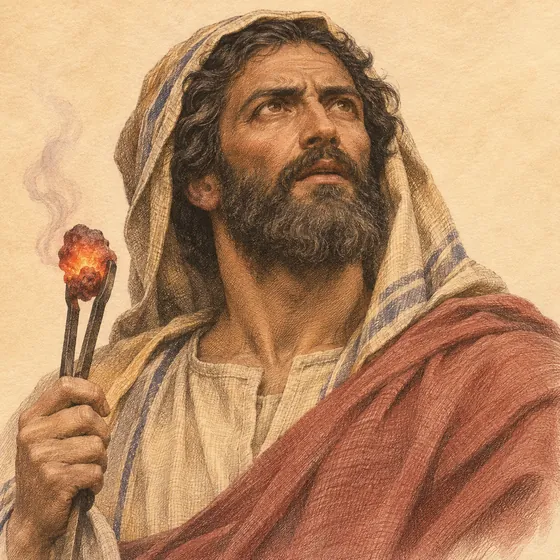
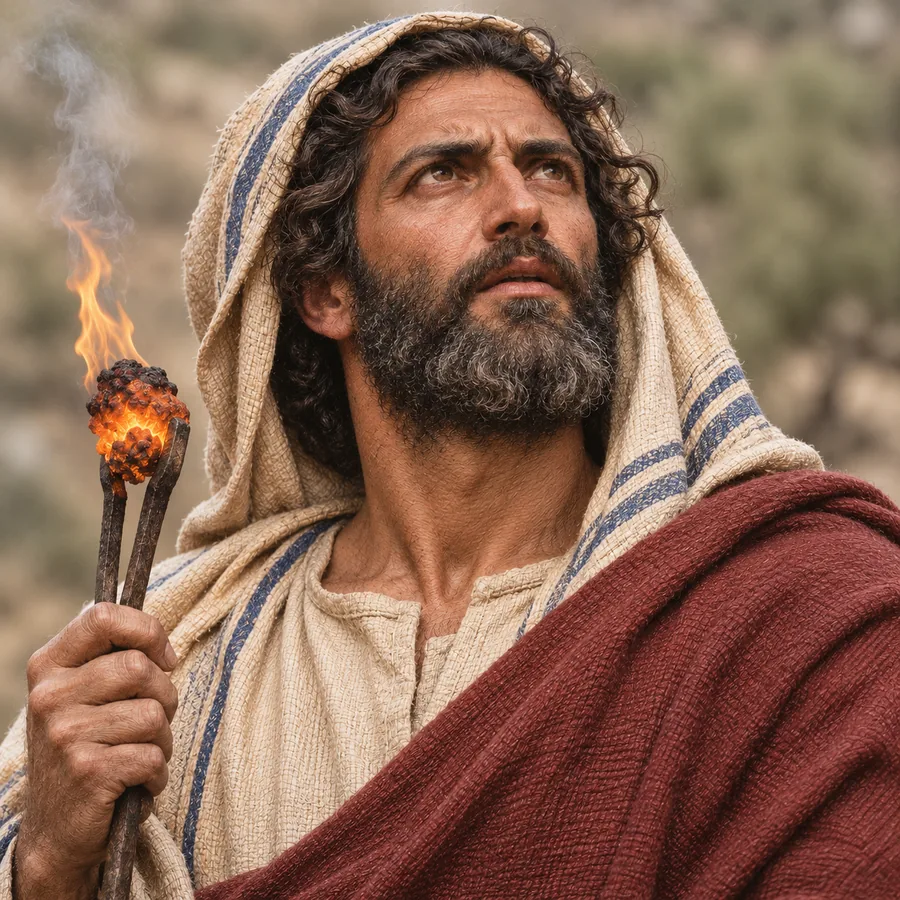

A prophet in Jerusalem in the reigns of Uzziah to Hezekiah, to whom the book of Isaiah is attributed; in a vision a seraph touches his lips with a live coal.
See Isaiah 1:1, Isaiah 6:6, Isaiah 6:7.
 A live coal in tongs marks Isaiah in the reading view: a seraph took a live coal from the altar with tongs (Isaiah 6:6).
Mentioned in 53 verses across 9 books, first in 2 Kings 19:2. The verses below are the ones linked to this person (the Theographic dataset, with our sourced corrections).
How artists have pictured him
3 works from different centuries and traditions. Each shows how its time and place imagined Isaiah, not how he looked.


In these stories
Questions about this
In the Bible
The first 10 of 53 verses, in Bible order. Text from the Berean Standard Bible; verse numbers follow the KJV.
2 Kings
- 2 Kings 19:2
And he sent Eliakim the palace administrator, Shebna the scribe, and the leading priests, all wearing sackcloth, to the prophet Isaiah son of Amoz
- 2 Kings 19:5
So the servants of King Hezekiah went to Isaiah,
- 2 Kings 19:6
who replied, “Tell your master that this is what the LORD says: ‘Do not be afraid of the words you have heard, with which the servants of the king of Assyria have blasphemed Me.
- 2 Kings 19:20
Then Isaiah son of Amoz sent a message to Hezekiah: “This is what the LORD, the God of Israel, says: I have heard your prayer concerning Sennacherib king of Assyria.
- 2 Kings 20:1
In those days Hezekiah became mortally ill. The prophet Isaiah son of Amoz came to him and said, “This is what the LORD says: ‘Put your house in order, for you are about to die; you will not recover.’”
- 2 Kings 20:4
Before Isaiah had left the middle courtyard, the word of the LORD came to him, saying,
- 2 Kings 20:7
Then Isaiah said, “Prepare a poultice of figs.” So they brought it and applied it to the boil, and Hezekiah recovered.
- 2 Kings 20:8
Now Hezekiah had asked Isaiah, “What will be the sign that the LORD will heal me and that I will go up to the house of the LORD on the third day?”
- 2 Kings 20:9
And Isaiah had replied, “This will be a sign to you from the LORD that He will do what He has promised: Would you like the shadow to go forward ten steps, or back ten steps?”
- 2 Kings 20:11
So Isaiah the prophet called out to the LORD, and He brought the shadow back the ten steps it had descended on the stairway of Ahaz.
Events
Events the dataset lists Isaiah as taking part in. Dates follow its Ussher–Jones reckoning (one of several traditional counts), not established history.
- c. 759 BCProphecies of Isaiah
Dictionary
From Easton’s Bible Dictionary (1897), as attached to this record by Theographic. The entry is for the name and can describe more than one person who bore it. Easton wrote in 1897, and some of his views are now debated.
Read Easton’s entry
The son of Amoz (Isa. 1:1; 2:1), who was apparently a man of humble rank. His wife was called “the prophetess” (8:3), either because she was endowed with the prophetic gift, like Deborah (Judg. 4:4) and Huldah (2 Kings 22:14-20), or simply because she was the wife of “the prophet” (Isa. 38:1). He had two sons, who bore symbolical names.
He exercised the functions of his office during the reigns of Uzziah (or Azariah), Jotham, Ahaz, and Hezekiah (1:1). Uzziah reigned fifty-two years (B.C. 810-759), and Isaiah must have begun his career a few years before Uzziah’s death, probably B.C. 762. He lived till the fourteenth year of Hezekiah, and in all likelihood outlived that monarch (who died B.C. 698), and may have been contemporary for some years with Manasseh. Thus Isaiah may have prophesied for the long period of at least sixty-four years.
His first call to the prophetical office is not recorded. A second call came to him “in the year that King Uzziah died” (Isa. 6:1). He exercised his ministry in a spirit of uncompromising firmness and boldness in regard to all that bore on the interests of religion. He conceals nothing and keeps nothing back from fear of man. He was also noted for his spirituality and for his deep-toned reverence toward “the holy One of Israel.”
In early youth Isaiah must have been moved by the invasion of Israel by the Assyrian monarch Pul (q.v.), 2 Kings 15:19; and again, twenty years later, when he had already entered on his office, by the invasion of Tiglath-pileser and his career of conquest. Ahaz, king of Judah, at this crisis refused to co-operate with the kings of Israel and Syria in opposition to the Assyrians, and was on that account attacked and defeated by Rezin of Damascus and Pekah of Samaria (2 Kings 16:5; 2 Chr. 28:5, 6). Ahaz, thus humbled, sided with Assyria, and sought the aid of Tiglath-pileser against Israel and Syria. The consequence was that Rezin and Pekah were conquered and many of the people carried captive to Assyria (2 Kings 15:29; 16:9; 1 Chr. 5:26). Soon after this Shalmaneser determined wholly to subdue the kingdom of Israel. Samaria was taken and destroyed (B.C. 722). So long as Ahaz reigned, the kingdom of Judah was unmolested by the Assyrian power; but on his accession to the throne, Hezekiah (B.C. 726), who “rebelled against the king of Assyria” (2 Kings 18:7), in which he was encouraged by Isaiah, who exhorted the people to place all their dependence on Jehovah (Isa. 10:24; 37:6), entered into an alliance with the king of Egypt (Isa. 30:2-4). This led the king of Assyria to threaten the king of Judah, and at length to invade the land. Sennacherib (B.C. 701) led a powerful army into Palestine. Hezekiah was reduced to despair, and submitted to the Assyrians (2 Kings 18:14-16). But after a brief interval war broke out again, and again Sennacherib (q.v.) led an army into Palestine, one detachment of which threatened Jerusalem (Isa. 36:2-22; 37:8). Isaiah on that occasion encouraged Hezekiah to resist the Assyrians (37:1-7), whereupon Sennacherib sent a threatening letter to Hezekiah, which he “spread before the Lord” (37:14). The judgement of God now fell on the Assyrian host. “Like Xerxes in Greece, Sennacherib never recovered from the shock of the disaster in Judah. He made no more expeditions against either Southern Palestine or Egypt.” The remaining years of Hezekiah’s reign were peaceful (2 Chr. 32:23, 27-29). Isaiah probably lived to its close, and possibly into the reign of Manasseh, but the time and manner of his death are unknown. There is a tradition that he suffered martyrdom in the heathen reaction in the time of Manasseh (q.v.).