Person
Adam
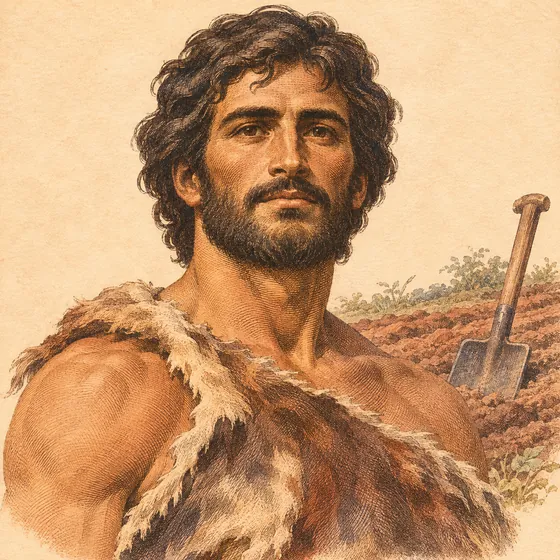


In Genesis 2–3, the first man, formed from the dust and placed in the garden of Eden; after eating the forbidden fruit he is sent out to work the ground.
See Genesis 2:7, Genesis 2:15, Genesis 3:23.
 A spade in tilled earth marks Adam in the reading view: sent out of the garden “to till the ground from whence he was taken” (Genesis 3:23).
Mentioned in 26 verses across 9 books, first in Genesis 2:19. The verses below are the ones linked to this person (the Theographic dataset, with our sourced corrections).
How artists have pictured him
3 works from different centuries and traditions. Each shows how its time and place imagined Adam, not how he looked.


In these stories
In the Bible
The first 10 of 26 verses, in Bible order. Text from the Berean Standard Bible; verse numbers follow the KJV.
Genesis
- Genesis 2:19
And out of the ground the LORD God formed every beast of the field and every bird of the air, and He brought them to the man to see what he would name each one. And whatever the man called each living creature, that was its name.
- Genesis 2:20
The man gave names to all the livestock, to the birds of the air, and to every beast of the field. But for Adam no suitable helper was found.
- Genesis 2:21
So the LORD God caused the man to fall into a deep sleep, and while he slept, He took one of the man’s ribs and closed up the area with flesh.
- Genesis 2:23
And the man said: “This is now bone of my bones and flesh of my flesh; she shall be called ‘woman,’ for out of man she was taken.”
- Genesis 3:8
Then the man and his wife heard the voice of the LORD God walking in the garden in the breeze of the day, and they hid themselves from the presence of the LORD God among the trees of the garden.
- Genesis 3:9
But the LORD God called out to the man, “Where are you?”
- Genesis 3:17
And to Adam He said: “Because you have listened to the voice of your wife and have eaten from the tree of which I commanded you not to eat, cursed is the ground because of you; through toil you will eat of it all the days of your life.
- Genesis 3:20
And Adam named his wife Eve, because she would be the mother of all the living.
- Genesis 3:21
And the LORD God made garments of skin for Adam and his wife, and He clothed them.
- Genesis 4:1
And Adam had relations with his wife Eve, and she conceived and gave birth to Cain. “With the help of the LORD I have brought forth a man,” she said.
Events
Events the dataset lists Adam as taking part in. Dates follow its Ussher–Jones reckoning (one of several traditional counts), not established history.
- c. 4004 BCCreation of Adam and Eve
- c. 4004 BCThe Fall
- c. 4004 BCLifetime of Adam
- c. 3874 BCBirth of Seth
- c. 3074 BCDeath of Adam
Dictionary
From Easton’s Bible Dictionary (1897), as attached to this record by Theographic. The entry is for the name and can describe more than one person who bore it. Easton wrote in 1897, and some of his views are now debated.
Read Easton’s entry
Red, a Babylonian word, the generic name for man, having the same meaning in the Hebrew and the Assyrian languages. It was the name given to the first man, whose creation, fall, and subsequent history and that of his descendants are detailed in the first book of Moses (Gen. 1:27-ch. 5). “God created man [Heb., Adam] in his own image, in the image of God created he him; male and female created he them.”
Adam was absolutely the first man whom God created. He was formed out of the dust of the earth (and hence his name), and God breathed into his nostrils the breath of life, and gave him dominion over all the lower creatures (Gen. 1:26; 2:7). He was placed after his creation in the Garden of Eden, to cultivate it, and to enjoy its fruits under this one prohibition: “Of the tree of the knowledge of good and evil thou shalt not eat of it; for in the day that thou eatest thereof thou shalt surely die.”
The first recorded act of Adam was his giving names to the beasts of the field and the fowls of the air, which God brought to him for this end. Thereafter the Lord caused a deep sleep to fall upon him, and while in an unconscious state took one of his ribs, and closed up his flesh again; and of this rib he made a woman, whom he presented to him when he awoke. Adam received her as his wife, and said, “This is now bone of my bones, and flesh of my flesh: she shall be called Woman, because she was taken out of Man.” He called her Eve, because she was the mother of all living.
Being induced by the tempter in the form of a serpent to eat the forbidden fruit, Eve persuaded Adam, and he also did eat. Thus man fell, and brought upon himself and his posterity all the sad consequences of his transgression. The narrative of the Fall comprehends in it the great promise of a Deliverer (Gen. 3:15), the “first gospel” message to man. They were expelled from Eden, and at the east of the garden God placed a flame, which turned every way, to prevent access to the tree of life ([Gen. 3](/gen#Gen.3)). How long they were in Paradise is matter of mere conjecture.
Shortly after their expulsion Eve brought forth her first-born, and called him Cain. Although we have the names of only three of Adam’s sons, viz., Cain, Abel, and Seth, yet it is obvious that he had several sons and daughters (Gen. 5:4). He died aged 930 years.
Adam and Eve were the progenitors of the whole human race. Evidences of varied kinds are abundant in proving the unity of the human race. The investigations of science, altogether independent of historical evidence, lead to the conclusion that God “hath made of one blood all nations of men for to dwell on all the face of the earth” (Acts 17:26. Comp. Rom. 5:12-12; 1 Cor. 15:22-49).