Person
Eve
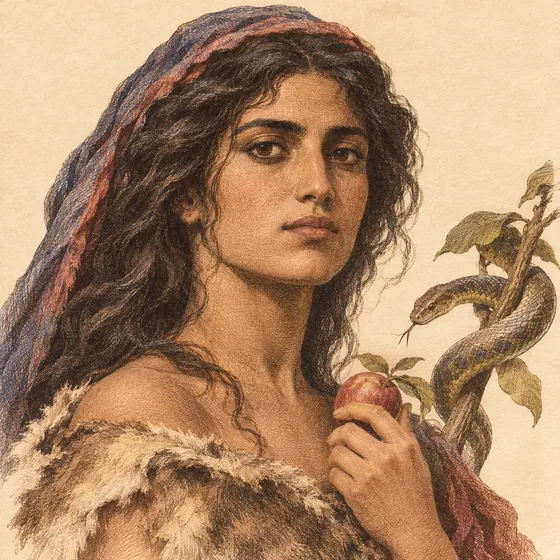


In Genesis 2–4, the first woman; persuaded by the serpent, she eats the forbidden fruit and gives some to Adam. She is the mother of Cain and Abel.
See Genesis 3:6, Genesis 3:20, Genesis 4:1, Genesis 4:2.
 A fruit and a serpent marks Eve in the reading view: the serpent's persuasion and the fruit she took and ate (Genesis 3:1, Genesis 3:6).
Mentioned in 4 verses across 3 books, first in Genesis 3:20. The verses below are the ones linked to this person (the Theographic dataset, with our sourced corrections).
How artists have pictured her
3 works from different centuries and traditions. Each shows how its time and place imagined Eve, not how she looked.


In these stories
In the Bible
All 4 verses, in Bible order. Text from the Berean Standard Bible; verse numbers follow the KJV.
Genesis
- Genesis 3:20
And Adam named his wife Eve, because she would be the mother of all the living.
- Genesis 4:1
And Adam had relations with his wife Eve, and she conceived and gave birth to Cain. “With the help of the LORD I have brought forth a man,” she said.
2 Corinthians
- 2 Corinthians 11:3
I am afraid, however, that just as Eve was deceived by the serpent’s cunning, your minds may be led astray from your simple and pure devotion to Christ.
1 Timothy
- 1 Timothy 2:13
For Adam was formed first, and then Eve.
Events
Events the dataset lists Eve as taking part in. Dates follow its Ussher–Jones reckoning (one of several traditional counts), not established history.
- c. 4004 BCCreation of Adam and Eve
- c. 4004 BCThe Fall
- c. 3874 BCBirth of Seth
Dictionary
From Easton’s Bible Dictionary (1897), as attached to this record by Theographic. The entry is for the name and can describe more than one person who bore it. Easton wrote in 1897, and some of his views are now debated.
Read Easton’s entry
Life; living, the name given by Adam to his wife (Gen. 3:20; 4:1). The account of her creation is given in Gen. 2:21, 22. The Creator, by declaring that it was not good for man to be alone, and by creating for him a suitable companion, gave sanction to monogamy. The commentator Matthew Henry says: “This companion was taken from his side to signify that she was to be dear unto him as his own flesh. Not from his head, lest she should rule over him; nor from his feet, lest he should tyrannize over her; but from his side, to denote that species of equality which is to subsist in the marriage state.” And again, “That wife that is of God’s making by special grace, and of God’s bringing by special providence, is likely to prove a helpmeet to her husband.” Through the subtle temptation of the serpent she violated the commandment of God by taking of the forbidden fruit, which she gave also unto her husband (1 Tim. 2:13-15; 2 Cor. 11:3). When she gave birth to her first son, she said, “I have gotten a man from the Lord” (R.V., “I have gotten a man with the help of the Lord,” Gen. 4:1). Thus she welcomed Cain, as some think, as if he had been the Promised One the “Seed of the woman.”