Person
Samson
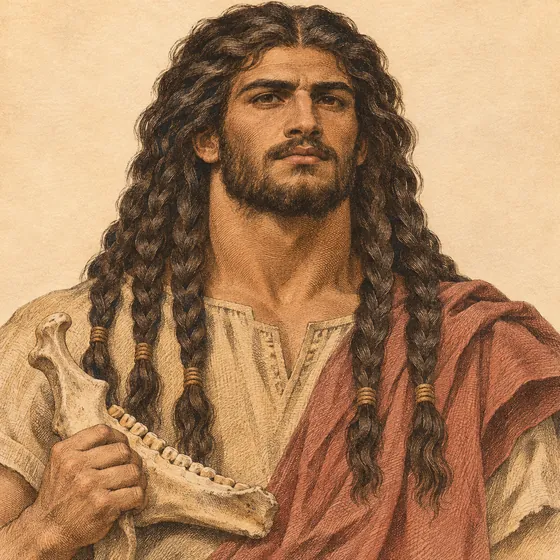
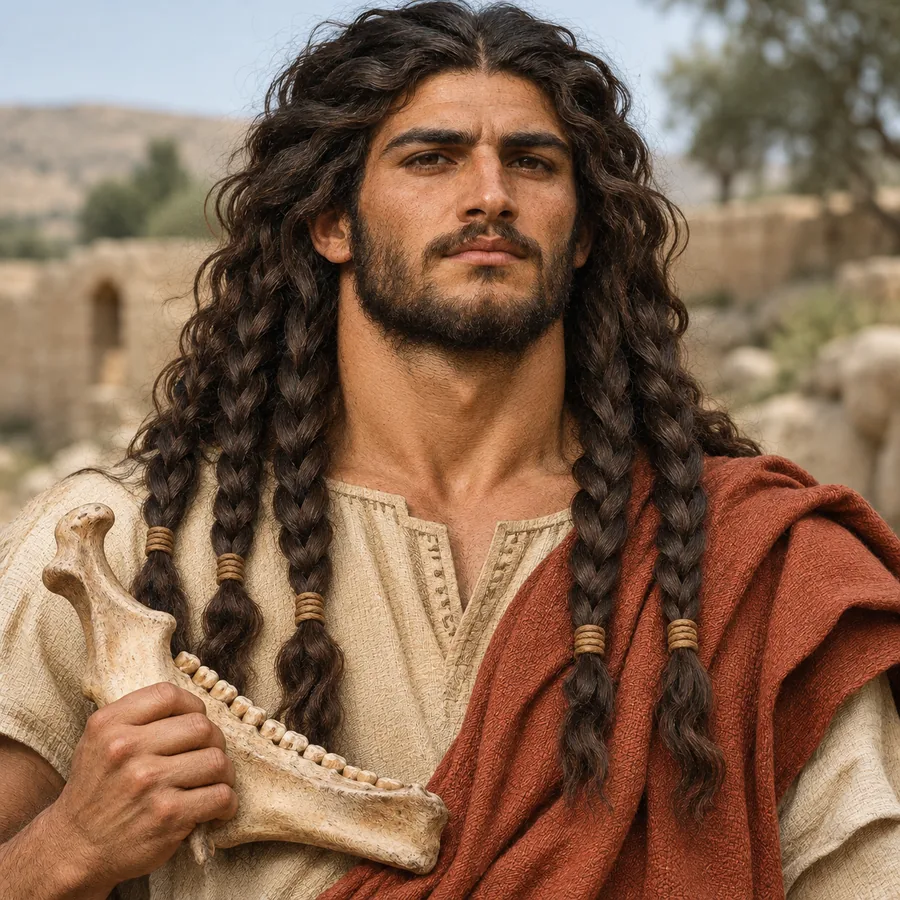

In Judges 13–16, a Nazirite of great strength who fights the Philistines; after Delilah has his hair cut, he is captured, and dies pulling down a Philistine temple.
See Judges 13:5, Judges 16:19, Judges 16:30.
 A donkey's jawbone marks Samson in the reading view: with the jawbone of a donkey he struck down a thousand men (Judges 15:15).
Mentioned in 38 verses across 2 books, first in Hebrews 11:32. The verses below are the ones linked to this person (the Theographic dataset, with our sourced corrections).
How artists have pictured him
3 works from different centuries and traditions. Each shows how its time and place imagined Samson, not how he looked.


In the Bible
All 1 verse in Hebrews, in Bible order. Text from the Berean Standard Bible; verse numbers follow the KJV.
Hebrews
- Hebrews 11:32
And what more shall I say? Time will not allow me to tell of Gideon, Barak, Samson, Jephthah, David, Samuel, and the prophets,
Events
Events the dataset lists Samson as taking part in. Dates follow its Ussher–Jones reckoning (one of several traditional counts), not established history.
- c. 1141 BCPhilistine Dominion
- c. 1121 BCJudgeship of Samson
- c. 1101 BCSampson destroys Temple of Dagon
Dictionary
From Easton’s Bible Dictionary (1897), as attached to this record by Theographic. The entry is for the name and can describe more than one person who bore it. Easton wrote in 1897, and some of his views are now debated.
Read Easton’s entry
Of the sun, the son of Manoah, born at Zorah. The narrative of his life is given in [Judg. 13](/judg#Judg.13)-16. He was a “Nazarite unto God” from his birth, the first Nazarite mentioned in Scripture (Judg. 13:3-5; comp. Num. 6:1-21). The first recorded event of his life was his marriage with a Philistine woman of Timnath (Judg. 14:1-5). Such a marriage was not forbidden by the law of Moses, as the Philistines did not form one of the seven doomed Canaanite nations (Ex. 34:11-16; Deut. 7:1-4). It was, however, an ill-assorted and unblessed marriage. His wife was soon taken from him and given “to his companion” (Judg. 14:20). For this Samson took revenge by burning the “standing corn of the Philistines” (15:1-8), who, in their turn, in revenge “burnt her and her father with fire.” Her death he terribly avenged (15:7-19). During the twenty years following this he judged Israel; but we have no record of his life. Probably these twenty years may have been simultaneous with the last twenty years of Eli’s life. After this we have an account of his exploits at Gaza (16:1-3), and of his infatuation for Delilah, and her treachery (16:4-20), and then of his melancholy death (16:21-31). He perished in the last terrible destruction he brought upon his enemies. “So the dead which he slew at his death were more [in social and political importance=the elite of the people] than they which he slew in his life.”
“Straining all his nerves, he bowed: As with the force of winds and waters pent, When mountains tremble, those two massy pillars With horrible convulsion to and fro He tugged, he shook, till down they came, and drew The whole roof after them, with burst of thunder Upon the heads of all who sat beneath, Lords, ladies, captains, counsellors, or priests, Their choice nobility and flower.” Milton’s Samson Agonistes.