Person
Gideon
Also called Jerubbaal, Gedeon
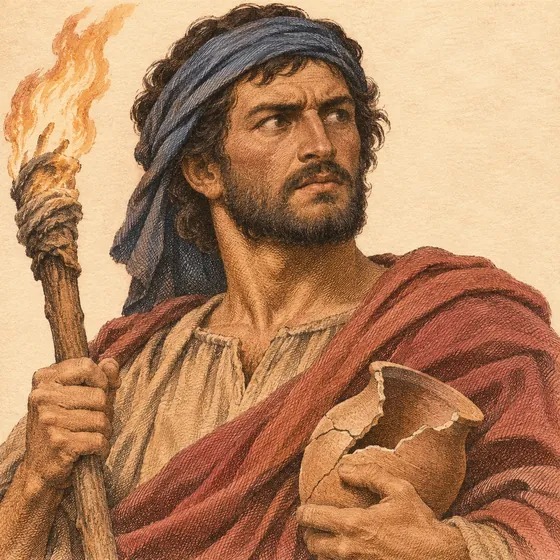
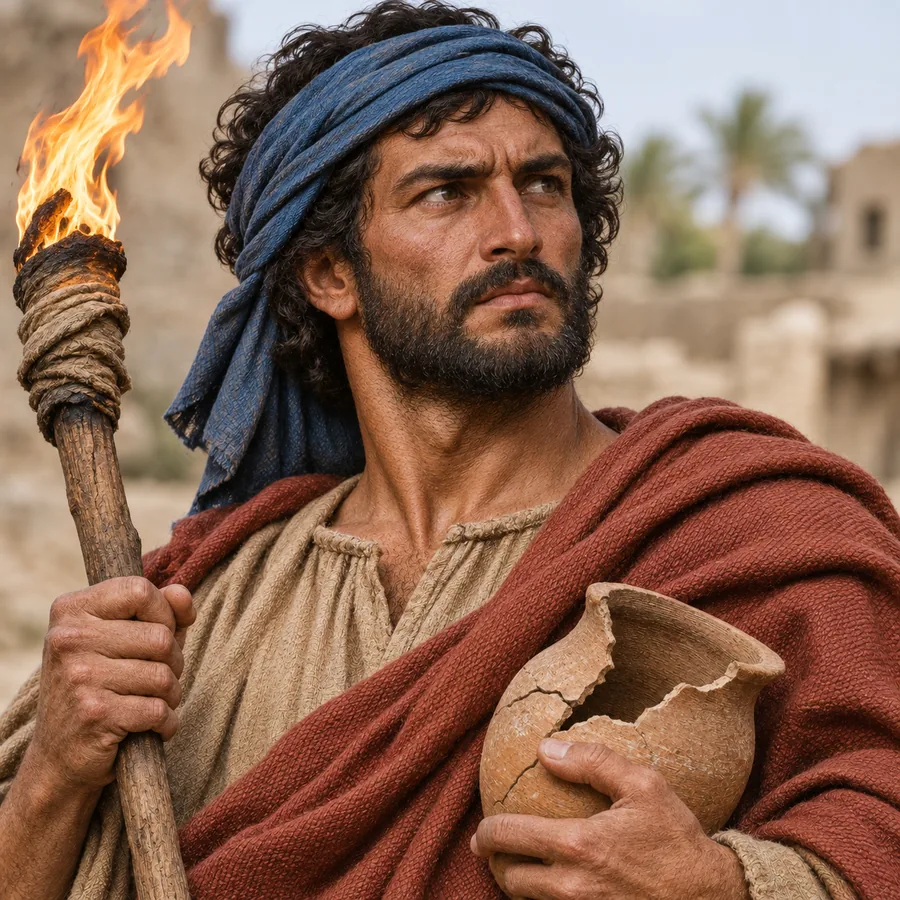

In Judges 6–8, a farmer called to save Israel from the Midianites; he asks for a sign with a fleece and routs their camp with three hundred men carrying trumpets and torches in jars.
See Judges 6:11, Judges 6:37, Judges 7:7, Judges 7:20.
 A torch and a broken jar marks Gideon in the reading view: his men broke their jars and held up their torches (Judges 7:20).
Mentioned in 49 verses across 3 books, first in Judges 6:11. The verses below are the ones linked to this person (the Theographic dataset, with our sourced corrections).
How artists have pictured him
3 works from different centuries and traditions. Each shows how its time and place imagined Gideon, not how he looked.


In the Bible
The first 10 of 49 verses, in Bible order. Text from the Berean Standard Bible; verse numbers follow the KJV.
Judges
- Judges 6:11
Then the angel of the LORD came and sat down under the oak in Ophrah that belonged to Joash the Abiezrite, where his son Gideon was threshing wheat in a winepress to hide it from the Midianites.
- Judges 6:13
“Please, my Lord,” Gideon replied, “if the LORD is with us, why has all this happened to us? And where are all His wonders of which our fathers told us, saying, ‘Has not the LORD brought us up out of Egypt?’ But now the LORD has forsaken us and delivered us into the hand of Midian.”
- Judges 6:19
So Gideon went in and prepared a young goat and unleavened bread and an ephah of flour. He placed the meat in a basket and the broth in a pot and brought them out to present to Him under the oak.
- Judges 6:22
When Gideon realized that it was the angel of the LORD, he said, “Oh no, Lord GOD! I have seen the angel of the LORD face to face!”
- Judges 6:24
So Gideon built an altar to the LORD there and called it The LORD Is Peace. To this day it stands in Ophrah of the Abiezrites.
- Judges 6:27
So Gideon took ten of his servants and did as the LORD had told him. But because he was too afraid of his father’s household and the men of the city, he did it by night rather than in the daytime.
- Judges 6:29
“Who did this?” they said to one another. And after they had investigated thoroughly, they were told, “Gideon son of Joash did it.”
- Judges 6:32
So on that day Gideon was called Jerubbaal, that is to say, “Let Baal contend with him,” because he had torn down Baal’s altar.
- Judges 6:34
So the Spirit of the LORD came upon Gideon, who blew the ram’s horn and rallied the Abiezrites behind him.
- Judges 6:36
Then Gideon said to God, “If You are going to save Israel by my hand, as You have said,
Events
Events the dataset lists Gideon as taking part in. Dates follow its Ussher–Jones reckoning (one of several traditional counts), not established history.
- c. 1251 BCDeliverance by Gideon
Dictionary
From Easton’s Bible Dictionary (1897), as attached to this record by Theographic. The entry is for the name and can describe more than one person who bore it. Easton wrote in 1897, and some of his views are now debated.
Read Easton’s entry
Called also Jerubbaal (Judg. 6:29, 32), was the first of the judges whose history is circumstantially narrated ([Judg. 6](/judg#Judg.6)-8). His calling is the commencement of the second period in the history of the judges. After the victory gained by Deborah and Barak over Jabin, Israel once more sank into idolatry, and the Midianites (q.v.) and Amalekites, with other “children of the east,” crossed the Jordan each year for seven successive years for the purpose of plundering and desolating the land. Gideon received a direct call from God to undertake the task of delivering the land from these warlike invaders. He was of the family of Abiezer (Josh. 17:2; 1 Chr. 7:18), and of the little township of Ophrah (Judg. 6:11). First, with ten of his servants, he overthrew the altars of Baal and cut down the asherah which was upon it, and then blew the trumpet of alarm, and the people flocked to his standard on the crest of Mount Gilboa to the number of twenty-two thousand men. These were, however, reduced to only three hundred. These, strangely armed with torches and pitchers and trumpets, rushed in from three different points on the camp of Midian at midnight, in the valley to the north of Moreh, with the terrible war-cry, “For the Lord and for Gideon” (Judg. 7:18, R.V.). Terror-stricken, the Midianites were put into dire confusion, and in the darkness slew one another, so that only fifteen thousand out of the great army of one hundred and twenty thousand escaped alive. The memory of this great deliverance impressed itself deeply on the mind of the nation (1 Sam. 12:11; Ps. 83:11; Isa. 9:4; 10:26; Heb. 11:32). The land had now rest for forty years. Gideon died in a good old age, and was buried in the sepulchre of his fathers. Soon after his death a change came over the people. They again forgot Jehovah, and turned to the worship of Baalim, “neither shewed they kindness to the house of Jerubbaal” (Judg. 8:35). Gideon left behind him seventy sons, a feeble, sadly degenerated race, with one exception, that of Abimelech, who seems to have had much of the courage and energy of his father, yet of restless and unscrupulous ambition. He gathered around him a band who slaughtered all Gideon’s sons, except Jotham, upon one stone.