Person
Jonah
Also called Jonas
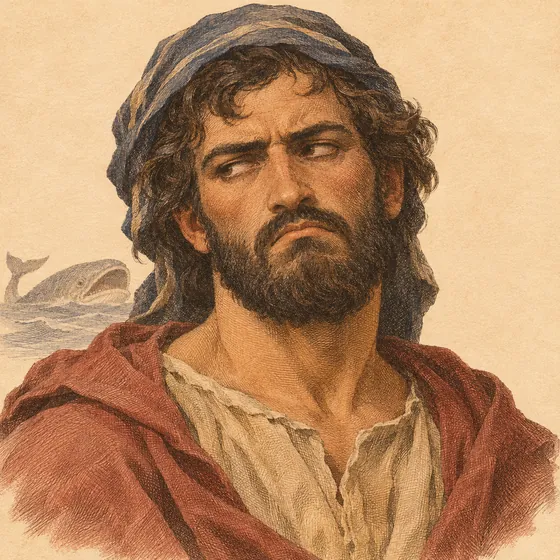
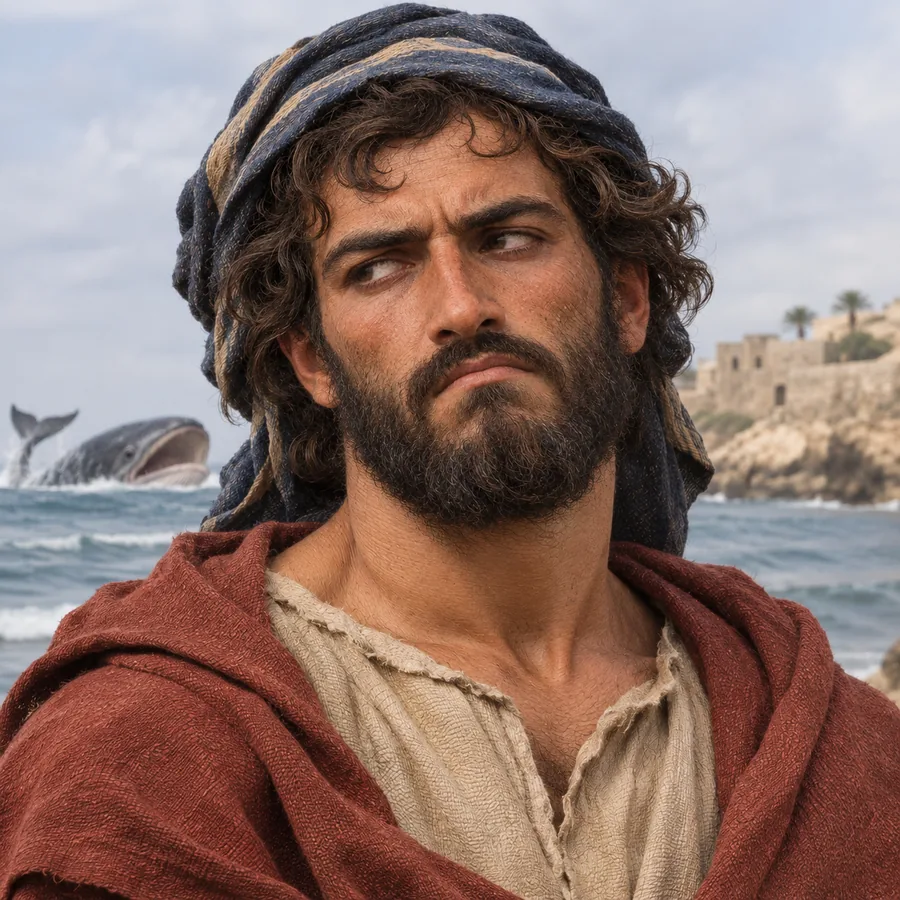

In the book of Jonah, a prophet who flees from God's call to preach to Nineveh, is swallowed by a great fish, and then preaches there.
See Jonah 1:3, Jonah 1:17, Jonah 3:4.
 A great fish marks Jonah in the reading view: “the LORD had prepared a great fish to swallow up Jonah” (Jonah 1:17).
Mentioned in 24 verses across 4 books, first in Matthew 12:39. The verses below are the ones linked to this person (the Theographic dataset, with our sourced corrections).
How artists have pictured him
3 works from different centuries and traditions. Each shows how its time and place imagined Jonah, not how he looked.


In these stories
In the Bible
All 4 verses in Matthew, in Bible order. Text from the Berean Standard Bible; verse numbers follow the KJV.
Matthew
- Matthew 12:39
Jesus replied, “A wicked and adulterous generation demands a sign, but none will be given it except the sign of the prophet Jonah.
- Matthew 12:40
For as Jonah was three days and three nights in the belly of the great fish, so the Son of Man will be three days and three nights in the heart of the earth.
- Matthew 12:41
The men of Nineveh will stand at the judgment with this generation and condemn it; for they repented at the preaching of Jonah, and now One greater than Jonah is here.
- Matthew 16:4
A wicked and adulterous generation demands a sign, but none will be given it except the sign of Jonah.” Then He left them and went away.
Events
Events the dataset lists Jonah as taking part in. Dates follow its Ussher–Jones reckoning (one of several traditional counts), not established history.
- c. 825 BCProphecies of Jonah
Dictionary
From Easton’s Bible Dictionary (1897), as attached to this record by Theographic. The entry is for the name and can describe more than one person who bore it. Easton wrote in 1897, and some of his views are now debated.
Read Easton’s entry
A dove, the son of Amittai of Gath-hepher. He was a prophet of Israel, and predicted the restoration of the ancient boundaries (2 Kings 14:25-27) of the kingdom. He exercised his ministry very early in the reign of Jeroboam II., and thus was contemporary with Hosea and Amos; or possibly he preceded them, and consequently may have been the very oldest of all the prophets whose writings we possess. His personal history is mainly to be gathered from the book which bears his name. It is chiefly interesting from the two-fold character in which he appears, (1) as a missionary to heathen Nineveh, and (2) as a type of the “Son of man.”