Person
Herod Agrippa I
A grandson of Herod the Great (according to Josephus) and king over Judea. In Acts 12 he kills James, John's brother, imprisons Peter, and dies suddenly after accepting praise as a god.
See Acts 12:1, Acts 12:2, Acts 12:4, Acts 12:23.
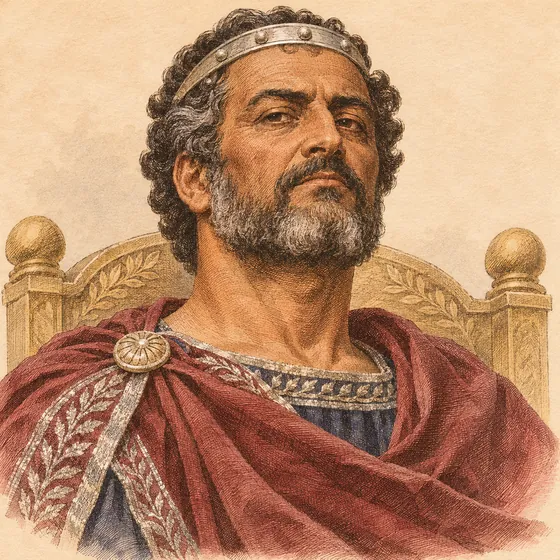
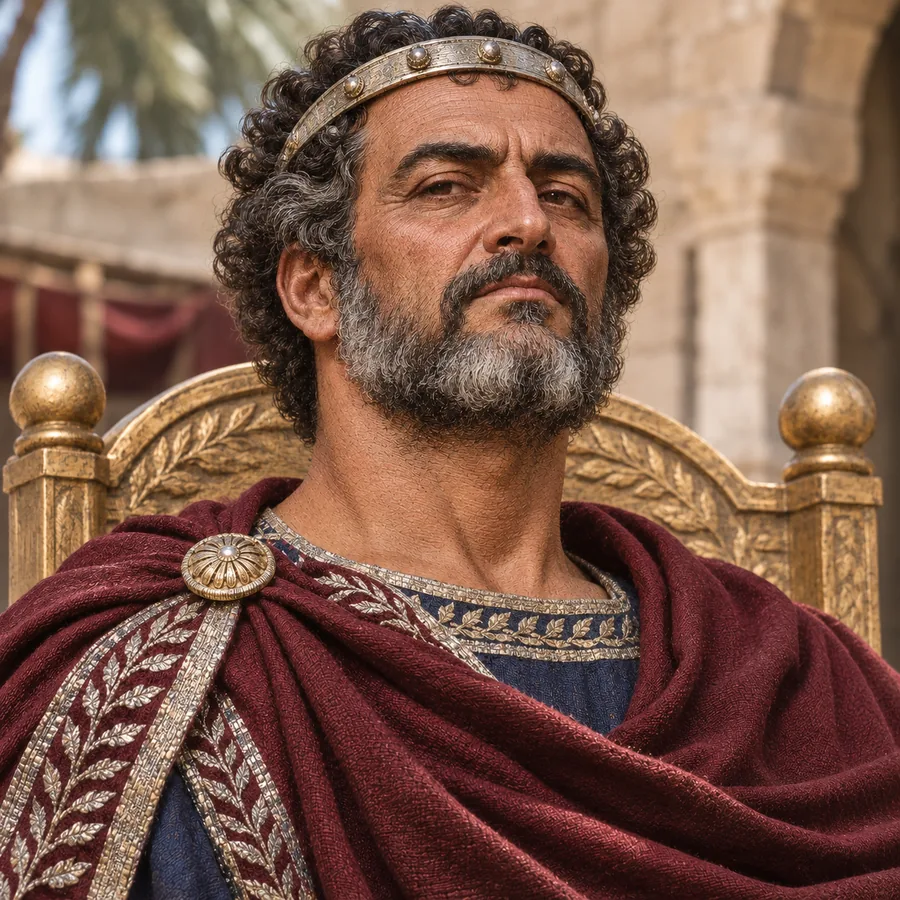
 A throne marks Herod Agrippa I in the reading view: arrayed in royal apparel, he sat upon his throne (Acts 12:21).
Mentioned in 6 verses, first in Acts 12:1. The verses below are the ones linked to this person (the Theographic dataset, with our sourced corrections).
How artists have pictured him
2 works from different centuries and traditions. Each shows how its time and place imagined Herod Agrippa I, not how he looked.


In the Bible
All 6 verses, in Bible order. Text from the Berean Standard Bible; verse numbers follow the KJV.
Acts
- Acts 12:1
About that time, King Herod reached out to harm some who belonged to the church.
- Acts 12:6
On the night before Herod was to bring him to trial, Peter was sleeping between two soldiers, bound with two chains, with sentries standing guard at the entrance to the prison.
- Acts 12:11
Then Peter came to himself and said, “Now I know for sure that the Lord has sent His angel and rescued me from Herod’s grasp and from everything the Jewish people were anticipating.”
- Acts 12:19
After Herod had searched for him unsuccessfully, he examined the guards and ordered that they be executed. Then he went down from Judea to Caesarea and spent some time there.
- Acts 12:20
Now Herod was in a furious dispute with the people of Tyre and Sidon, and they convened before him. Having secured the support of Blastus, the king’s chamberlain, they asked for peace, because their region depended on the king’s country for food.
- Acts 12:21
On the appointed day, Herod donned his royal robes, sat on his throne, and addressed the people.
Events
Events the dataset lists Herod Agrippa I as taking part in. Dates follow its Ussher–Jones reckoning (one of several traditional counts), not established history.
- c. AD 40Herod kills James
- c. AD 40Herod imprisons Peter
- c. AD 40An angel rescues Peter from prison
- c. AD 45Herod dies
Dictionary
From Easton’s Bible Dictionary (1897), as attached to this record by Theographic. The entry is for the name and can describe more than one person who bore it. Easton wrote in 1897, and some of his views are now debated.
Read Easton’s entry
Son of Aristobulus and Bernice, and grandson of Herod the Great. He was made tetrarch of the provinces formerly held by Lysanias II., and ultimately possessed the entire kingdom of his grandfather, Herod the Great, with the title of king. He put the apostle James the elder to death, and cast Peter into prison (Luke 3:1; Acts 12:1-19). On the second day of a festival held in honour of the emperor Claudius, he appeared in the great theatre of Caesarea. “The king came in clothed in magnificent robes, of which silver was the costly brilliant material. It was early in the day, and the sun’s rays fell on the king, so that the eyes of the beholders were dazzled with the brightness which surrounded him. Voices here and there from the crowd exclaimed that it was the apparition of something divine. And when he spoke and made an oration to them, they gave a shout, saying, ’It is the voice of a god, and not of a man.’ But in the midst of this idolatrous ostentation an angel of God suddenly smote him. He was carried out of the theatre a dying man.” He died (A.D. 44) of the same loathsome malady which slew his grandfather (Acts. 12:21-23), in the fifty-fourth year of his age, having reigned four years as tetrarch and three as king over the whole of Palestine. After his death his kingdom came under the control of the prefect of Syria, and Palestine was now fully incorporated with the empire.