Person
Esther
Also called Hadassah
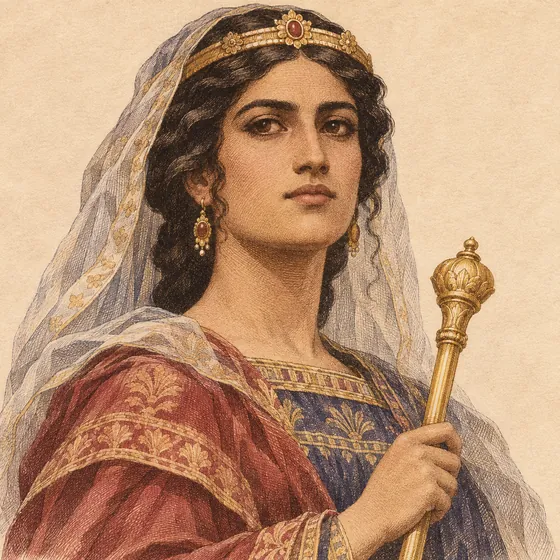
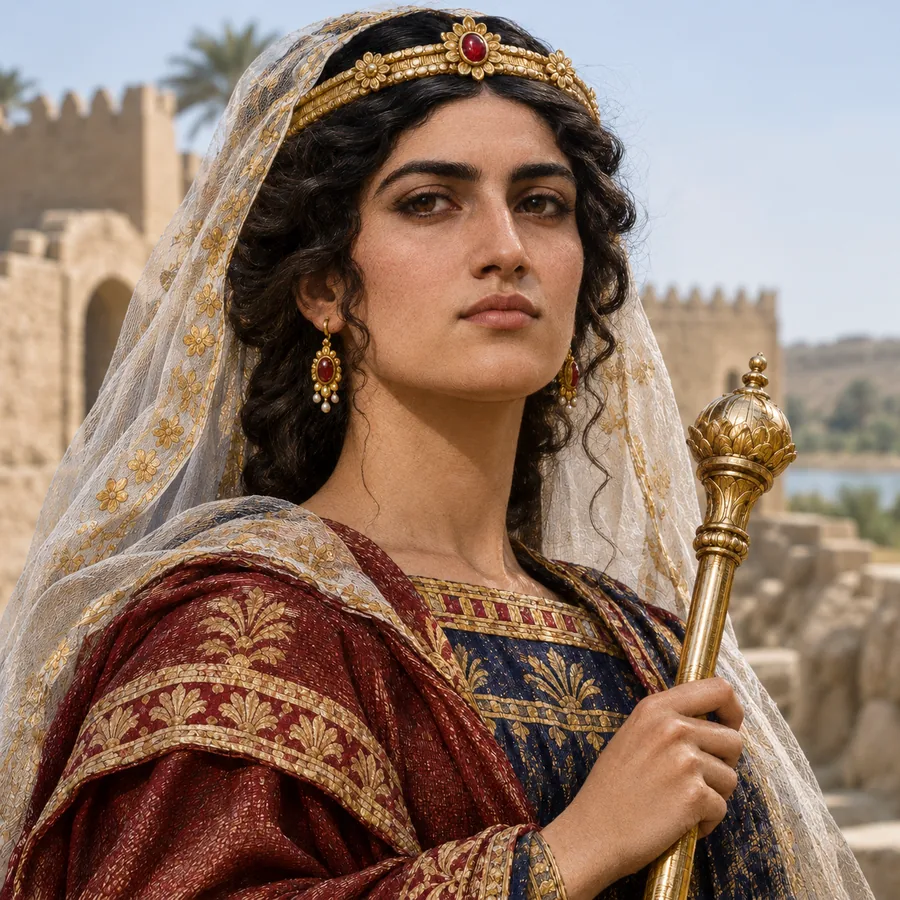

In the book of Esther, a Jewish woman who becomes queen of Persia and risks her life to stop a plot to destroy her people.
See Esther 2:17, Esther 4:16, Esther 7:3.
 A golden sceptre marks Esther in the reading view: the king held out the golden sceptre to her (Esther 5:2).
Mentioned in 46 verses, first in Esther 2:7. The verses below are the ones linked to this person (the Theographic dataset, with our sourced corrections).
How artists have pictured her
3 works from different centuries and traditions. Each shows how its time and place imagined Esther, not how she looked.


In the Bible
The first 10 of 46 verses, in Bible order. Text from the Berean Standard Bible; verse numbers follow the KJV.
Esther
- Esther 2:7
And Mordecai had brought up Hadassah (that is, Esther), the daughter of his uncle, because she did not have a father or mother. The young woman was lovely in form and appearance, and when her father and mother had died, Mordecai had taken her in as his own daughter.
- Esther 2:8
When the king’s command and edict had been proclaimed, many young women gathered at the citadel of Susa under the care of Hegai. Esther was also taken to the palace and placed under the care of Hegai, the custodian of the women.
- Esther 2:10
Esther did not reveal her people or her lineage, because Mordecai had instructed her not to do so.
- Esther 2:11
And every day Mordecai would walk back and forth in front of the court of the harem to learn about Esther’s welfare and what was happening to her.
- Esther 2:15
Now Esther was the daughter of Abihail, the uncle from whom Mordecai had adopted her as his own daughter. And when it was her turn to go to the king, she did not ask for anything except what Hegai, the king’s trusted official in charge of the harem, had advised. And Esther found favor in the eyes of everyone who saw her.
- Esther 2:16
She was taken to King Xerxes in the royal palace in the tenth month, the month of Tebeth, in the seventh year of his reign.
- Esther 2:17
And the king loved Esther more than all the other women, and she found grace and favor in his sight more than all of the other virgins. So he placed the royal crown upon her head and made her queen in place of Vashti.
- Esther 2:18
Then the king held a great banquet, Esther’s banquet, for all his officials and servants. He proclaimed a tax holiday in the provinces and gave gifts worthy of the king’s bounty.
- Esther 2:20
Esther still had not revealed her lineage or her people, just as Mordecai had instructed. She obeyed Mordecai’s command, as she had done under his care.
- Esther 2:22
When Mordecai learned of the plot, he reported it to Queen Esther, and she informed the king on Mordecai’s behalf.
Dictionary
From Easton’s Bible Dictionary (1897), as attached to this record by Theographic. The entry is for the name and can describe more than one person who bore it. Easton wrote in 1897, and some of his views are now debated.
Read Easton’s entry
The queen of Ahasuerus, and heroine of the book that bears her name. She was a Jewess named Hadas’sah (the myrtle), but when she entered the royal harem she received the name by which she henceforth became known (Esther 2:7). It is a Syro-Arabian modification of the Persian word satarah, which means a star. She was the daughter of Abihail, a Benjamite. Her family did not avail themselves of the permission granted by Cyrus to the exiles to return to Jerusalem; and she resided with her cousin Mordecai, who held some office in the household of the Persian king at “Shushan in the palace.” Ahasuerus having divorced Vashti, chose Esther to be his wife. Soon after this he gave Haman the Agagite, his prime minister, power and authority to kill and extirpate all the Jews throughout the Persian empire. By the interposition of Esther this terrible catastrophe was averted. Haman was hanged on the gallows he had intended for Mordecai ([Esther 7](/esth#Esth.7)); and the Jews established an annual feast, the feast of Purim (q.v.), in memory of their wonderful deliverance. This took place about fifty-two years after the Return, the year of the great battles of Plataea and Mycale (B.C. 479).
Esther appears in the Bible as a “woman of deep piety, faith, courage, patriotism, and caution, combined with resolution; a dutiful daughter to her adopted father, docile and obedient to his counsels, and anxious to share the king’s favour with him for the good of the Jewish people. There must have been a singular grace and charm in her aspect and manners, since ‘she obtained favour in the sight of all them that looked upon her’ (Esther 2:15). That she was raised up as an instrument in the hand of God to avert the destruction of the Jewish people, and to afford them protection and forward their wealth and peace in their captivity, is also manifest from the Scripture account.”